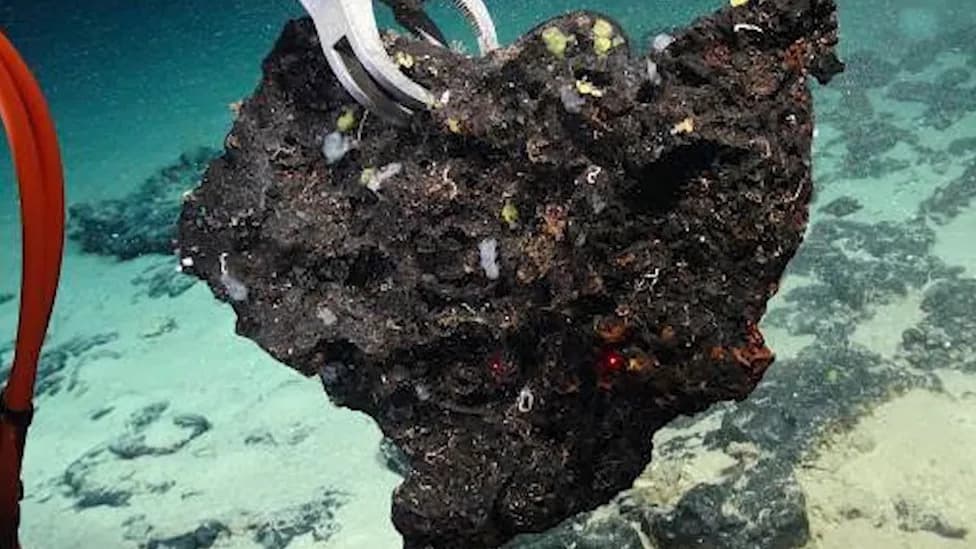
Japan's research vessel Chikyu has embarked on a landmark expedition to drill for rare earth minerals at about 6,000 metres near Minami Torishima, aiming to reduce reliance on Chinese supplies. The area is estimated to hold over 16 million tonnes of rare earths, including large reserves of dysprosium and yttrium. Officials say successful domestic extraction would secure key supply chains amid rising tensions with China. The trial, described by JAMSTEC as a world-first at these depths, runs until February 14.
Japan Begins Historic 6,000m Deep‑Sea Drill For Rare Earths To Reduce Dependence On China
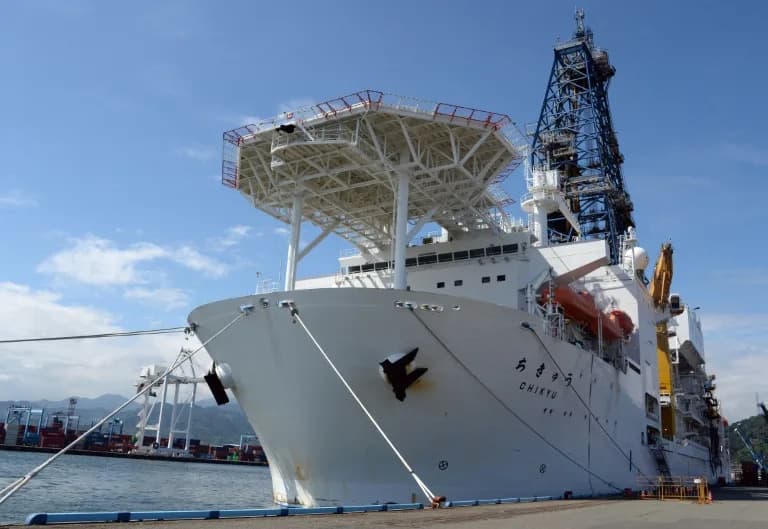
Japan's deep-sea drilling vessel, Chikyu is anchored at a pier in Shimizu port, Shizuoka prefecture on September 11, 2013 (TOSHIFUMI KITAMURA)(TOSHIFUMI KITAMURA/AFP/AFP)
A Japanese scientific research vessel on Monday set off on a landmark expedition to attempt extraction of rare earth minerals from the deep sea at roughly 6,000 metres, part of Tokyo's wider effort to diversify supplies away from China.
The drilling ship Chikyu departed Shimizu Port in Shizuoka at about 9:00 a.m. local time (0000 GMT), bound for the remote Pacific outcrop of Minami Torishima, where surrounding waters are believed to contain substantial deposits of valuable minerals. The voyage was delayed by one day because of bad weather.
Why This Matters
China is currently the world's largest producer of rare earth elements, and Tokyo cites supply-concentration risks as a national-security and economic concern. Rare earths — a group of 17 metals that are difficult to extract from the Earth's crust — are critical for technologies ranging from electric vehicles and hard drives to wind turbines, lasers and some missile components.
What Officials Say
Shoichi Ishii, a programme director at Japan's Cabinet Office, told reporters as the vessel prepared to sail:
"We are considering diversifying our procurement sources and avoiding excessive reliance on specific countries. One approach I believe could be pursued is establishing a process to achieve domestic production of rare earths."
The Japan Agency for Marine-Earth Science and Technology (JAMSTEC) has described the trial as the world's first attempt to drill at these depths.
Estimated Reserves And Strategic Impact
According to reports cited by the Nikkei business daily, waters around Minami Torishima — within Japan's exclusive economic zone — may contain more than 16 million tonnes of rare earths, a reserve the paper ranks as the third-largest globally. Nikkei estimates these deposits could contain the equivalent of roughly 730 years of dysprosium and about 780 years of yttrium based on current usage rates.
"If Japan could continuously extract rare earths around Minami Torishima, it would secure a domestic supply chain for key industries," said Takahiro Kamisuna, a research associate at the International Institute for Strategic Studies (IISS). "It would also be a strategic asset to reduce supply-chain dependence on China."
Geopolitical Context
The test cruise comes amid heightened tensions with Beijing after remarks by Prime Minister Sanae Takaichi suggesting Japan might respond militarily to an attack on Taiwan. Beijing regards Taiwan as part of its territory and has previously used trade measures — including restrictions on certain exports — as leverage in diplomatic disputes. Recent media reports say China has delayed some shipments to Japan and blocked exports of certain "dual-use" items, raising concerns in Tokyo about potential supply disruptions.
Outlook And Considerations
The research cruise is scheduled to continue until February 14. Beyond the technical challenge of deep-sea extraction, any move toward commercial mining will need to address environmental risks, regulatory hurdles, and the economic viability of large-scale recovery. If successful, however, domestic production could strengthen Japan's industrial resilience and shift part of the global rare-earth supply landscape.
Help us improve.