Summary: In Bowe v. United States, the Supreme Court held that a statutory restriction on review of state habeas decisions does not apply to federal successive-motion authorizations and forbade importing a state-law old-claim bar into the federal scheme. The ruling restores a route for federal prisoners—like Michael Bowe—to seek appellate review when later Supreme Court decisions (e.g., Davis and Taylor) undercut the legal basis for their sentences. Strict gatekeeping and deadlines remain, but an arbitrary timing-based barrier has been removed.
Sotomayor Restores Appeal Rights For Federal Prisoners In Bowe v. United States
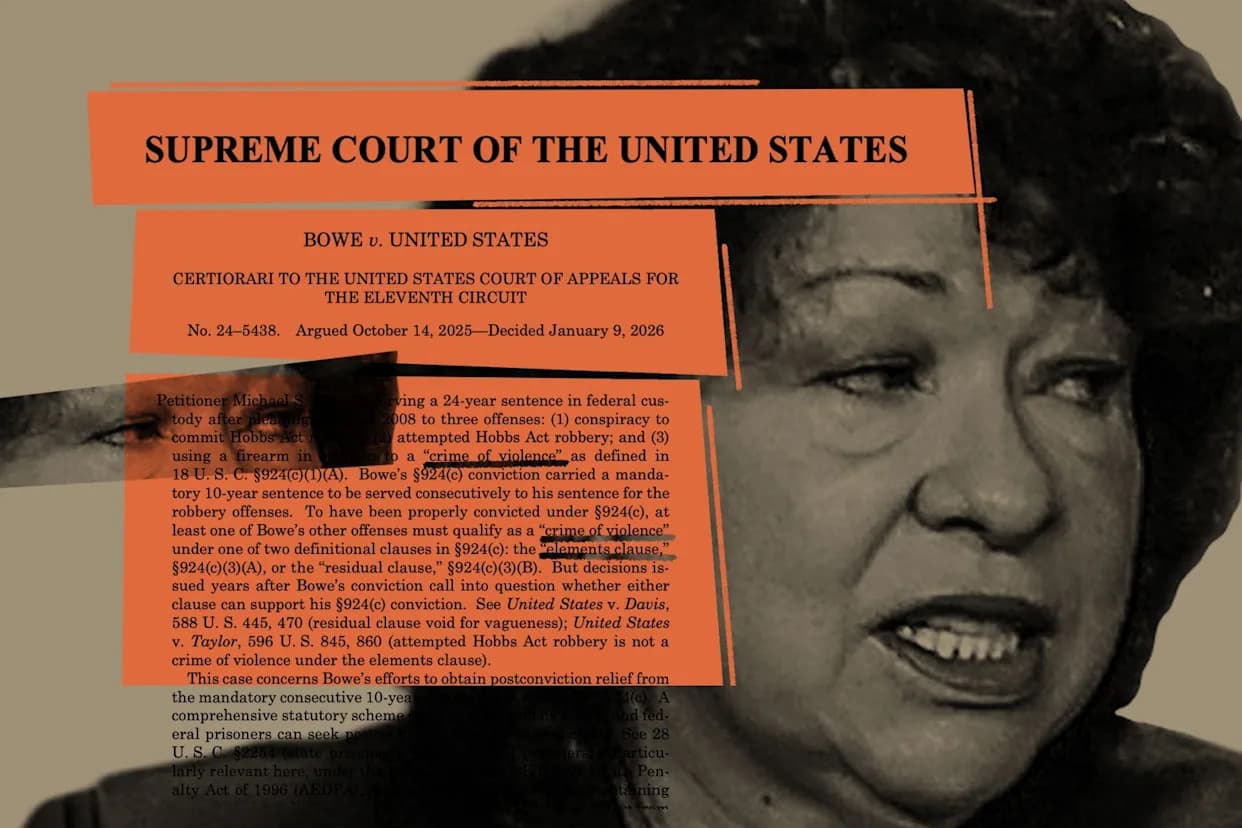
The Supreme Court’s decision in Bowe v. United States reshapes how federal prisoners can seek post-conviction review. In a ruling authored by Justice Sonia Sotomayor, the Court held that a statutory restriction aimed at state habeas petitions does not strip the Supreme Court of jurisdiction over federal post-conviction authorization decisions and refused to import a state-law "old-claim" bar into federal successive-motion practice. The combined holdings remove a narrowly tailored procedural trap that had blocked prisoners from returning to court after the law changed in their favor.
Background
Michael Bowe received a mandatory 10-year enhancement on top of a 14-year sentence under a federal firearms statute that applies only when a defendant’s prior offenses qualify as a "crime of violence." His predicate convictions were for conspiracy and attempted robbery under the Hobbs Act. After his sentencing, the Supreme Court decided United States v. Davis (2019), striking down a portion of the statute as unconstitutionally vague, and later decided United States v. Taylor (2022), holding that attempted Hobbs Act robbery does not qualify under the statute’s remaining clause. The Eleventh Circuit has also held that conspiracy does not qualify. Had Bowe been sentenced under today’s precedents, his enhancement likely would not have applied.
The Procedural Puzzle
Federal prisoners typically have one clear route to challenge a conviction or sentence; a second or successive motion is allowed only under narrow circumstances—such as newly discovered evidence of innocence or a new rule of constitutional law the Supreme Court has made retroactive. Because these screens are strict, Bowe became trapped by the sequencing of Supreme Court decisions: his initial challenge arising after Davis was denied because circuit precedent at the time supported the enhancement, and when Taylor removed that fallback, the Eleventh Circuit barred reconsideration on the ground that the earlier Davis claim was an "old claim."
What the Court Held
First, the Court concluded it retains jurisdiction to review denials of authorization to file successive federal post-conviction motions—Congress’s bar on review described state habeas "applications," not federal motions, and the Court declined to read ambiguity as a withdrawal of its authority. Second, the Court held that the statutory old-claim bar applicable to state habeas petitions cannot be grafted onto federal post-conviction practice; Congress used different language for a reason, and courts may not add restrictions beyond the federal statutory scheme.
Practical Effects
The decision removes the particular procedural device that left Bowe and similarly situated prisoners trapped by the timing of doctrinal change. Federal prisoners may now seek authorization to file successive motions when later precedent—like Taylor—eliminates a legal fallback that previously justified a sentence. Importantly, the ruling does not abolish strict gatekeeping: statutes of limitation, the high bar for successive motions, and appellate screening remain in place. What changes is the removal of an arbitrary timing penalty that turned favorable doctrinal developments into permanent obstacles.
Why It Matters
Post-conviction review often hinges on procedural access rather than on the merits of a claim. By preserving Supreme Court jurisdiction and refusing to import an extra-statutory old-claim bar, the Court restored an avenue for appellate oversight and coherence in federal post-conviction practice. For Michael Bowe, the ruling offers another chance to challenge a decade of imprisonment that may no longer be justified under current law. For the federal system, it prevents legal error from calcifying merely because the law evolved in stages.
Bottom line: Bowe reopens a narrow but important path for federal prisoners to seek relief when later Supreme Court decisions reveal that earlier denials rested on legal assumptions the Court has since rejected.
Help us improve.