
President Donald Trump’s second term has seen recurring efforts to expand executive power, use prosecutions as political tools, and reshape election law. In 2026 the Supreme Court will confront major disputes over partisan redistricting, the Justice Department’s treatment of critics, presidential tariff and firing authority, enforcement of court orders, and the constitutional guarantee of birthright citizenship. The rulings will have lasting effects on presidential power, voting rights and constitutional protections.
Voting Rights, Presidential Power and Retribution: 5 High‑Stakes Legal Battles to Watch in 2026

As 2026 begins, several high-profile legal disputes will shape the balance of presidential authority, voting rights and constitutional protections. President Donald Trump's second term has been marked by efforts to expand executive power, actions that critics call retributive, and litigation that has drawn repeated attention from the Supreme Court.
Gerrymandering Wars
Acting on the president’s call to help the GOP retain control of Congress ahead of the midterms, Texas Republicans enacted a new congressional map. A lower-court panel — led by a Trump‑appointed judge — struck the map down, finding it likely amounted to an illegal racial gerrymander. The Supreme Court’s Republican‑appointed majority intervened to allow the map to stand, concluding the plan was politically motivated rather than racially.
California has responded by adopting its own new congressional map, which now faces litigation. When the Supreme Court sided with Texas, several justices suggested they might reach the same outcome if a Democratic‑drawn map from California reached the court. That raises a key question for 2026: will the justices apply the same political‑vs‑racial framework to maps drawn by Democrats as they did to maps drawn by Republicans?
The high court is also expected to weigh a Louisiana redistricting appeal that could substantially weaken remaining protections under the Voting Rights Act.
Retribution Campaign Within the Justice Department
Retribution featured prominently in the president’s rhetoric: he pledged to punish officials who investigated him or his allies for actions surrounding the 2020 election and its aftermath. Early in his second term, he granted broad clemency to multiple Jan. 6 defendants — including some convicted of assaulting law enforcement — and removed officials involved in probes of the administration.
At the same time, the Justice Department has pursued cases against prominent critics, notably former FBI Director James Comey and New York Attorney General Letitia James. Both saw pretrial dismissals of indictments, but the department is seeking to revive charges. How aggressively the Justice Department will press such cases — and how courts will respond — will be an important barometer of the administration’s approach.
Presidential Authority Over Tariffs and Independent Agencies
The Roberts Court has extended certain aspects of presidential authority in recent years, sometimes via temporary “shadow docket” rulings. In 2026 the justices are poised to issue more definitive opinions. A pending case over the president’s tariff authority may clarify the executive’s reach in trade policy.
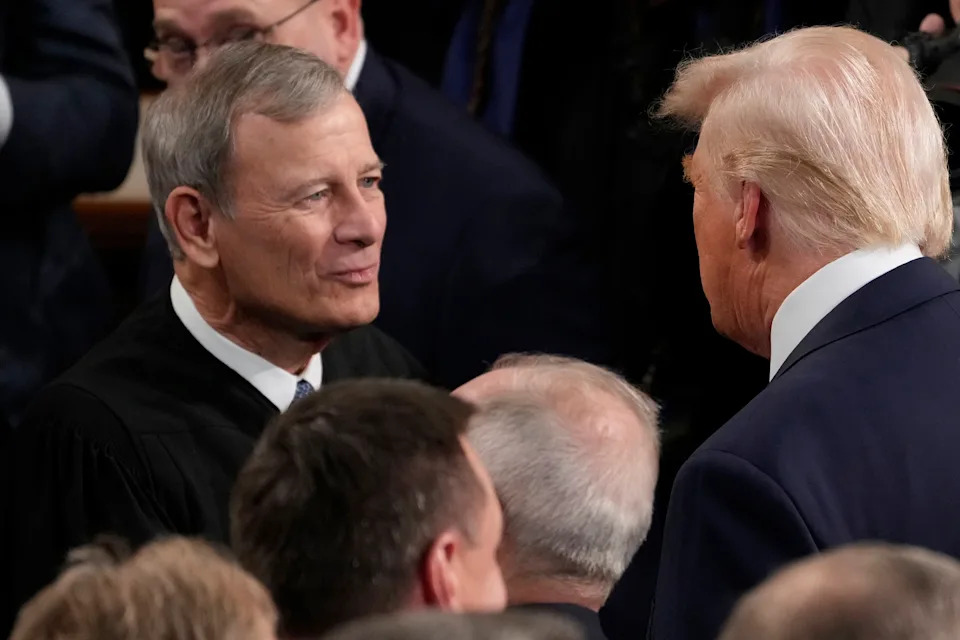
President Donald Trump greets Chief Justice John Roberts before he addresses a joint session of Congress at the U.S. Capitol on March 4, 2025.(Julia Demaree Nikhinson / Julia Demaree Nikhinson /AP Photo)
More consequentially, the Court is considering whether to overturn a roughly 90‑year precedent that protects the independence of certain federal agencies from direct presidential control. In Trump v. Slaughter, Justice Sonia Sotomayor warned that dismantling those protections would alter the structure of government and blunt Congress’s ability to design independent agencies.
Separately, Trump v. Cook — set for argument on Jan. 21 — asks whether the president may exercise broader firing power over the Federal Reserve. The Court’s GOP‑appointed majority has signaled an interest in preserving the Fed’s independence, but it must reconcile that stance with any broader rulings expanding presidential control over other agencies, such as the Federal Trade Commission.
Consequences for Violating Court Orders
An ongoing legal question in this administration is whether officials face meaningful consequences when they defy judicial orders. One active example is a contempt inquiry overseen by U.S. District Judge James Boasberg. In March, Boasberg — an Obama‑appointed judge — ordered officials not to transfer physical custody of Venezuelan nationals who had been flown from the U.S. to El Salvador after the administration invoked the Alien Enemies Act. Trump‑appointed appellate judges later paused Boasberg’s proceedings, leaving accountability in limbo as 2026 opens.
Birthright Citizenship
Perhaps the most consequential case the Court will consider is whether the administration can end automatic U.S. citizenship for people born on American soil. The Court agreed to hear the administration’s challenge to birthright citizenship under the 14th Amendment — a right affirmed by long‑standing precedent.
The decision could reaffirm a foundational constitutional protection or substantially redefine who qualifies as an American citizen by birth. Observers across the political spectrum view the case as a landmark test of constitutional text, statutory interpretation and precedent.
These five areas — redistricting, the Justice Department’s prosecutorial choices, presidential control over trade and agencies, enforcement of court orders, and birthright citizenship — will shape legal and political debates throughout 2026 and beyond.
Subscribe: For regular analysis of these cases and other legal developments, consider signing up for the Deadline: Legal newsletter.


