The Chesapeake Bay can look murky yet still deliver more light to underwater plants. Secchi disk readings measure visual clarity, not the quantity or wavelengths of light that reach the bottom. Light-sensor records show improved light penetration since about 1990, while submerged aquatic vegetation has grown from 38,227 acres in 1984 to 78,451 acres last year. Changes in particle composition and ongoing nutrient reductions mean a recovered Bay may not look like the past, but improved light supports ecological recovery.
Why Chesapeake Bay Looks Murkier But Plants Are Seeing More Light

Lowering a black-and-white Secchi disk into the water until it vanishes has long been the standard way to measure Chesapeake Bay water clarity. But that visible murkiness and the amount of light reaching underwater plants are telling different stories.
Secchi Depth vs. Photosynthetic Light
The Secchi disk is inexpensive and widely used by researchers and citizen scientists because it measures how far an observer can see into the water. However, it does not measure the quantity or quality of light that penetrates to the bottom — the light that actually fuels photosynthesis for submerged aquatic vegetation (SAV).
Much of the Bay's suspended material is made up of tiny organic particles: microscopic algae and detritus from decomposing material. Those particles scatter light, reducing visibility for an observer while still allowing photosynthetically useful light to pass through the water column. As Old Dominion University researcher Jessie Turner explains, it's like headlights in fog: the light brightens the fog even though you can't see far into it.
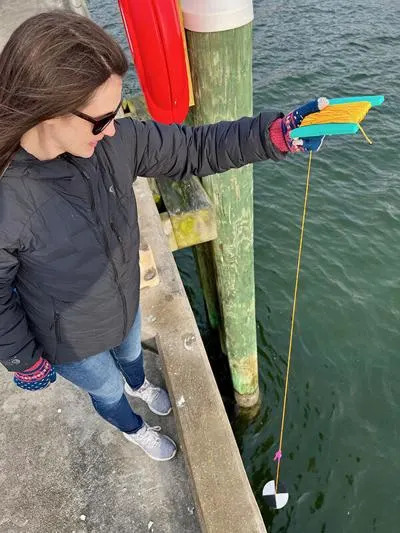
Jessie Turner demonstrates use of a Secchi disc, which has traditionally been used to measure water clarity, in the York River at the campus of the Virginia Institute of Marine Science. (Photo by David Malmquist/VIMS)
'You can have a lot of light getting to your eyeball in the fog, but the visibility is very poor. In the water, that would look like a very shallow Secchi depth reading. But you still have enough light for something like seagrass.'
What The Data Show
Traditional Secchi disk records and the Chesapeake Bay Report Card have suggested overall declines in visual clarity — the University of Maryland Center for Environmental Science rated 2024 water clarity as 'very poor'. Yet specialized light sensors that measure sunlight penetration, including wavelengths important for photosynthesis, indicate that light availability in many parts of the Bay has improved since about 1990.
These divergent indicators help explain an apparent contradiction: the Bay's submerged aquatic vegetation has grown markedly even as visual clarity scores remain weak. SAV acreage rose from 38,227 acres in 1984 to 78,451 acres last year, reflecting ecological gains even where water still looks turbid to the eye.
How Particles Change The Story
Multiple processes shape visibility and light penetration. Mineral sediment has generally declined over time, which would tend to clear the water. But clearer water can promote algal growth, increasing fine organic particles that scatter light and can be easily resuspended by wind and waves. Those fine particles reduce Secchi visibility while still transmitting light useful to SAV.
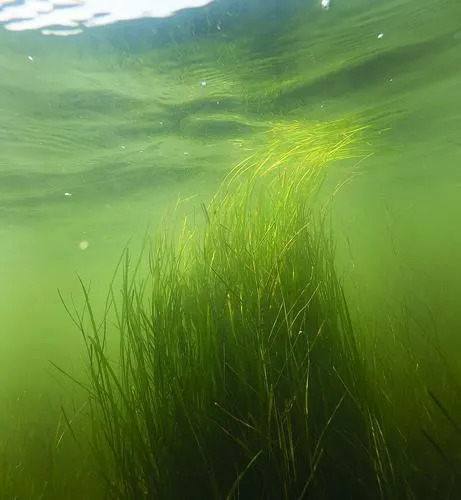
Getting enough sunlight through the water for the survival of underwater grass beds is a key goal of the Chesapeake cleanup effort. (Photo by David Harp/Chesapeakephotos.com)
Because the Bay's particle composition and hydrodynamics have changed — influenced by marsh loss, shoreline hardening and watershed development — a recovered Bay might not look the same as it did historically. Turner and colleagues caution that future particle mixtures could alter expectations about clarity even if ecological function improves.
Implications
Water clarity remains important for recreation and some fisheries: divers want to see, and anglers want fish to spot bait. But when the goal is ecological recovery, what matters most is light at depth. Continued nutrient and sediment reductions should further lower harmful algal blooms and, over time, may improve both visual clarity and light conditions. In the meantime, improved light penetration is already supporting larger grass beds, which benefits fish, crabs and overall Bay habitat.
Bottom line: The Chesapeake Bay may sometimes look murkier to the eye, but measured light available for plants has improved in many areas — a promising sign for SAV recovery and ecosystem health.
Help us improve.