Hubble imaging has confirmed Cloud‑9 as the first Reionization‑Limited H I Cloud (RELHIC): a starless, dark‑matter‑dominated object about 2,000 light‑years away. Its neutral‑hydrogen core spans ~4,900 light‑years and contains ~1 million solar masses of gas, while the halo holds an estimated ~5 billion solar masses of dark matter. The discovery supports long‑standing theoretical predictions about failed galaxy fragments and opens a new avenue for studying dark matter and early galaxy building blocks.
Hubble Confirms First RELHIC: Starless 'Cloud‑9' Dominated by Dark Matter
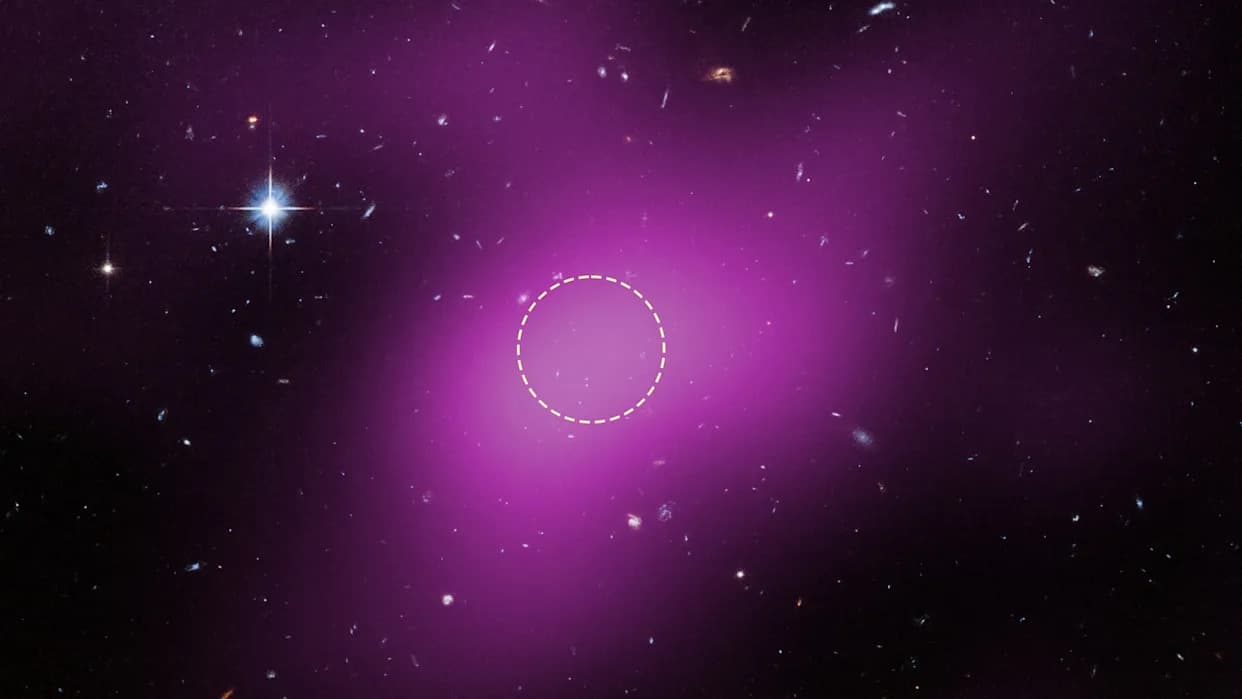
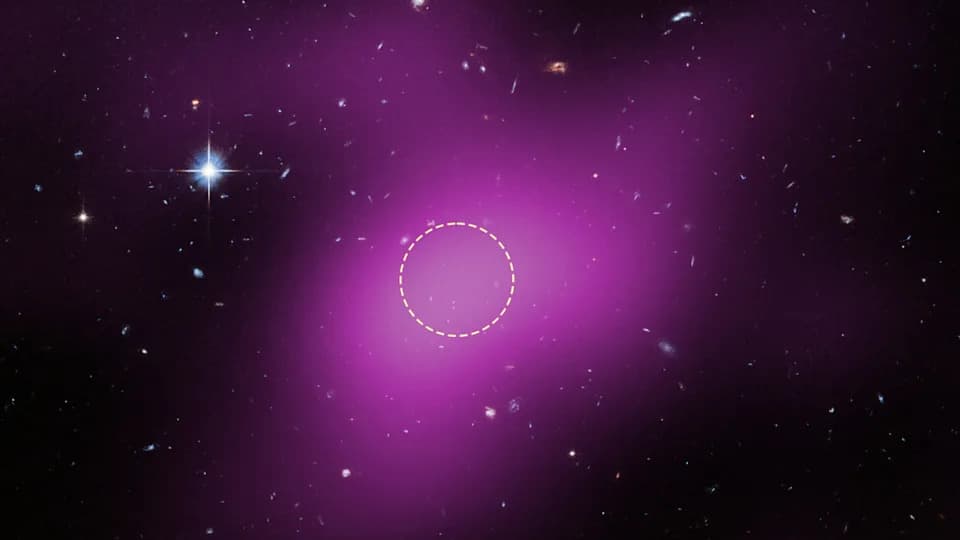
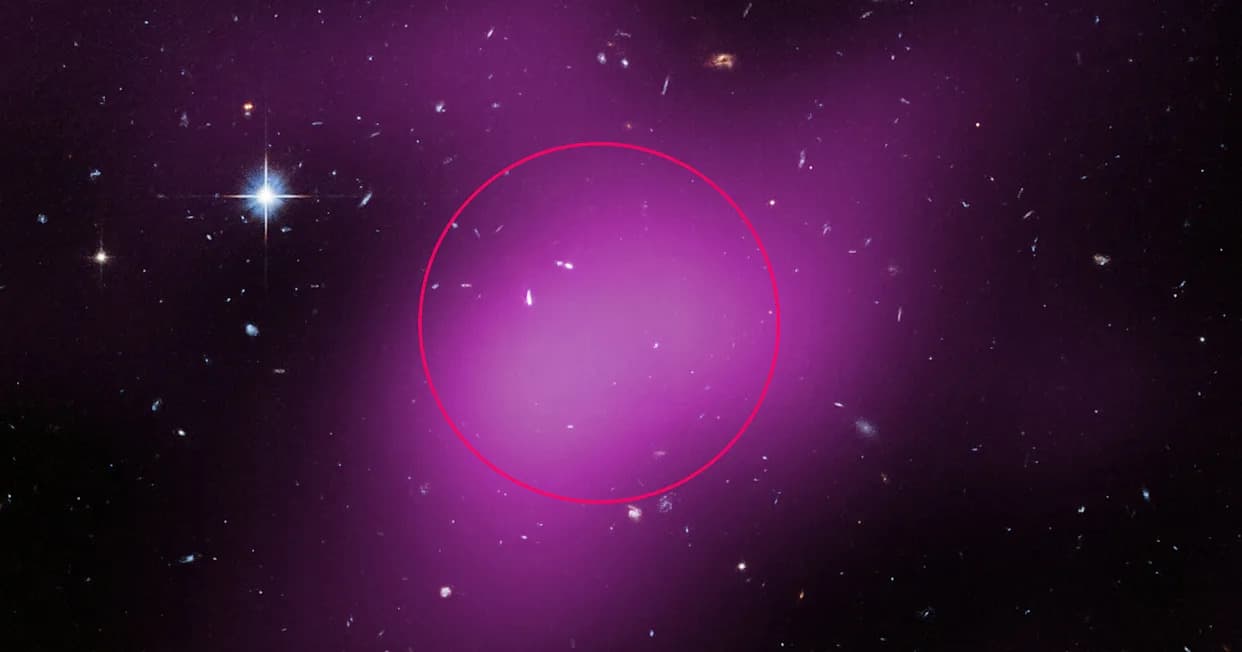
This image shows the location of Cloud-9, which is 2000 light-years from Earth. The diffuse magenta is radio data from the ground-based Very Large Array (VLA) showing the presence of the cloud. The dashed circle marks the peak of radio emission, which is where researchers focused their search for stars.
An international team of astronomers using the Hubble Space Telescope has identified the first confirmed Reionization‑Limited H I Cloud (RELHIC). The object, nicknamed Cloud‑9, appears to be completely starless yet contains a large dark‑matter halo—offering a rare observational window into the dark side of the Universe.
Cloud‑9 lies roughly 2,000 light‑years from Earth and is notably smaller, more symmetric, and more compact than the typical neutral‑hydrogen clouds around the Milky Way. Preliminary estimates indicate the cloud’s neutral‑hydrogen core spans about 4,900 light‑years and holds roughly one million solar masses in gas, while the dark‑matter halo that dominates its gravity is estimated at about 5 billion solar masses.
Why This Matters
RELHICs—Reionization‑Limited H I Clouds—were predicted by theory as primordial, gas‑rich structures that failed to form stars after the epoch of reionization. The lack of stars in Cloud‑9 strengthens this interpretation and gives astronomers a tangible example of a “failed galaxy,” a primordial building block that never ignited star formation.
“This cloud is a window into the dark Universe,” said Andrew Fox of the Space Telescope Science Institute (STScI). “Theoretical models predict most mass in the Universe is dark matter, but it is hard to detect because it does not emit light. Cloud‑9 gives us a rare opportunity to observe a cloud dominated by dark matter.”
Initial hints that Cloud‑9 was a RELHIC emerged in 2023 from ground‑based data, but only deep imaging with Hubble’s Advanced Camera for Surveys (ACS) could conclusively rule out the presence of faint stars. As STScI co‑author Gagandeep Anand explained, ground telescopes simply weren’t sensitive enough to detect any hypothetical stellar population—Hubble provided the necessary depth to show there are none.
Future Possibilities
Cloud‑9 might remain a permanent “failed galaxy,” but its fate is not sealed. If it accretes sufficient mass, the dark matter halo could draw the gas into a collapse that triggers star formation. Conversely, environmental effects—such as ram pressure or tidal interactions—could strip the cloud of gas as it moves through space. Either way, Cloud‑9 gives astronomers their first confirmed RELHIC to study, and researchers expect more such objects will be found.
“Among our galactic neighbors, there might be a few abandoned houses out there,” said STScI astronomer and co‑author Rachael Beaton, underscoring the likelihood of additional RELHIC discoveries in the local Universe.
Help us improve.