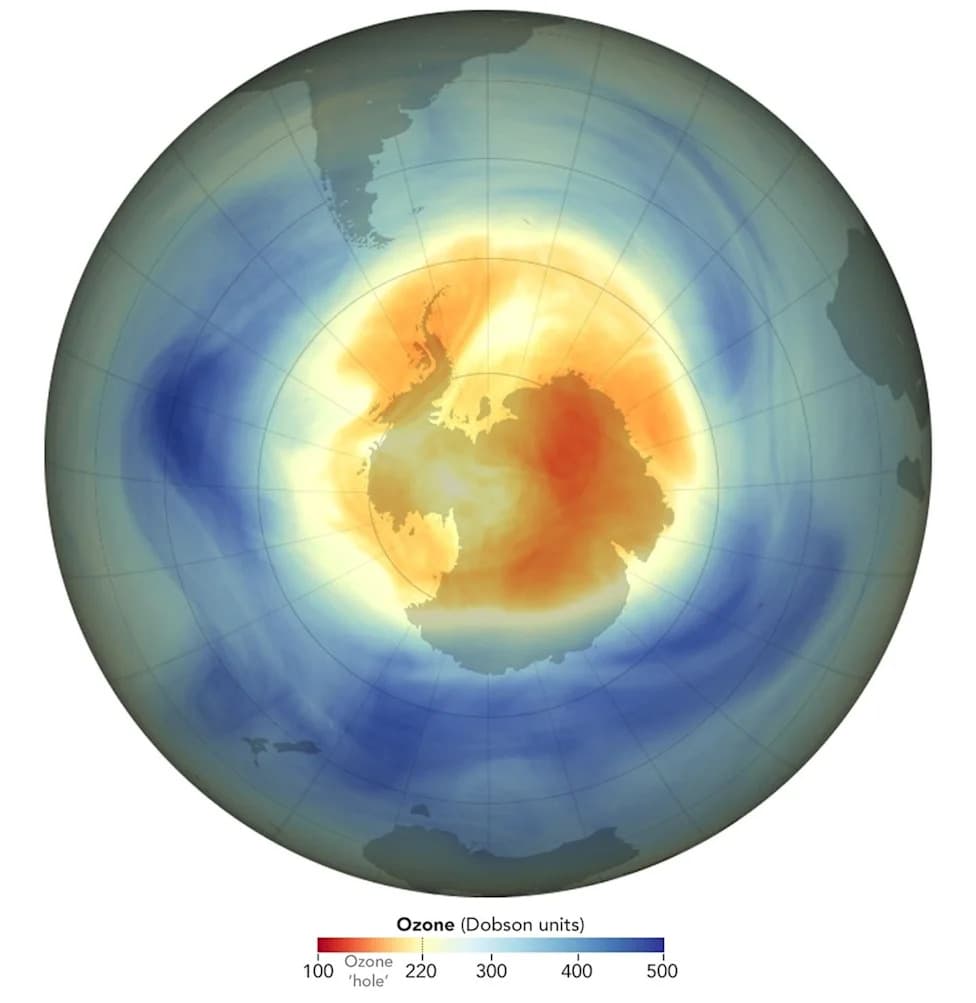
The 2025 Antarctic ozone hole ranked as the fifth smallest since satellite records began in 1992, averaging about 7.23 million square miles in September and peaking at 8.83 million on September 9. Scientists at NOAA and NASA credit reductions in ozone-depleting substances — driven by the Montreal Protocol — for the continued shrinking. Models indicate the ozone layer remains on track to recover later this century, though monitoring and policy compliance remain important.
Antarctic Ozone Hole Shrinks — 2025 Is Among The Five Smallest On Record

2025 Antarctic Ozone Hole Among Smallest Since Records Began
Scientists at NOAA and NASA report that the 2025 ozone hole over Antarctica ranks as the fifth smallest on record since satellite-era measurements began in 1992. During the peak of the 2025 ozone season in September, the hole averaged about 7.23 million square miles, with a maximum observed extent of 8.83 million square miles on September 9.
That 2025 peak is nearly 30% smaller than the largest recorded ozone hole, observed in 2006. NOAA researchers say the continued reduction in the size of the Antarctic ozone hole demonstrates the long-term effectiveness of global action to cut ozone-depleting substances.
Policy Progress: The Montreal Protocol
The Montreal Protocol, agreed in 1987 and entered into force in 1989, is the landmark international treaty that phased out many ozone-depleting chemicals. Models and observations suggest the ozone layer is on track to recover later this century as the atmospheric concentrations of those substances decline.
"Since peaking around the year 2000, levels of ozone-depleting substances in the Antarctic stratosphere have declined by about a third relative to pre-ozone-hole levels," said Stephen Montzka, senior scientist at NOAA's Global Monitoring Laboratory.
NASA scientist Newman added, "This year’s hole would have been more than one million square miles larger if chlorine levels in the stratosphere were as high as they were 25 years ago."
Why Ozone Matters
Ozone in the stratosphere — the ozone layer — shields Earth from harmful ultraviolet (UV) radiation. When the layer thins, more UV reaches the surface, increasing risks to human health (such as skin cancer and eye damage) and harming ecosystems and crops.
By contrast, ozone at ground level (in the troposphere) is a pollutant produced by vehicle emissions, industrial activity and other sources, and can aggravate respiratory conditions and other health problems when concentrations are high.
Bottom line: The smaller 2025 Antarctic ozone hole is a positive sign that international measures are working, but scientists emphasize continued monitoring and adherence to policies that limit ozone-depleting and climate-forcing emissions.
Help us improve.