In late 1967 Cambridge graduate student Jocelyn Bell Burnell detected a tiny, repeating radio signal she nicknamed "LGM" while operating the Mullard Radio Astronomy Observatory. The pulses — recorded as 1.3 seconds apart — were soon identified as emissions from pulsars: rapidly rotating neutron stars that beam radio waves like cosmic lighthouses. The 1974 Nobel Prize went to Antony Hewish and Martin Ryle, a decision that sparked debate because Bell Burnell played a central role in the discovery. In 2018 she received the $3 million Breakthrough Prize and donated the funds to scholarships.
How Jocelyn Bell Burnell Found the 'Little Green Men' — and the Discovery That Revealed Pulsars

On Nov. 28, 1967, Cambridge graduate student Jocelyn Bell Burnell noticed a tiny, regular blip in pages of radio-telescope readouts that would change astronomy. Working at the Mullard Radio Astronomy Observatory, Bell Burnell logged and analyzed more than 100 pages of instrumental data each day and spotted a narrow, repeating signal she initially nicknamed "LGM" for "little green men" — a tongue-in-cheek label for an unexplained transmission.
Discovery and investigation
Bell Burnell had helped build the improvised antenna array — an expanse of wires and receivers spanning an area roughly the size of 57 tennis courts — and was responsible for nightly monitoring and data analysis. The signal she found was exceptionally faint, amounting to roughly one part in 10 million of the recorded data, yet it repeated with remarkable regularity.
After checking earlier recordings and ruling out obvious terrestrial interference, Bell Burnell brought the traces to her adviser, Antony Hewish, who recommended a faster recorder to study the phenomenon. On Nov. 28 she recorded a series of pulses separated by about 1.3 seconds. An initial attempt to confirm the signal on another telescope failed because the team had miscalculated the instrument's pointing — and five minutes later the pulses returned.
From mystery to pulsars
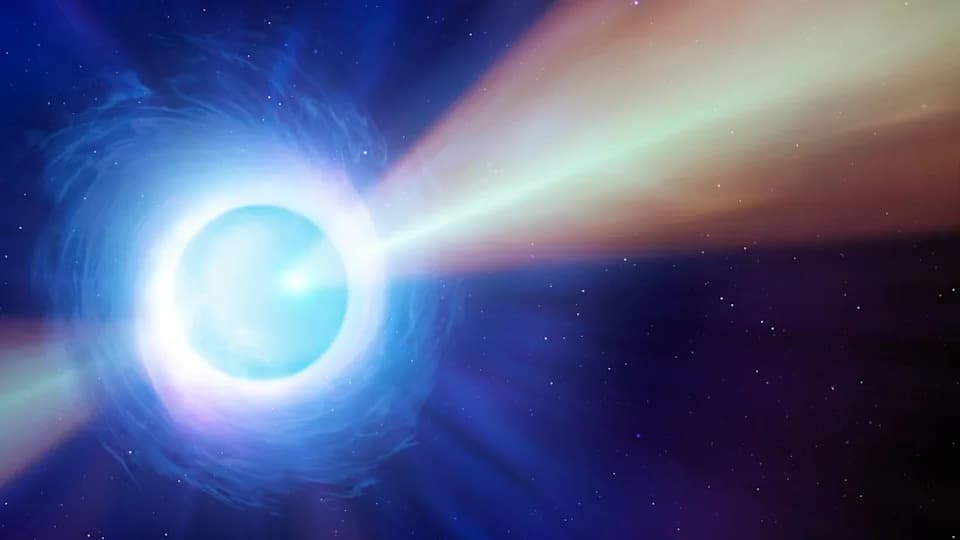
Over the next month the team identified multiple similar sources. The bursts were far too regular and too rapid to match any known type of star or typical interference. In May 1968 astrophysicist Thomas Gold proposed the correct interpretation: the signals came from pulsars, rapidly rotating neutron stars whose misaligned magnetic and rotational axes sweep beams of radio waves across space like cosmic lighthouses. Neutron stars are the ultradense remnants left behind when massive stars explode as supernovae.
Recognition and controversy
The discovery was submitted to Nature and attracted intense media interest — including sensational speculation about extraterrestrial origins and, regrettably, sexist and trivializing questions aimed at Bell Burnell. In 1974 the Nobel Prize in Physics was awarded to Antony Hewish and Martin Ryle for their roles in radio-astronomy research and the discovery of pulsars; Bell Burnell was not included. The omission generated debate and controversy in the scientific community over how credit should be allocated between students and supervisors.
"I am not myself upset about it — after all, I am in good company, am I not?" — Jocelyn Bell Burnell
Legacy
Bell Burnell later moved into X-ray and gamma-ray astronomy. Decades after the discovery she received broad recognition: in 2018 she was awarded the $3 million Breakthrough Prize for her role in discovering pulsars and donated the prize money to fund scholarships for underrepresented students in physics. The discovery of pulsars opened a new window on dense matter, gravitational physics and the life cycles of stars, and remains one of the most important breakthroughs in modern astrophysics.
Help us improve.