AT2025ulz is a candidate "superkilonova" discovered after a gravitational-wave detection on August 18, 2025. Early red emission matched kilonova behavior and heavy‑element synthesis, but the source later rebrightened with hydrogen-rich spectra typical of a supernova. The authors propose the merger occurred inside an exploding star, possibly involving an unusually low-mass compact object; the interpretation is intriguing but still tentative.
Scientists May Have Detected the First 'Superkilonova' — A Star That Exploded Twice

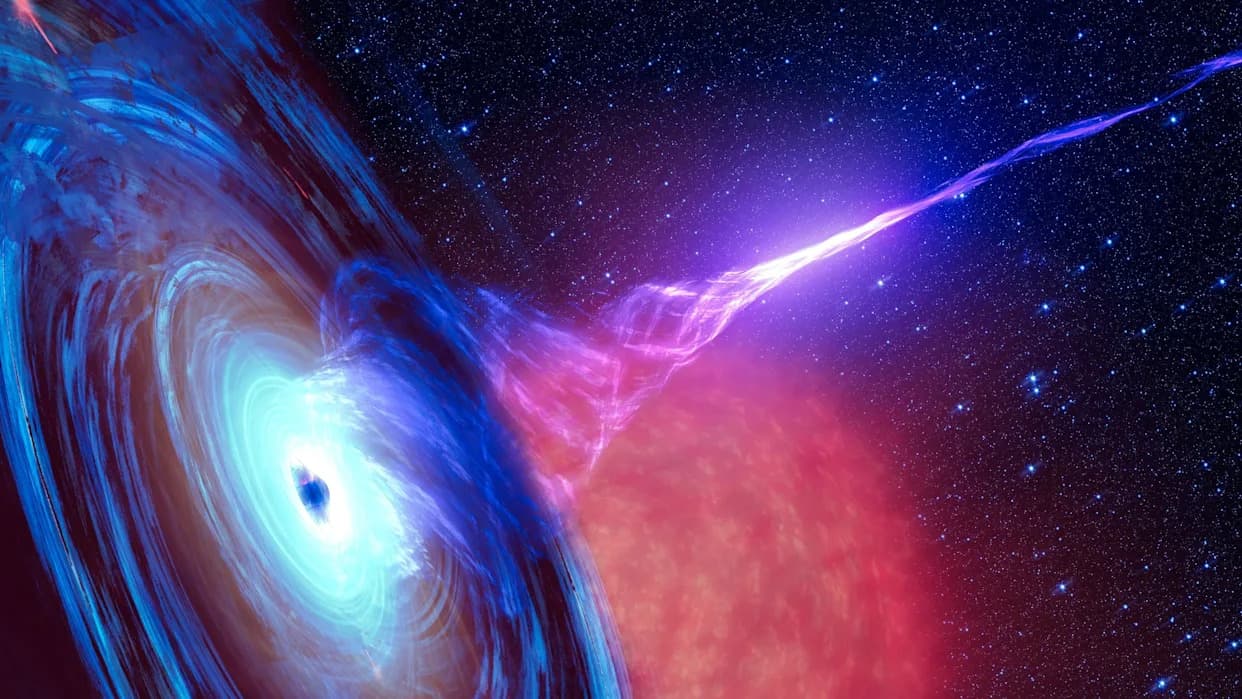
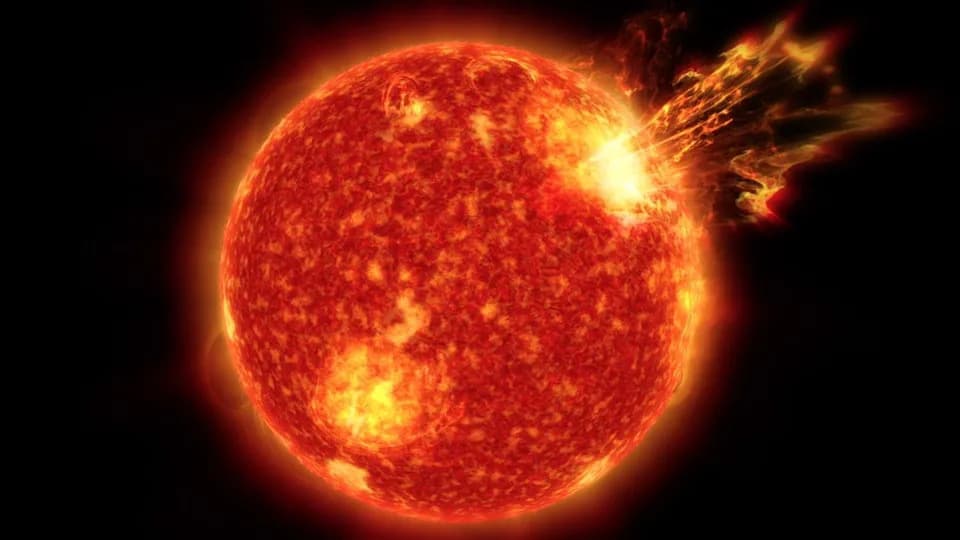
artist's impression of a superkilonova
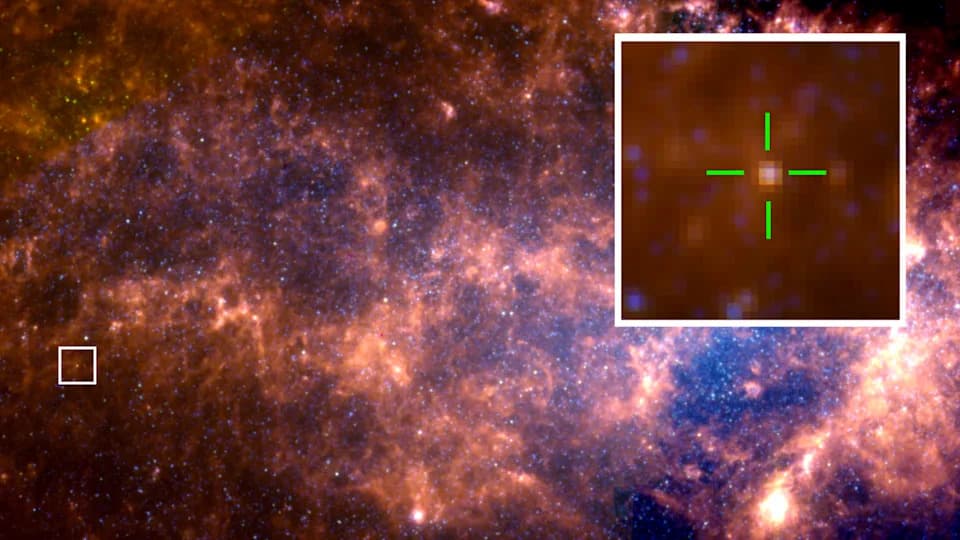
A Caltech-led research team has reported a candidate for the first-ever "superkilonova": a single astronomical system that appears to have produced both a kilonova and a supernova in rapid succession. The transient, designated AT2025ulz, followed a gravitational-wave detection on August 18, 2025 and was located about 1.3 billion light-years away.
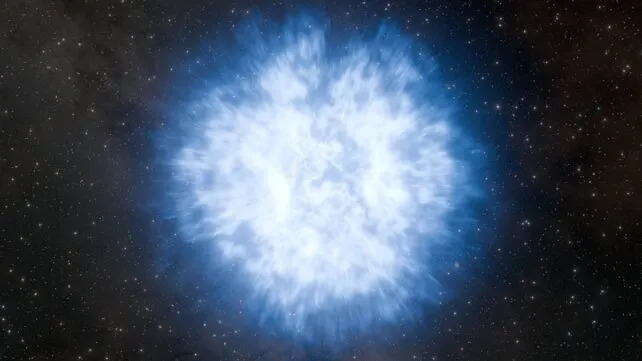
The first stage of a superkilonova: The supernova of a rapidly spinning star many times more massive than the Sun.(Caltech/K. Miller and R. Hurt (IPAC))
What Observers Saw
Follow-up observations after the LIGO–Virgo–KAGRA gravitational-wave alert found a fast-fading source whose early emission turned red — a hallmark of kilonovae that synthesize heavy elements such as gold. That early behavior echoed the well-known 2017 event GW170817, the only previously unambiguous kilonova.

Subscribe to ScienceAlert's free fact-checked newsletter
Unusually, however, AT2025ulz brightened again a few days later and displayed strong hydrogen lines in its spectrum, a signature more typical of an ordinary supernova. This two-phase light curve — an early red kilonova-like glow followed by a hydrogen-rich rebrightening — prompted the authors to propose a single, combined explanation.
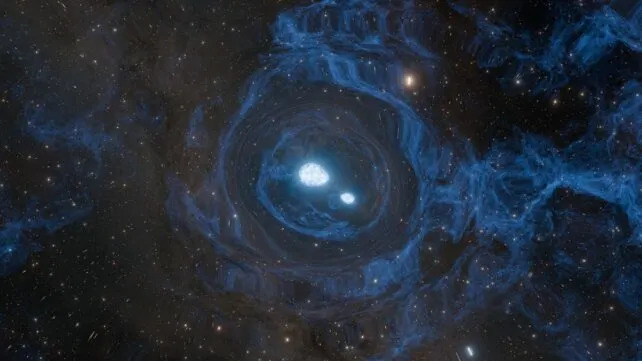
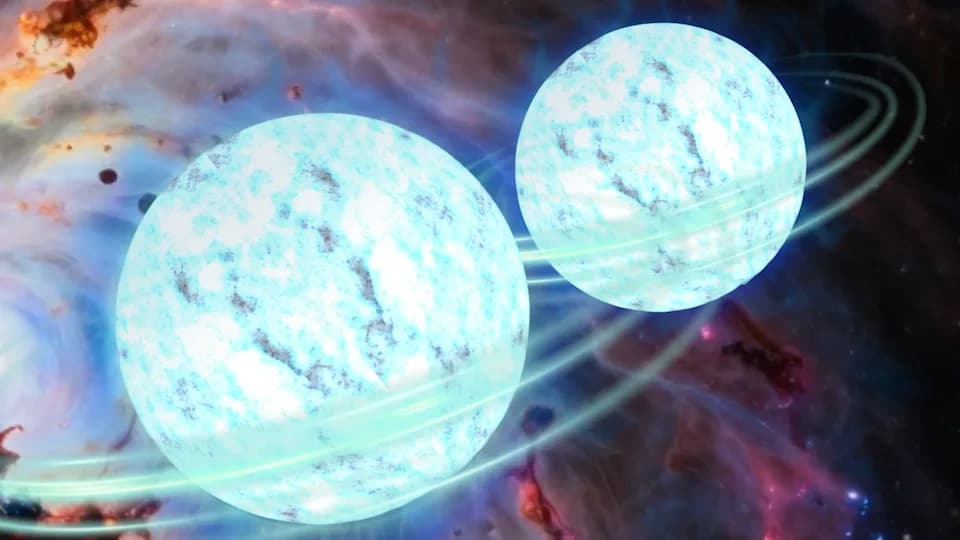
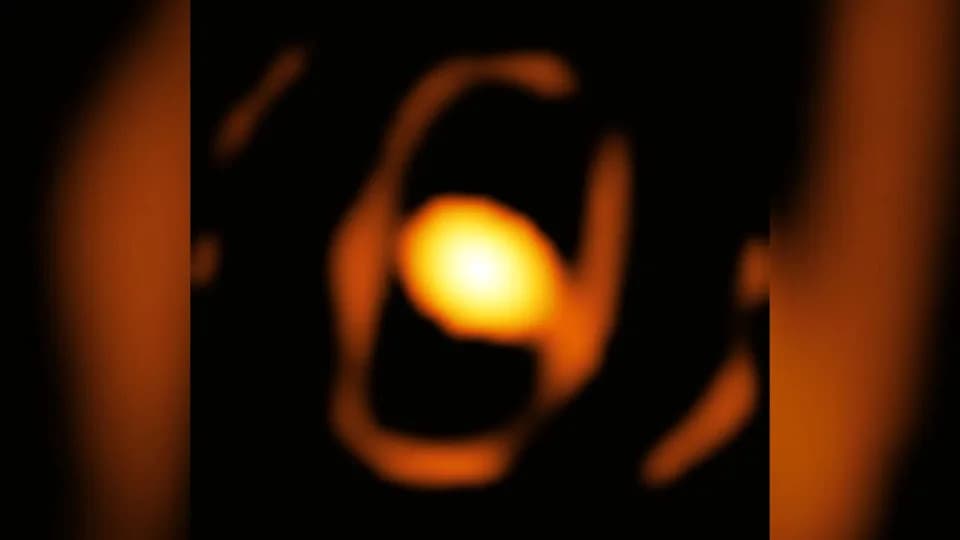
The second stage of the superkilonova: Two lower-mass neutron stars are produced by the supernova, instead of a single higher-mass neutron star as usual.(Caltech/K. Miller and R. Hurt (IPAC))
How a Superkilonova Could Form
The team suggests a rare scenario in which a rapidly rotating massive star collapses and first produces a supernova while simultaneously forming multiple compact remnants. Two of those remnants could collide almost immediately inside the expanding stellar debris, producing the gravitational-wave signal and kilonova-like ejecta embedded within the larger supernova outflow.
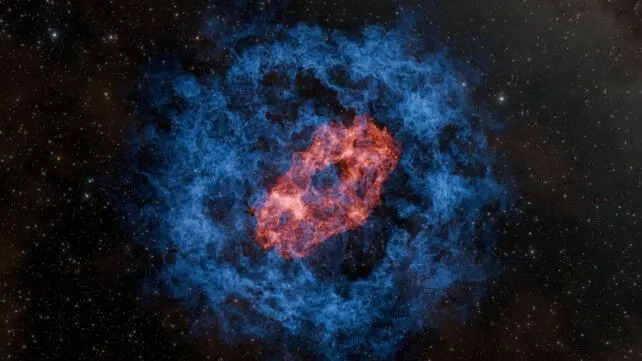
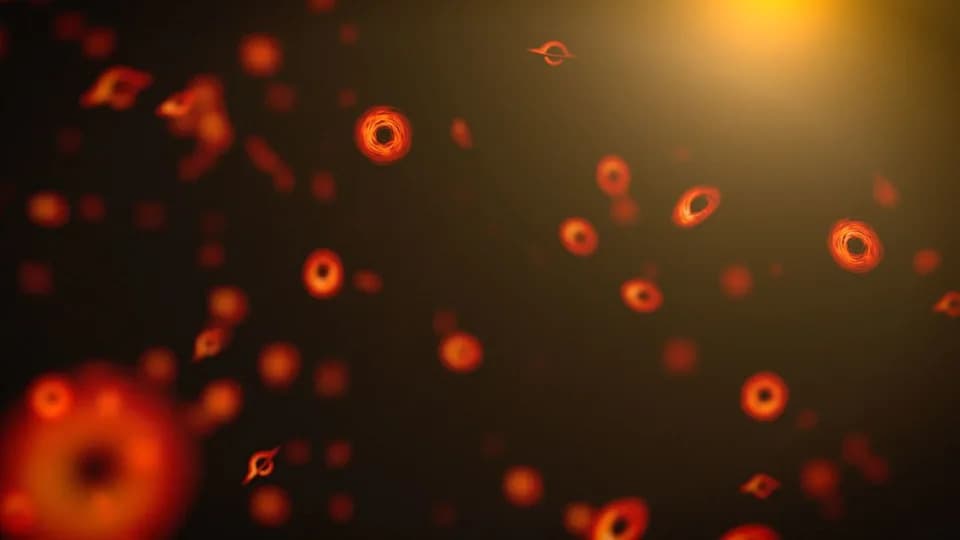
The final stage of the superkilonova: The neutron stars merge, triggering a kilonova that produces heavy metals, including gold, platinum, and uranium. (Caltech/K. Miller and R. Hurt (IPAC))
Brian Metzger (Columbia University) told ScienceAlert that the key distinction for AT2025ulz is that "the merger appears to have taken place inside the exploding star," so the kilonova emission would be largely hidden by the much more massive supernova ejecta.
Another surprising result is that at least one colliding object appears to be less massive than a typical neutron star. As co-author David Reitze (LIGO) notes, such a low-mass compact object — if real — challenges current stellar-evolution models and requires exotic formation pathways.
Possible Formation Mechanisms
The paper discusses two plausible routes to create low-mass compact objects during collapse:
- Fission: A very rapidly spinning collapsing core splits into two compact remnants rather than one.
- Fragmentation: A massive, fast-rotating disk forms around the newly collapsed core and fragments into smaller clumps that each collapse into low-mass neutron stars within seconds.
Metzger compares fragmentation to the way planets form in disks around young stars: self-gravity breaks the disk into pieces that then collapse on their own.
Why This Matters
If confirmed, a superkilonova would expand our understanding of how compact-object mergers can occur and how heavy elements are produced and dispersed. It also warns astronomers that future kilonovae may not resemble GW170817 and could be misclassified as ordinary supernovae when their kilonova phase is hidden.
Next Steps
The authors emphasize that the interpretation remains tentative. Additional observations of similar events, improved modeling, and careful analysis of gravitational-wave data are needed to confirm the superkilonova scenario. The study is published in The Astrophysical Journal Letters.
Help us improve.