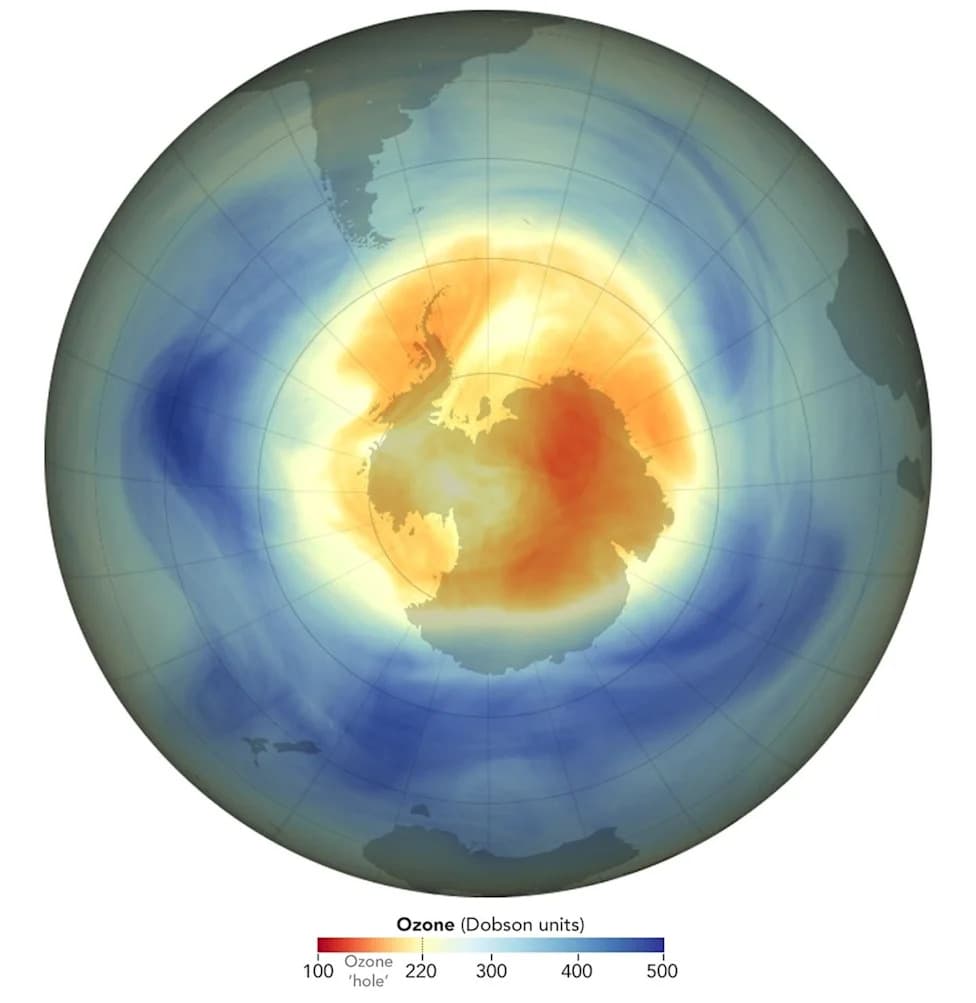
The 2025 Antarctic ozone hole averaged about 7.23 million square miles at its peak and ranks as the fifth-smallest in over 20 years. Scientists attribute the improvement largely to the Montreal Protocol's phase-out of CFCs and related chemicals. Although the hole is closing sooner than the recent average, full recovery of the ozone layer will take several decades and requires continued monitoring and global cooperation.
Antarctic Ozone Hole Shrinks — 2025 Hole Ranks Fifth-Smallest in Over 20 Years, Showing Lasting Impact of Global Action

Official monitoring shows encouraging progress for the ozone layer: the 2025 Antarctic ozone hole ranked as the fifth-smallest recorded in more than two decades. During the peak depletion period (early September through mid-October), the ozone hole averaged about 7.23 million square miles and is expected to close roughly three weeks earlier than the average over the past decade.
Experts point to international agreements to eliminate ozone-depleting substances as the main driver of the recovery. The Montreal Protocol, adopted in 1987, phased out many chlorofluorocarbons (CFCs) and similar compounds that erode stratospheric ozone. CFCs were widely used as aerosol propellants, foam-blowing agents, packing materials and refrigerants.
Declines in ozone-depleting chemicals have been measurable. Stephen Montzka of NOAA's Global Monitoring Laboratory notes that "since peaking around the year 2000, levels of ozone-depleting substances in the Antarctic stratosphere have declined by about a third relative to pre-ozone-hole levels." That reduction in stratospheric chlorine and related compounds has helped limit the size and duration of annual ozone depletion.
Paul Newman, leader of an ozone research team at the University of Maryland, emphasizes the effect of lower chlorine loads: "This year's hole would have been more than one million square miles larger if there were still as much chlorine in the stratosphere as there was 25 years ago."
While the trend is positive, scientists caution that recovery is gradual. Full restoration of the ozone layer is expected to take several more decades, and continued monitoring, compliance with existing regulations, and careful management of substitute chemicals are essential to sustain progress.
Why this matters: A smaller, shorter-lived ozone hole reduces the amount of harmful ultraviolet radiation reaching the Southern Hemisphere, protecting ecosystems and human health. The 2025 results illustrate how coordinated international policy can deliver long-term environmental benefits.
Help us improve.