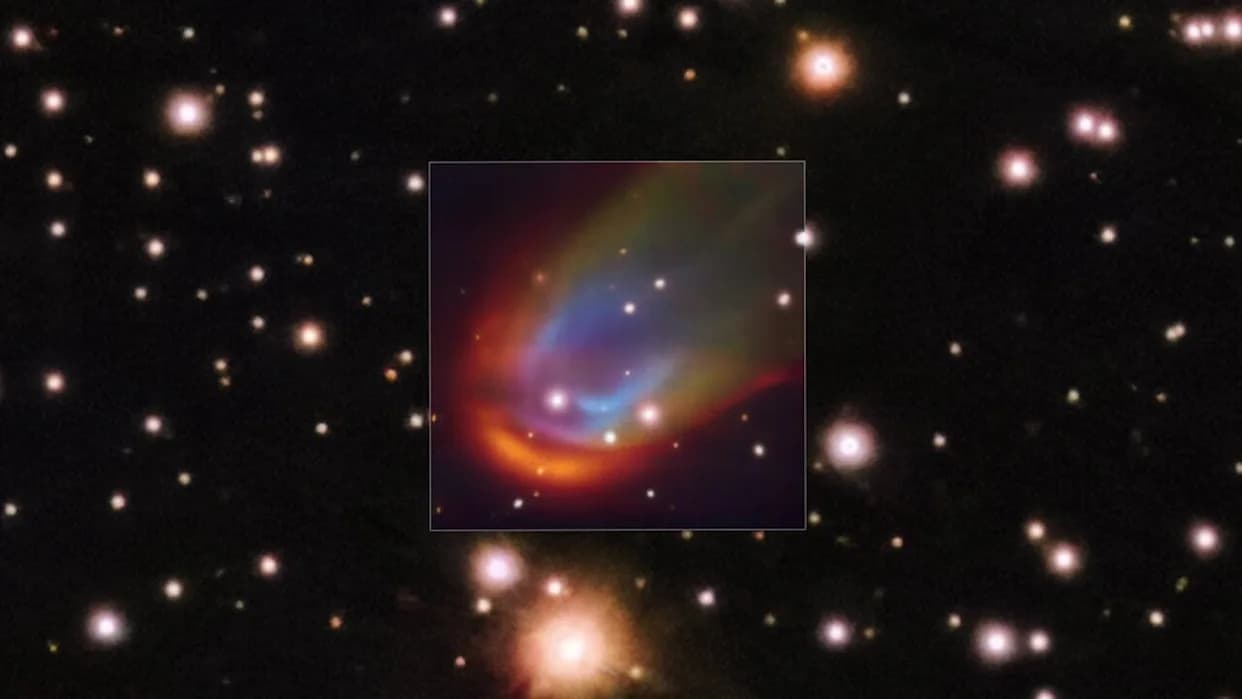
Using NASA's IXPE, MIT researchers have for the first time mapped the inner accretion flow of EX Hydrae, a nearby 'vampire' white dwarf system about 200 light-years away. Seven days of observations revealed an unexpectedly tall, ~2,000-mile (3,200 km) column of superheated gas and an ~8% X-ray polarization degree, higher than many models predicted. Polarization-angle data also show that some X-rays reflect off the white dwarf surface before scattering, validating long-standing theoretical expectations. The work highlights X-ray polarimetry as a powerful tool for studying accreting white dwarfs and systems that may produce Type Ia supernovae.
IXPE Reveals First Detailed View of a 'Vampire' White Dwarf Feeding on Its Companion

Using NASA's Imaging X-ray Polarimetry Explorer (IXPE), a team of astronomers at the Massachusetts Institute of Technology has captured the first detailed view of the inner region around a white dwarf that is actively siphoning material from a nearby companion star. The system, EX Hydrae, lies roughly 200 light-years from Earth and completes an orbit every 98 minutes, making it one of the closest known examples of an intermediate polar binary.
The researchers analyzed about seven Earth-days of IXPE observations taken in January 2025 and detected a surprisingly high X-ray polarization degree of about 8%. By tracing the polarization direction, they pinpointed the high-energy emission to a column of superheated gas roughly 2,000 miles (3,200 kilometers) tall falling onto the white dwarf — a structure about half the white dwarf's radius and substantially larger than previous estimates. The team also found evidence that a portion of the X-rays reflect off the white dwarf's surface before being scattered into space, a long-predicted effect now observed for the first time.
What an Intermediate Polar Looks Like
White dwarfs span a range of magnetic field strengths. In very strongly magnetized systems, material stripped from a companion follows field lines directly onto the magnetic poles. In weak-field systems, the gas forms an accretion disk that gradually feeds the star. Intermediate polars, like EX Hydrae, fall between these regimes: a warped accretion disk is dragged toward the poles, where magnetic forces lift material into funnel-like curtains that rain down at tremendous speeds.
Models predicted that downward streams should collide with previously lifted material, producing turbulent columns heated to millions of degrees and emitting X-rays. IXPE's polarimetric measurements provide direct evidence for this picture, allowing the team to reconstruct the geometry of the accretion flow for the first time.
"We showed that X-ray polarimetry can be used to make detailed measurements of the white dwarf's accretion geometry," said team leader Sean Gunderson of MIT's Kavli Institute for Astrophysics and Space Research. "It opens the window into the possibility of making similar measurements of other types of accreting white dwarfs."
MIT scientist Herman Marshall explained the method: every incoming X-ray carries a polarization direction; by collecting many such events and averaging them, researchers derive a preferred degree and angle of polarization that reveal the emitting geometry. Team member Swati Ravi emphasized that X-ray polarization provides an otherwise inaccessible view of the innermost, most energetic regions of these systems.
The discovery of an ~8% polarization degree — significantly higher than many theoretical expectations — allowed the team to confirm that the X-rays originate in a tall, colliding accretion column and that some emission reflects from the white dwarf surface. Gunderson described the structure this way: "If you were able to stand somewhat close to the white dwarf's pole, you would see a column of gas stretching 2,000 miles into the sky, and then fanning outward."
Why It Matters
These results demonstrate the power of X-ray polarimetry for probing extreme and violent astrophysical environments. By mapping accretion geometry in systems like EX Hydrae, astronomers can better understand how matter accumulates on white dwarfs — a process that, in some cases, can push a white dwarf toward a Type Ia supernova. Those explosions are critical tools for cosmology because they can be used to measure distances across the universe.
The team's findings were published on Nov. 10 in The Astrophysical Journal.
Help us improve.