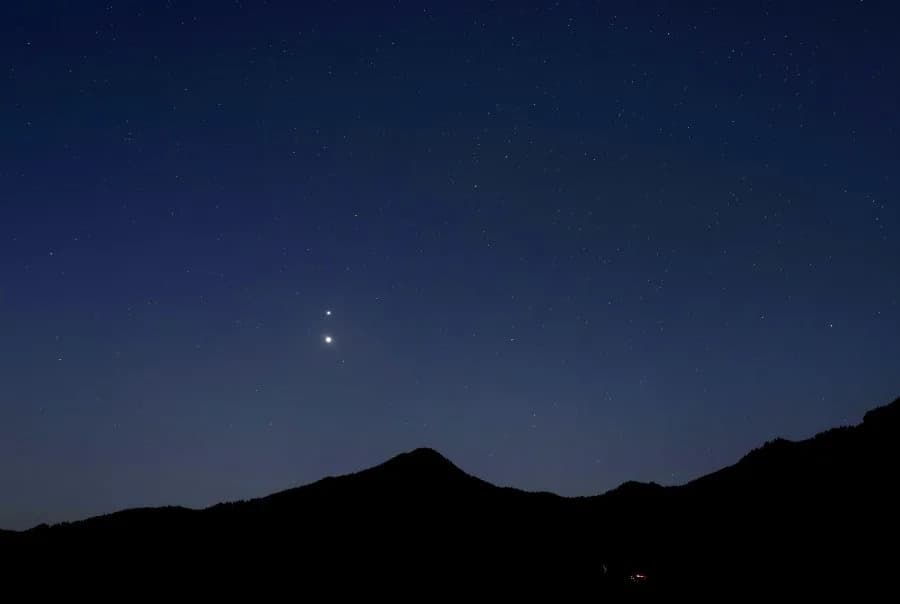
Early risers on Tuesday, Nov. 25 have a rare opportunity to spot Mercury, the planet closest to the Sun, rising just above brighter Venus in the east-southeast pre-dawn sky. A favorable viewing window begins that morning and continues through roughly Dec. 25, with the pairing most noticeable in the last week of November and early December.
What to expect
Mercury will shine near magnitude -2 while Venus will be about magnitude -3.8, making Mercury roughly five times dimmer than Venus on the astronomical magnitude scale (lower numbers = brighter objects). Mercury completes an orbit in just 88 days, which normally keeps it lost in the Sun's glare; this brief morning apparition is a good chance to tick the Swift Planet off your observing list.
When Mercury is highest
Mercury's appearance will peak near its greatest western elongation on Dec. 7, when the planet is farthest from the Sun in Earth's sky and therefore highest in the predawn hours. The broader pairing of Mercury and Venus will be visible between about Nov. 25 and Dec. 25.
How to watch
To see the pair:
- Find an unobstructed view of the east-southeast horizon about 30–10 minutes before local sunrise.
- Start by locating bright Venus; Mercury will appear a short distance above it. If you have trouble, binoculairs (or binoculars) will help — Mercury will look like a faint, steady point of light.
- Use a tripod or a steady hand for binoculars, and stow optical gear well before the Sun rises to avoid accidental sun exposure.
Why this pairing matters for Venus
As Mercury climbs into view each morning, Venus is sinking toward the Sun from Earth's perspective. After months of appearing bright in evening skies, Venus has been visible in the morning but is rising later each day and will soon slip back toward the Sun. On Jan. 6, 2026, Venus will pass between Earth and the Sun at what astronomers call inferior conjunction. In the weeks that follow it will reappear in the evening sky and is expected to reach peak evening brightness again on Sept. 22, 2026 (source: EarthSky).
Safety note: Never look directly at the Sun or use binoculars or a telescope while the Sun is above the horizon. Always put optical devices away before sunrise and double-check local sunrise times for safe observing.
By Jamie Carter, freelance astronomy writer.
Sources: EarthSky and contributor observations.