Jupiter dominates January's evening sky, shining from Gemini and forming a clear triangle with Pollux and Castor. It reaches opposition at 4 a.m. EST on Jan. 10, while Earth's closest approach occurs about 25 hours earlier at 393.3 million miles (632.9 million km). January is ideal for observing Jupiter's belts, rapid rotation and the changing positions of its four Galilean moons. NASA's Juno data favor a "dilute" core, and a series of close pairings with the Moon, Venus and Mercury will unfold through late spring and summer.
January Belongs to Jupiter: How to Spot the King of Planets This Month
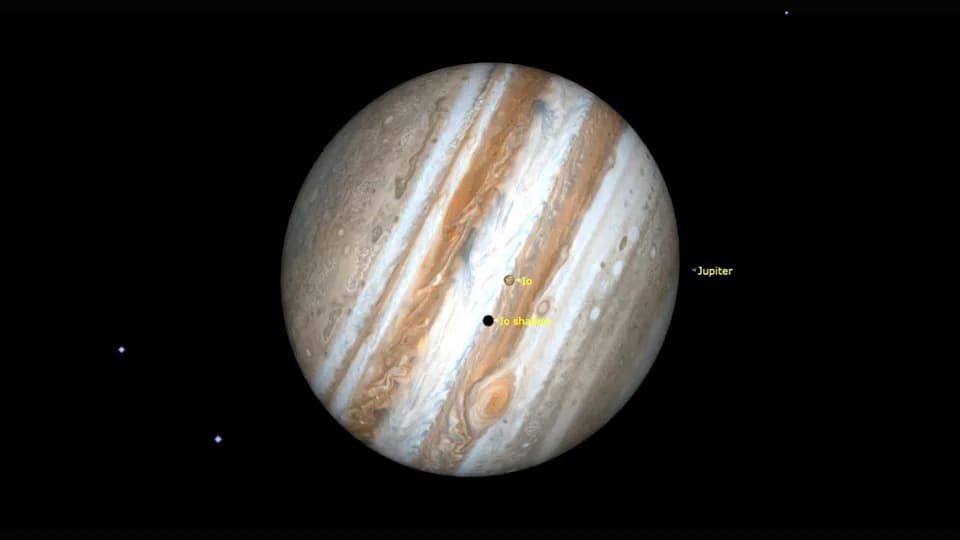
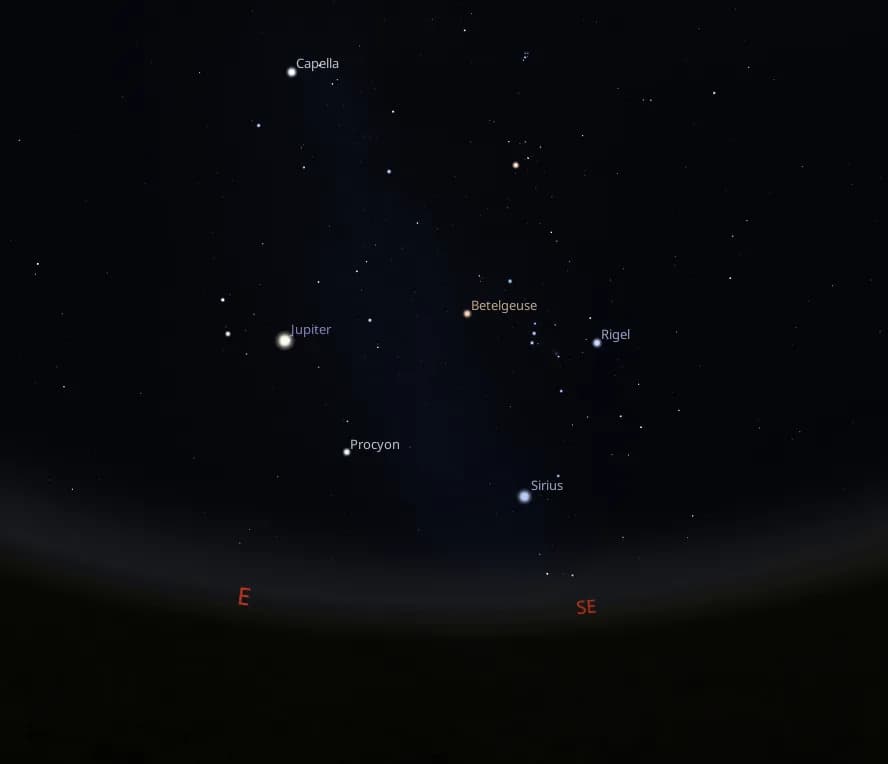
Jupiter puts on a show in January. . | Credit: Starry Night/Chris Vaughan
Jupiter, the solar system's largest planet, is currently the brightest "star" in the east-northeast after dusk, shining from the constellation Gemini. Look for a distinctive scalene triangle formed with the twin stars Pollux and Castor — an easy and rewarding target on clear winter evenings.
Opposition, Distance and Timing
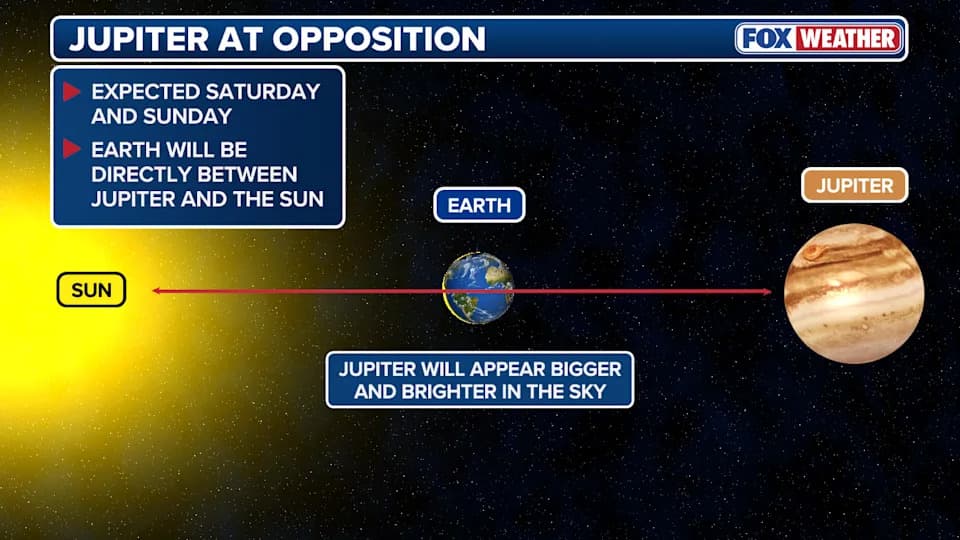
Jupiter reaches opposition at 4 a.m. EST (0900 GMT) on Saturday, Jan. 10 — the moment the planet lies opposite the Sun in our sky. Earth's closest approach to Jupiter in this cycle occurs about 25 hours earlier at 3 a.m. EST (0800 GMT) on Friday, Jan. 9, when the two planets are roughly 393.3 million miles (632.9 million km) apart. Around opposition, Jupiter appears to slow and trace a retrograde loop against the background stars for a period of roughly four months centered on the event.
What You'll See Through Binoculars and Telescopes
Even binoculars show Jupiter as a small disk and reveal its four bright Galilean moons — Io, Europa, Ganymede and Callisto — as tiny points of light that change position hour by hour. A medium-sized telescope will reveal the planet's dark belts, lighter zones, oval storms and festoons. Jupiter rotates faster than any other planet, completing a rotation in just under 10 hours, which produces a noticeable equatorial bulge.
What Science Tells Us About Jupiter
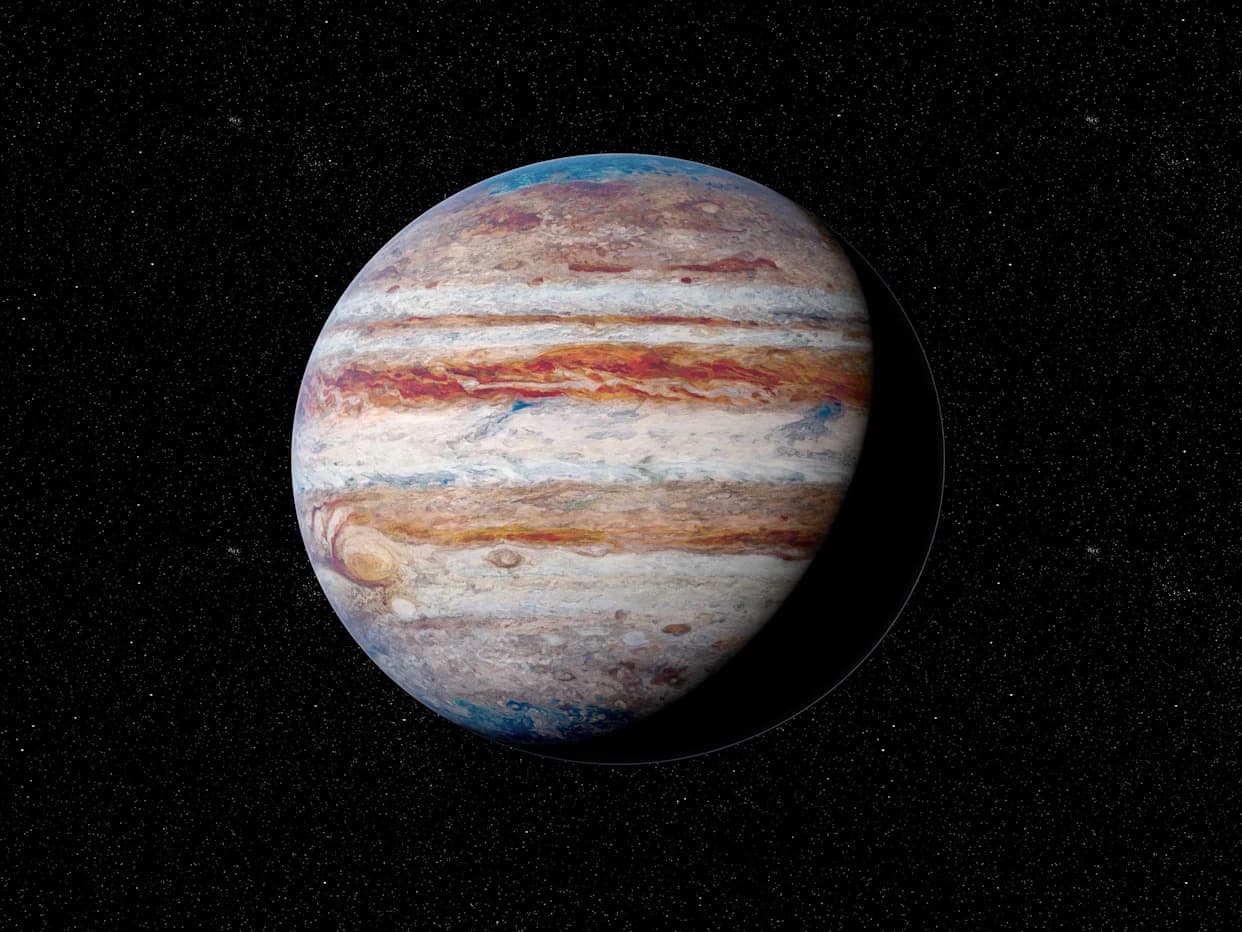
Jupiter is a colossal ball of hydrogen and helium with an equatorial diameter of about 88,846 miles (142,984 km). It contains nearly 2.5 times the mass of all the other planets combined and takes nearly 12 Earth years to orbit the Sun. Data from NASA's Juno mission and updated interior models favor a "dilute" core — heavy elements mixed into an extensive mantle of metallic hydrogen beneath thick, multicolored cloud layers that include ammonia and ammonium hydrosulfide clouds.
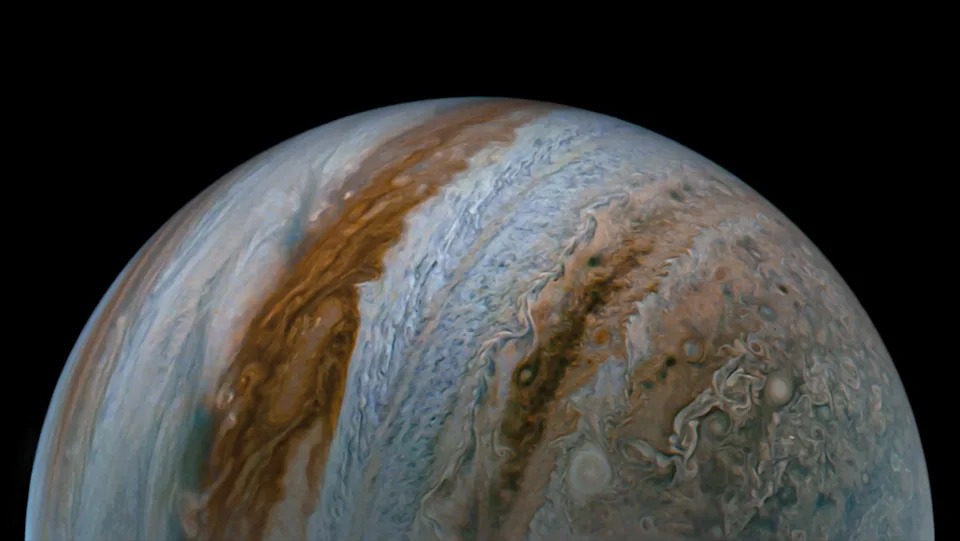
NASA’s Juno spacecraft captured this view of Jupiter during the mission’s 54th close flyby of the giant planet on Sept. 7, 2023. | Credit: NASA/JPL-Caltech/SwRI/MSSS. Image processing by Tanya Oleksuik CC BY NC SA 3.0
Viewing Tips
From mid-northern latitudes January provides nearly ideal views: Jupiter is well placed for telescopic observation by about 7 p.m., roughly one-third of the way from the eastern horizon to the zenith. It reaches its highest point in the southern sky near midnight and sets toward dawn. Because Jupiter rotates quickly, observers at mid-northern latitudes can see every longitude of the planet during a long winter night — a great opportunity for sketching or imaging cloud detail over multiple hours.
Notable Dates and Events This Year
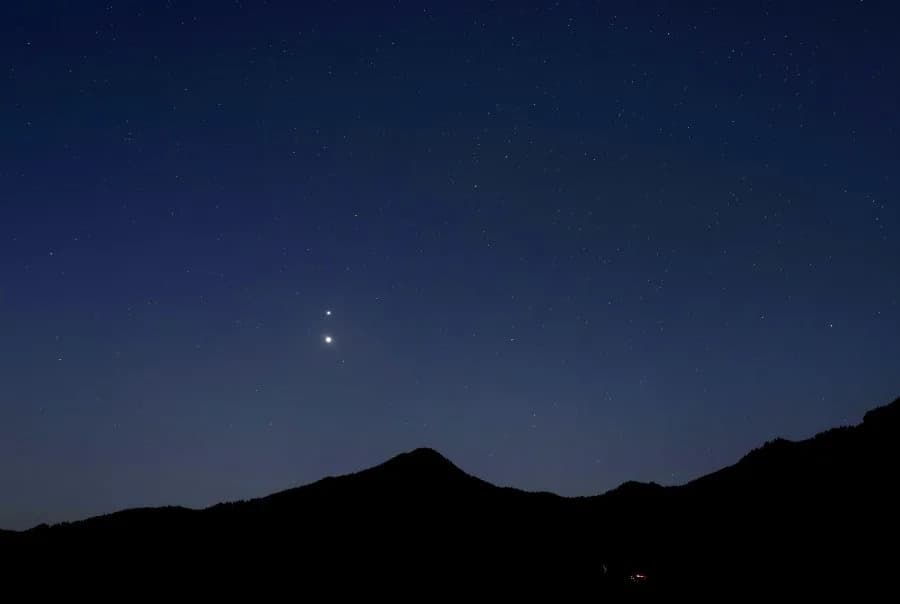
Watch these upcoming highlights: on Feb. 27 the triangle with Pollux and Castor narrows into a nearly isosceles shape with a waxing gibbous Moon nearby; late May and early June bring a close sequence of pairings — a crescent Moon near Jupiter on May 20, Venus climbing to meet Jupiter during the final week of May, a conspicuous Venus–Jupiter pairing by June 9 low in the west-northwest, and a thin crescent Moon with Mercury near Jupiter on June 16. Later in the year, an occultation of Jupiter will be visible to early risers across much of North America on Oct. 6, and Mars will pass just north of Jupiter on Nov. 16. Jupiter reaches aphelion (its farthest point from the Sun) on Dec. 28, 2028, at about 507 million miles (815.7 million km).
Why Jupiter Captivates Observers
After the Sun and Moon, Jupiter is arguably the most engaging object for backyard observers: its constantly changing atmosphere, rapid rotation and lively system of moons have fascinated cultures for millennia and continue to reward frequent viewing and imaging. Before telescopes, planets were considered a special class of stars; today they remain central to our understanding of planetary systems.
Observer Note: On the night of Jan. 10 you can expect three of Jupiter's Galilean moons (Ganymede, Io and Europa) to appear on one side of the planet, with Callisto isolated on the opposite side — a fine demonstration of orbital motion visible over a single evening.
Joe Rao is an instructor and guest lecturer at New York's Hayden Planetarium and a long-time astronomy writer.
Help us improve.