A study in Nature Communications combines simulations and real-time experiments to show that some iron-rich meteorites can strengthen under intense, short-duration impacts. Researchers used CERN’s HiRadMat facility to irradiate a Campo del Cielo meteorite fragment and observed a 2.5× microscopic strength increase and strain-rate dependent damping. These findings imply a standoff nuclear detonation might deflect certain asteroids without shattering them, though more tests on mixed-composition bodies are needed.
Simulation and Experiments Suggest a Nuclear 'Standoff' Could Deflect — Not Shatter — Some Earth-Bound Asteroids
It May Be Safe to Nuke an Earthbound Asteroid After All, Simulation Suggests
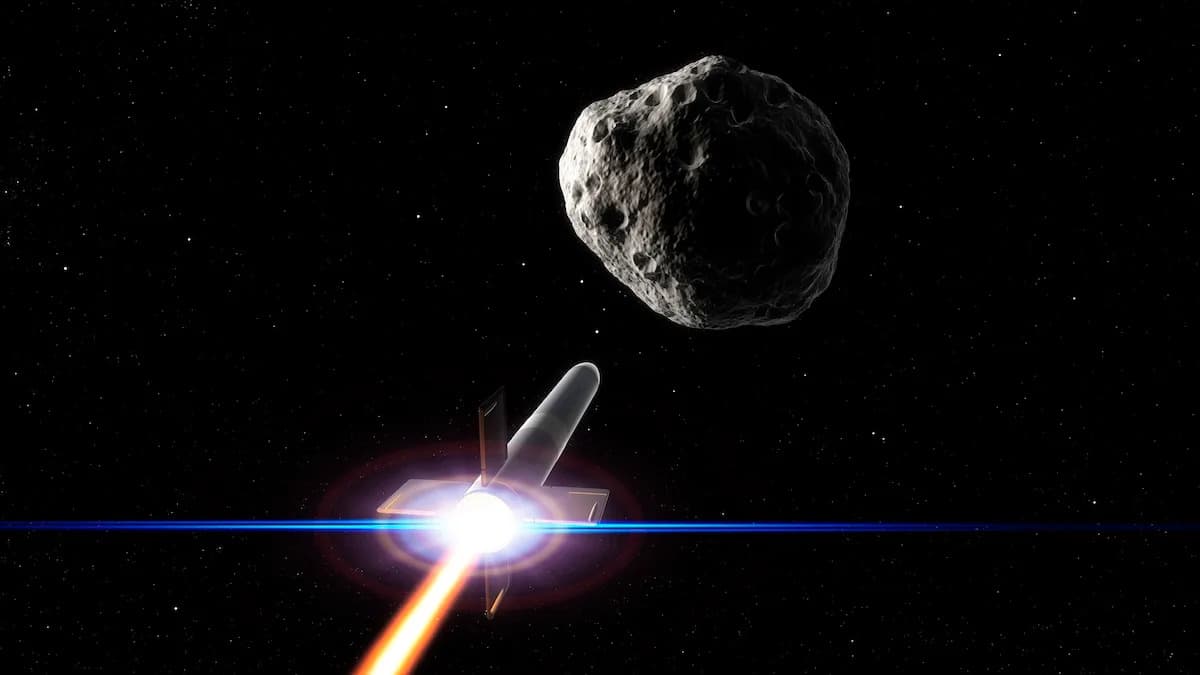
Could a nuclear detonation be a viable last-resort method to nudge an incoming asteroid away from Earth without shredding it into dangerous fragments? New simulations and laboratory experiments indicate that, for at least some iron-rich bodies, intense, short-duration impacts can increase material strength and dissipate energy — making a standoff nuclear deflection less likely to fragment the target than previously feared.
What the Study Did
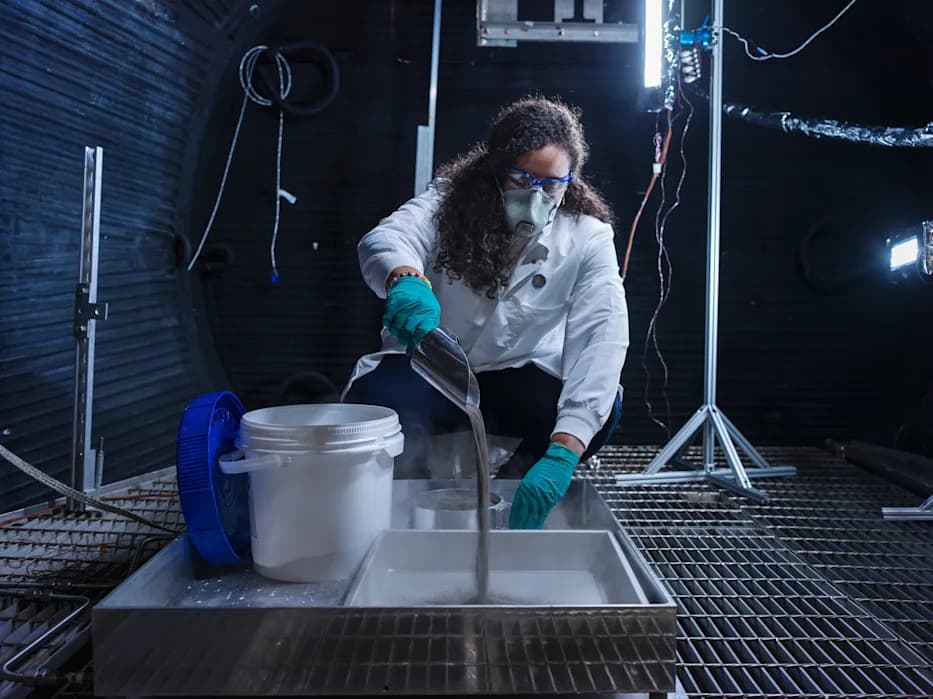
In research published in Nature Communications, a team including physicists from the University of Oxford and engineers from the Outer Solar System Company (OuSoCo) examined how an iron meteorite responds to very high, short bursts of energy. To mimic the extreme, rapid loading that a kinetic strike or a nearby nuclear detonation would impose, the researchers used the Super Proton Synchrotron accelerator at CERN's HiRadMat facility to irradiate a fragment of the Campo del Cielo iron meteorite with short, high-energy proton-beam pulses.
Key Observations
Using temperature sensors and laser Doppler vibrometry (which measures surface vibrations), the team recorded a sequence of behaviors: the meteorite initially softened and flexed under the pulses, then unexpectedly re-strengthened. The sample showed a roughly 2.5× increase in microscopic material strength in those tests and demonstrated strain-rate dependent damping — meaning it dissipates incoming energy more effectively when struck harder or more rapidly.

Subscribe to ScienceAlert's free fact-checked newsletter
"This is the first time we have been able to observe — non-destructively and in real time — how an actual meteorite sample deforms, strengthens and adapts under extreme conditions," said Gianluca Gregori (University of Oxford), a co-author of the study.
Why This Matters For Planetary Defense
Defenders typically consider two broad options: a kinetic impactor (like NASA’s 2022 DART mission) or, as a last resort, a nuclear standoff detonation that vaporizes surface material to produce a reactive impulse. The new data help refine how energy transfers to an asteroid and how its internal structure redistributes stress during and after a high-rate impact.
Previous estimates of asteroid yield strength have varied by as much as a factor of seven depending on whether they measured microscopic (local) or macroscopic (bulk) properties. That scatter — and the fact that material properties evolve in real time under extreme loading — has complicated predictions about whether an attempted deflection would push a body off course or instead fragment it into many dangerous pieces.
Limitations And Next Steps
The experiments deliberately used a relatively homogeneous, iron-rich sample to simplify interpretation. The authors note that more heterogeneous asteroids — mixtures of rock, metal, and porosity — may behave very differently depending on the spatial distribution of their constituents. The team plans to extend experiments and simulations to a wider range of compositions to improve models for real-world deflection scenarios.
"The world must be able to execute a nuclear deflection mission with high confidence, yet cannot conduct a real-world test in advance. This places extraordinary demands on material and physics data," said Karl-Georg Schlesinger, co-founder of OuSoCo and co-leader of the research team.
Takeaway
The new experiments add valuable, real-time material data to models of asteroid deflection. For certain iron-rich bodies, a standoff nuclear detonation may be less likely to produce hazardous fragmentation than earlier, more pessimistic models suggested — but more work is needed to understand heterogeneous and rubble-pile asteroids before changing operational plans.
Help us improve.