The Vera C. Rubin Observatory's pre-survey found a Main-Belt asteroid, 2025 MN45, about 710 meters across that rotates once every 1.88 minutes, far faster than the expected 2.2-hour spin barrier. Over nine nights in April–May 2025 the survey measured rotation periods for 76 asteroids and identified 19 that spin faster than the classical limit, including three under five minutes. These results imply many Main-Belt asteroids may have high internal cohesion—possibly solid-rock fragments from early violent collisions—and will reshape models of asteroid structure and evolution.
Record-Breaking Main-Belt Asteroid Spins Once Every 1.88 Minutes — Shattering Spin Limits

Record-Breaking Asteroid Spins So Fast It Should Tear Itself Apart
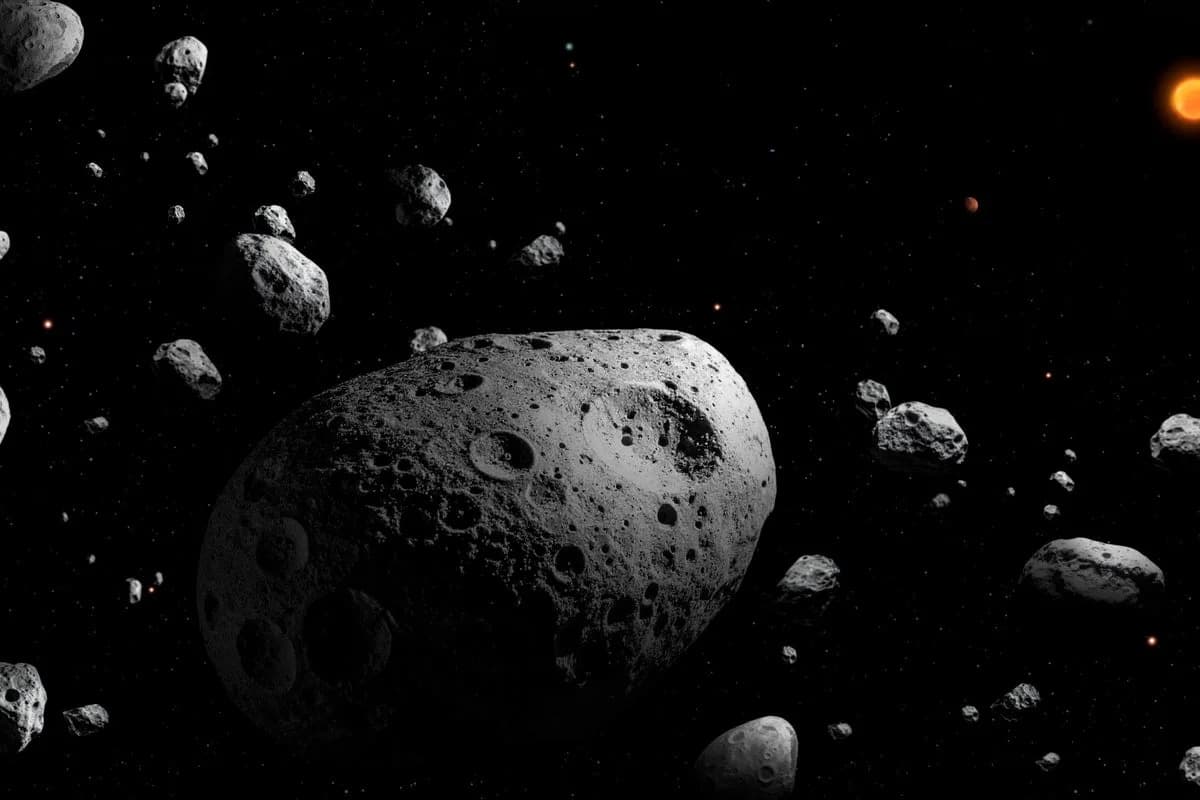
Months before its main survey formally begins, the Vera C. Rubin Observatory has already upended expectations about asteroid structure and strength. During a nine-night pre-survey campaign, the telescope discovered a large Main-Belt asteroid, 2025 MN45, that measures roughly 710 meters (2,330 feet) across and completes a full rotation in just 1.88 minutes.
Discovery and Measurements
Between 21 April and 5 May 2025, Rubin observed roughly 340,000 asteroids. From that dataset, astronomers led by Sarah Greenstreet measured rotation periods for 76 objects (75 Main Belt asteroids and one near-Earth object). Remarkably, 19 of those measured bodies rotate faster than the classical 2.2-hour "spin barrier": 16 so-called super-fast rotators with periods between 2.2 hours and 13 minutes, and three ultra-fast rotators spinning in under five minutes. The standout is 2025 MN45, the fastest and largest in the sample.
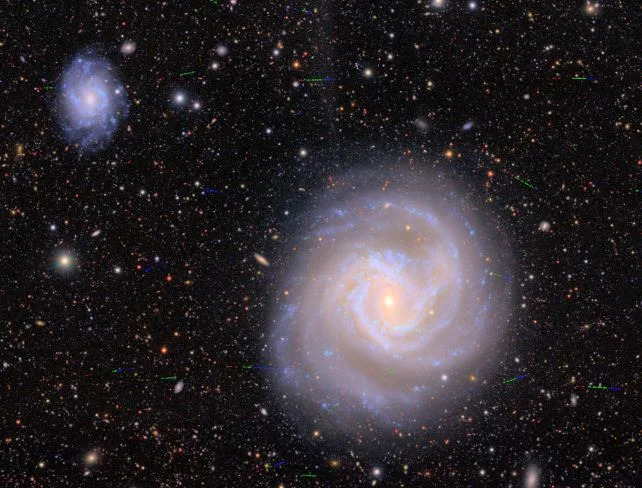
Rubin observations of the Virgo Cluster photobombed by asteroids in the foreground, seen as thin, tri-colored streaks. (RubinObs/NOIRLab/SLAC/NSF/DOE/AURA)
Why This Is Surprising
For decades, astronomers believed many asteroids were "rubble piles"—loose aggregates of boulders, pebbles, and dust held together mainly by gravity. Theory and earlier surveys set a practical spin limit of about 2.2 hours for objects larger than ~150 meters; faster rotation should fling such rubble piles apart, much like riders are pressed against the wall of a Gravitron ride. Finding numerous, relatively large Main-Belt asteroids spinning well past that limit challenges that assumption.
"The unexpected prevalence of asteroids the size of several football fields that complete a full rotation in less than two minutes requires us to refine our understanding of the formation and evolution of asteroid rotations," says Sarah Greenstreet of the US National Science Foundation's National Optical-Infrared Astronomy Research Laboratory, lead author on the study.
Implications for Asteroid Science and Missions
The simplest explanation is that many of these fast rotators have far greater internal cohesion and density than typical rubble piles—possibly approaching the cohesive strength of solid rock. Such objects may be fragments of unusually violent collisions in the early Solar System that retained internal structure while other bodies were ground down to rubble.

Subscribe to ScienceAlert's free fact-checked newsletter
These findings affect models of asteroid formation, collisional history, and rotational evolution. They also have practical implications for mission planning: a larger population of high-strength asteroids could offer unexpected scientific targets for spacecraft like NASA's Lucy mission and for future reconnaissance or resource-assessment missions.
Next Steps
The Rubin Observatory will continue its wide, deep survey of the sky and is expected to enlarge the sample of measured asteroid rotations dramatically. Follow-up observations (spectroscopy, radar, and spacecraft encounters) will be essential to determine compositions, densities, shapes, and internal structures that explain these record-breaking spin rates.
Publication: The findings are published in The Astrophysical Journal Letters.
Help us improve.