Researchers led by Jure Zupan propose two realistic mechanisms by which fusion reactors could produce axions — hypothetical particles that are strong dark matter candidates. The first involves neutron-induced nuclear transitions in lithium-lined reactor walls; the second relies on bremsstrahlung from abruptly decelerated charged particles and related secondary processes. Published in the Journal of High Energy Physics, the analysis estimates detectable particle fluxes consistent with current limits and outlines how detectors at fusion facilities could search for axions on Earth.
Fictional Puzzle, Real Breakthrough: How Fusion Reactors Could Produce Axions — And Help Hunt Dark Matter
Scientists Just Solved a Deep Physics Conundrumbymuratdeniz - Getty Images
Physicists have proposed realistic mechanisms by which fusion reactors might generate axions — hypothetical particles long considered promising dark matter candidates — resolving a puzzle that even The Big Bang Theory's characters couldn't crack on television.
From TV Whiteboards to Real-World Theory
In three episodes of the sitcom The Big Bang Theory, Sheldon Cooper and Leonard Hofstadter struggled with an equation and diagram that attempted to show how axions could be produced, ultimately abandoning the effort. Real researchers, led by theoretical physicist Jure Zupan of the University of Cincinnati and collaborators at the Fermi National Accelerator Laboratory (Fermilab), MIT and the Technion–Israel Institute of Technology, revisited that idea and outline two plausible production routes in a paper published in the Journal of High Energy Physics.
Two Potential Production Mechanisms
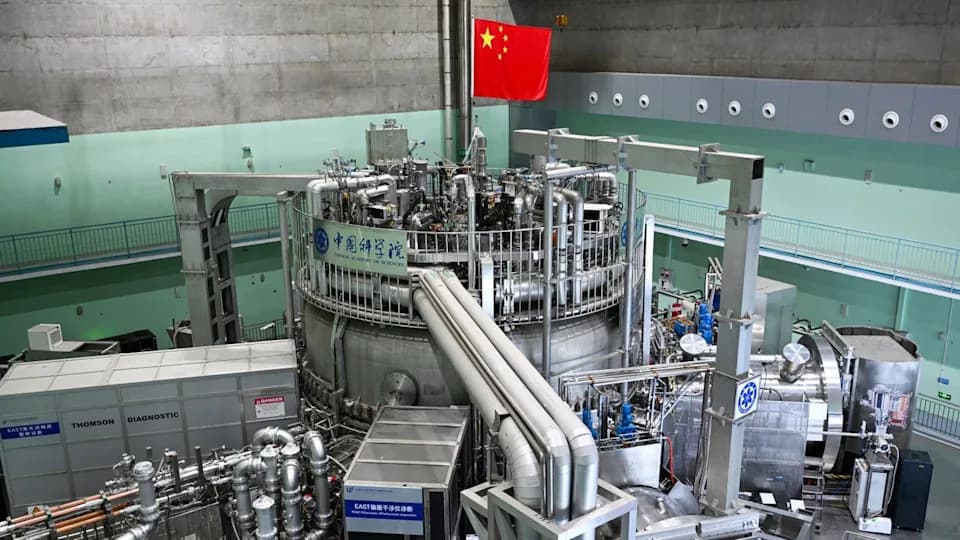
1) Neutron-Induced Nuclear Transitions: In a deuterium–tritium (D–T) fusion reactor with lithium-lined walls, intense neutron flux from the plasma can interact with nuclei in the vessel lining. Those interactions can induce exotic nuclear transitions that, in principle, emit axions or axion-like particles. Because neutrons are abundant in D–T reactions, the lithium mantle of a reactor provides a plausible production site.
2) Bremsstrahlung From Fast Charged Particles: Bremsstrahlung ("braking radiation") occurs when fast charged particles — for example, protons or electrons produced in reactor interactions — are suddenly decelerated. That abrupt slowing can release energy that, under certain conditions, produces weakly interacting exotic particles such as axions. The authors also consider secondary processes triggered by neutrons that can lead to charged-particle production and further contribute to axion emission.
"Fusion reactors will provide a promising new avenue for probing light [exotic particles]," Zupan and colleagues write. "These particles can be produced in the mantle of fusion reactors via exotic nuclear transitions triggered by the intense neutron flux emitted from the inner volume of the reactor."
Why This Matters
Axions were originally proposed to resolve anomalies in certain subatomic reactions related to time-translation symmetry and have since become strong dark matter candidates. Dark matter does not emit or absorb light, and is estimated to make up roughly 84% of the universe's matter. Because it interacts very weakly with ordinary matter, direct detection has been extraordinarily difficult.
Zupan's team estimates the flux of axions that these two mechanisms could produce, showing that, within existing experimental constraints, a detectable flux just outside reactor walls is in principle possible. They also outline how detectors placed near active fusion devices might search for this signal.
Outlook
The Sun remains a far larger natural source of any dark-matter-producing processes, but the work suggests that terrestrial fusion facilities — current or planned — could become practical laboratories to search for axions. If experiments at fusion reactors detect axions, it would be a major step toward identifying at least part of the dark matter in the universe.
And for fans of the sitcom: the real scientists may have done what fictional ones could not — a result that could make some physicists want to shout, playfully, "Bazinga!"
Help us improve.