The ALPHA‑g team at CERN produced neutral antihydrogen, trapped and laser‑cooled about 100 antiatoms, then lowered the magnetic confinement to observe their escape. After removing background noise, roughly 80% of detected annihilations occurred at the bottom of the trap, showing antihydrogen falls toward Earth. While the experiment confirms the direction of the fall and supports the weak equivalence principle, it does not yet measure antimatter’s gravitational acceleration with 1%‑level precision.
Antimatter Falls Down — CERN’s ALPHA‑g Shows Antihydrogen Is Not Repelled by Gravity
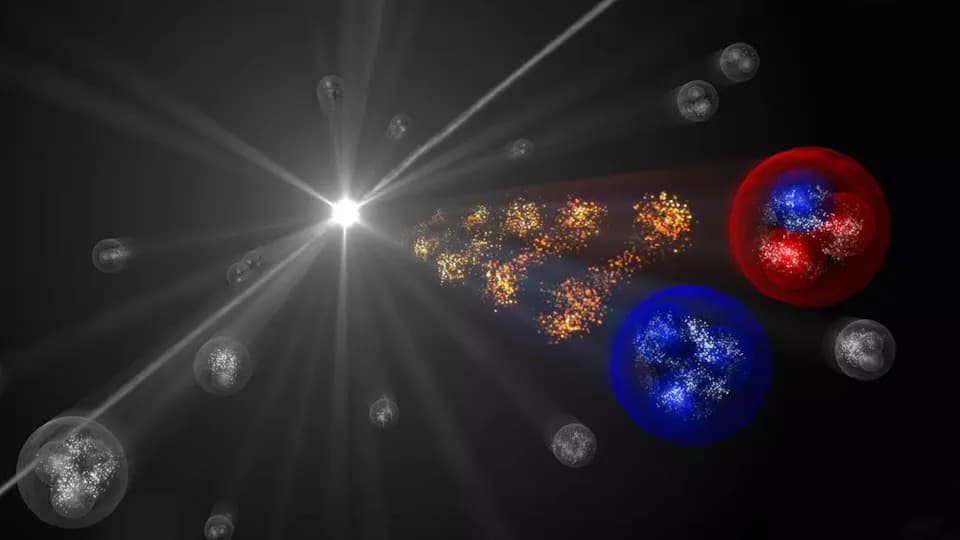
A illutsration of particle annhilation creating antimatter in then form of antihelium. | Credit: CERN
Recent results from CERN’s ALPHA‑g experiment strengthen a simple but profound idea: antimatter falls toward Earth, not away from it. By producing, trapping and laser‑cooling neutral antihydrogen atoms, researchers watched how these antiatoms escaped a magnetic trap and found a clear preference for the bottom of the apparatus — consistent with ordinary gravity.
Background
In 1971 astronaut David Scott echoed Galileo’s famous thought experiment on the Moon when he dropped a hammer and a feather; in the lunar vacuum they struck the surface together, illustrating the weak equivalence principle that underpins Einstein’s general relativity. Antimatter — first predicted by Paul Dirac in the 1920s when his relativistic quantum equation produced solutions interpreted as particles and their oppositely charged partners — offers a sensitive test of whether gravity truly treats all forms of matter the same.
How the ALPHA‑g Experiment Worked
The experimenters produced neutral antihydrogen atoms by combining antiprotons with positrons. Neutral antiatoms are far less affected by stray electric fields, so they provide a cleaner probe of gravity. The team confined roughly 100 antihydrogen atoms in a magnetic confinement device (a Penning/magnetic trap), then used laser cooling to slow their motion to temperatures close to absolute zero.
In a controlled sequence the magnetic fields were ramped down and the researchers monitored where escaping antiatoms annihilated on the chamber walls. Sophisticated detectors and careful background rejection (to remove signals from cosmic rays and other noise) allowed the team to determine whether atoms preferentially exited through the top or bottom of the apparatus.
Results And Significance
After filtering background events, about 80% of the detected annihilations came from antiatoms exiting through the bottom of the trap. In plain terms: antimatter fell down. This result supports the weak equivalence principle and shows no evidence that antihydrogen is gravitationally repelled by Earth.
Important caveats remain. The experiment establishes the direction of the fall but does not yet measure the gravitational acceleration of antimatter with high precision. A difference of order 1% or larger between the acceleration of antimatter and ordinary matter would be a clear sign of new physics, but current results are not yet sensitive to such a small discrepancy.
ALPHA‑g’s findings are an important early milestone: they close a speculative loophole that antimatter might ‘fall up,’ and they pave the way for follow‑up measurements that aim to pin down the acceleration of antihydrogen to much higher precision.
Help us improve.