The Dark Energy Survey’s latest data release combined four observational probes—Type Ia supernovae, galaxy and cluster counts, weak lensing, and BAO—to produce measurements that are more than twice as precise as earlier analyses. The results align more closely with the ΛCDM model but do not exclude wCDM. The team also confirmed a persistent tension in the amplitude and pattern of galaxy clustering compared with early-universe predictions. Upcoming data from the Vera C. Rubin Observatory will further test and refine these results.
Four Complementary Probes from DES Sharpen Constraints on Dark Energy
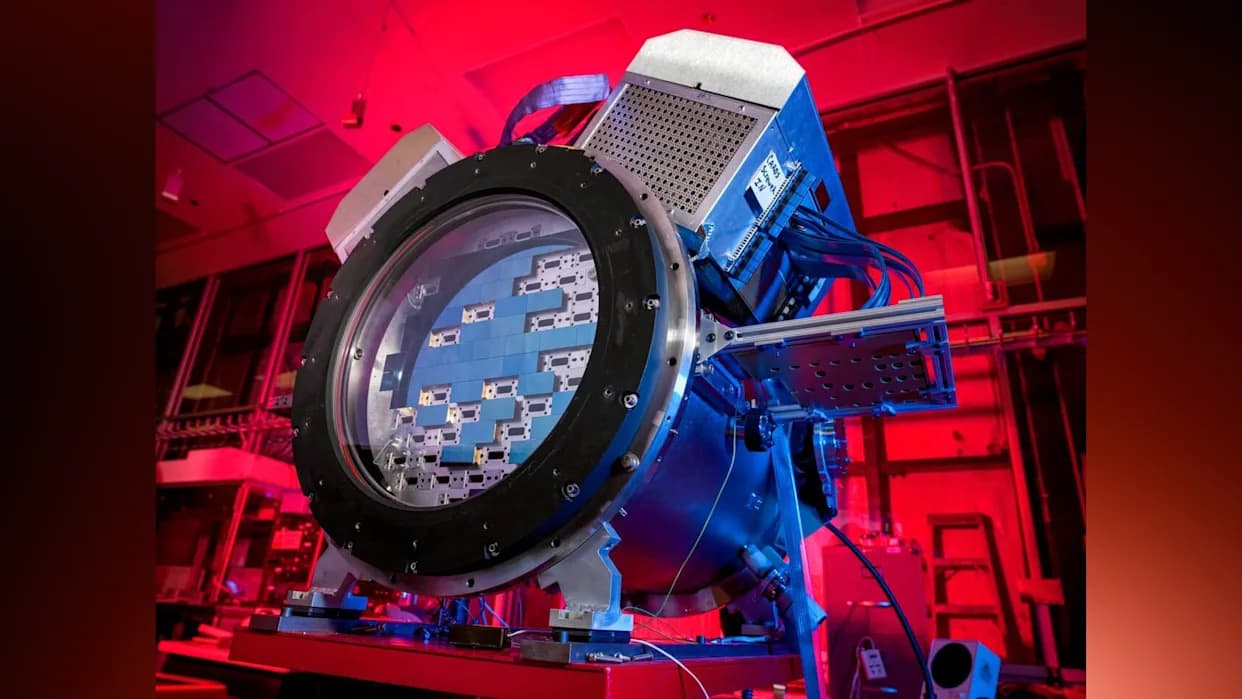
DECam is just one of the methods this study used to help reveal the nature of space itself. (Credit: DOE/FNAL/DECam/R. Hahn/CTIO/NOIRLab/NSF/AURA)
The Dark Energy Survey (DES), now in its sixth year, released a new dataset that allowed researchers to combine four independent observational techniques to produce significantly tighter measurements of dark energy than before.
What the Team Combined
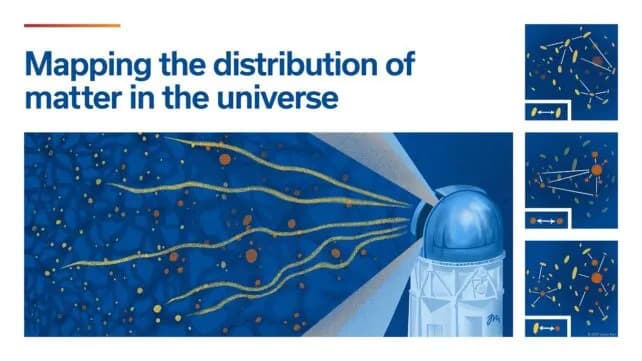
DES merged results from four complementary probes: Type Ia supernovae, optical surveys of galaxy and galaxy-cluster distributions, weak gravitational lensing that maps mass via the distortion of background galaxies, and baryon acoustic oscillation (BAO) signatures imprinted on the cosmic matter distribution. Much of the imaging came from the Dark Energy Camera (DECam), an instrument built and operated with key contributions from Fermilab (Credit: Fermilab).
Main Findings
The joint analysis produces measurements that are more precise than previous single-probe or smaller combined studies. The new constraints are reported to be better than a twofold improvement over earlier DES results, and the combined data are more closely aligned with the predictions of the standard ΛCDM (Lambda Cold Dark Matter) model. However, the alternative wCDM model—where dark energy can evolve in time—is not ruled out by this analysis.
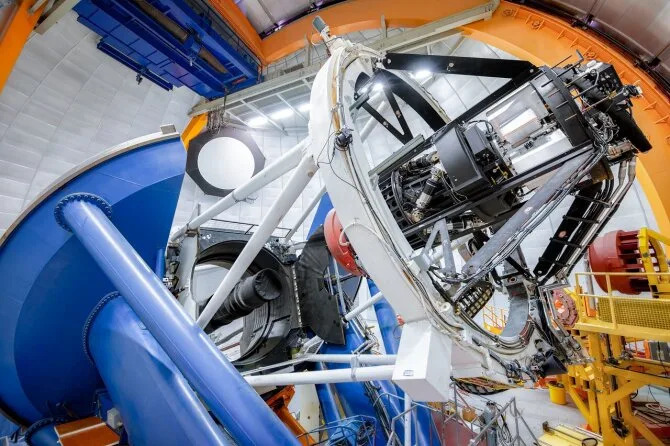
DECam photo
Persistent Tension
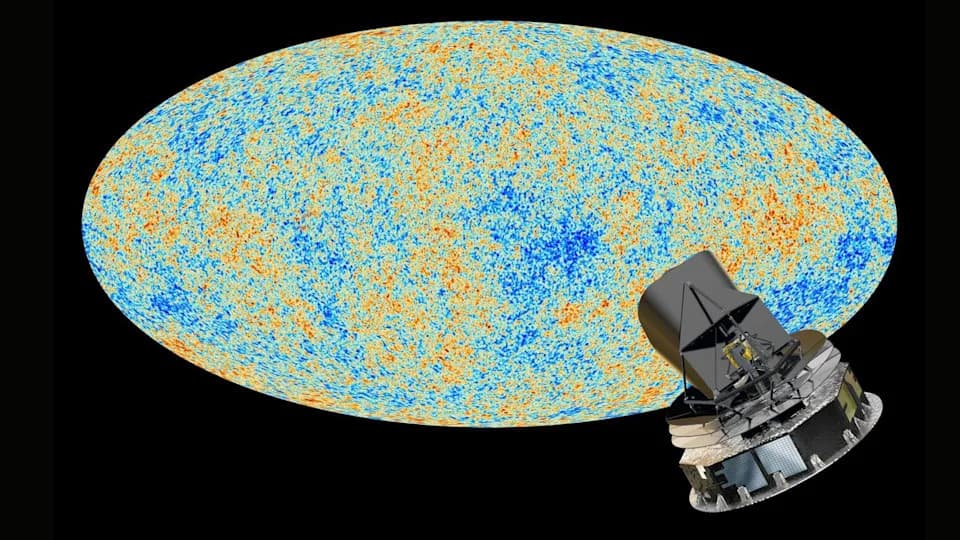
While tightening parameter ranges, the collaboration also confirms a long-standing tension between predictions based on the early universe and the observed clustering of matter in the late universe. In other words, the amplitude and pattern of galaxy clustering measured today differ from the values extrapolated from early-universe observations under both ΛCDM and wCDM, a discrepancy often discussed in terms of the clustering amplitude (S8) tension.
Looking Ahead
DES’s combined approach fulfills a core goal that motivated the survey: robust multi-probe cross-checking to reduce systematic uncertainties. Future imaging from the Vera C. Rubin Observatory (whose Legacy Survey of Space and Time, LSST, is expected to reconstruct images of tens of billions of galaxies) will provide far deeper, wider datasets. Those next-generation observations should sharpen parameter estimates further and either narrow the space of viable dark energy models or point toward new physics or modeling refinements.
Bottom line: DES’s multi-probe analysis significantly tightens constraints on dark energy and favors ΛCDM more strongly than before, but important discrepancies in galaxy clustering remain and will be prime targets for upcoming surveys.
Help us improve.