Researchers at the University of Sheffield report evidence that dark matter may weakly interact with neutrinos, a possibility that would challenge the standard Lambda Cold Dark Matter (LCDM) model. Combined observations from the Dark Energy Camera, Sloan Digital Sky Survey, ACT, and ESA's Planck show the present universe is slightly less clumpy than LCDM predicts. The team argues that tiny momentum exchanges between neutrinos and dark matter could resolve this mismatch; future CMB and gravitational lensing data can test the idea.
Could Dark Matter Interact With 'Ghost Particles'? New Study Finds a Weak Signal
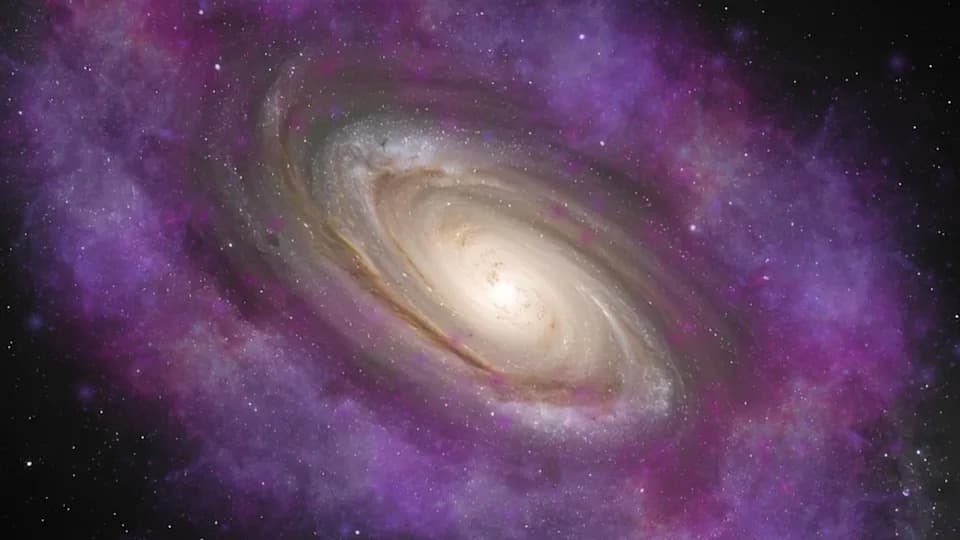
An illustration showing a halo of dark matter around a spiral galaxy. | Credit: Robert Lea (created with Canva)
New research from a team at the University of Sheffield presents evidence that dark matter may interact weakly with neutrinos — the nearly massless, chargeless "ghost particles" that stream through the cosmos. If confirmed, this subtle interaction would challenge the standard Lambda Cold Dark Matter (LCDM) framework and could help explain a persistent mismatch between early- and late-time cosmological measurements.
What Are Neutrinos And Dark Matter?
Neutrinos are extremely light, neutral particles that travel close to the speed of light and rarely interact with ordinary matter: roughly 100 trillion neutrinos pass through your body every second with no effect. Dark matter is similarly elusive: it makes up about 85% of the universe's matter but has been detected only through its gravitational influence on galaxies and light.
What The Study Found
Using a combination of modern datasets, the researchers find a mild preference for a tiny exchange of momentum between dark matter and neutrinos. Under the LCDM model, dark matter and neutrinos evolve independently and do not interact; introducing a weak interaction can reduce the predicted growth of cosmic structure and produce a slightly less "clumpy" late-time universe — which is what the data appear to show.
Data And Methods
The study combines multiple complementary observations: large-scale galaxy surveys from the Dark Energy Camera on the Victor M. Blanco Telescope and the Sloan Digital Sky Survey, plus precise measurements of the early universe from the Atacama Cosmology Telescope (ACT) and the European Space Agency's Planck satellite. By confronting these datasets with cosmological models that allow for dark matter–neutrino interactions, the team identifies parameter ranges where the models better match the observed reduced clumpiness of matter today.
Why This Matters
If neutrinos and dark matter do interact, even very weakly, it would be a major result for both cosmology and particle physics. Such interactions would alter how galaxies and clusters form over time and offer a concrete direction for laboratory searches aiming to reveal the particle nature of dark matter.
“Our results address a long-standing puzzle in cosmology. Measurements of the early universe predict that cosmic structures should have grown more strongly over time than what we observe today,” said Eleonora Di Valentino of the University of Sheffield. “This tension does not mean the standard cosmological model is wrong, but it may suggest that it is incomplete.”
“If this interaction between dark matter and neutrinos is confirmed, it would be a fundamental breakthrough,” said William Giarè of the University of Hawaii. “It would not only shed new light on a persistent mismatch between different cosmological probes, but also provide particle physicists with a concrete direction.”
Next Steps
The hypothesis can be further tested with upcoming high-precision measurements. Future analyses of the Cosmic Microwave Background (CMB) could reveal subtle signatures of coupling between dark matter and neutrinos. Precise gravitational lensing surveys — which map how mass bends light — can also help distinguish interacting from non-interacting scenarios by better measuring the distribution of ordinary and dark matter across cosmic time.
The team's paper was published on Jan. 2 in the journal Nature Astronomy. The result is suggestive but not yet definitive: additional data and independent analyses will be needed to confirm or refute the hypothesis.
Help us improve.