New research proposes that dark matter could have been created at relativistic speeds during the post-inflationary reheating phase and later cooled to act like cold dark matter. This challenges the standard Lambda Cold Dark Matter (LCDM) picture and reopens the possibility that low-mass neutrinos or similar particles might be viable candidates. The team plans accelerator experiments and cosmological searches to test the idea, which could illuminate the reheating era near the Big Bang.
Hot Dark Matter Could Rewrite the Cosmic Playbook — New Study Reopens the Neutrino Option

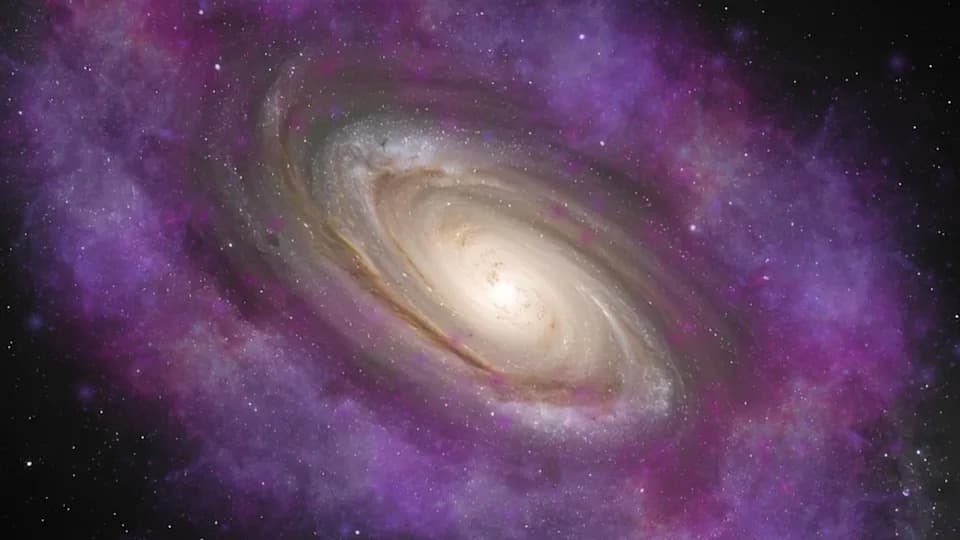
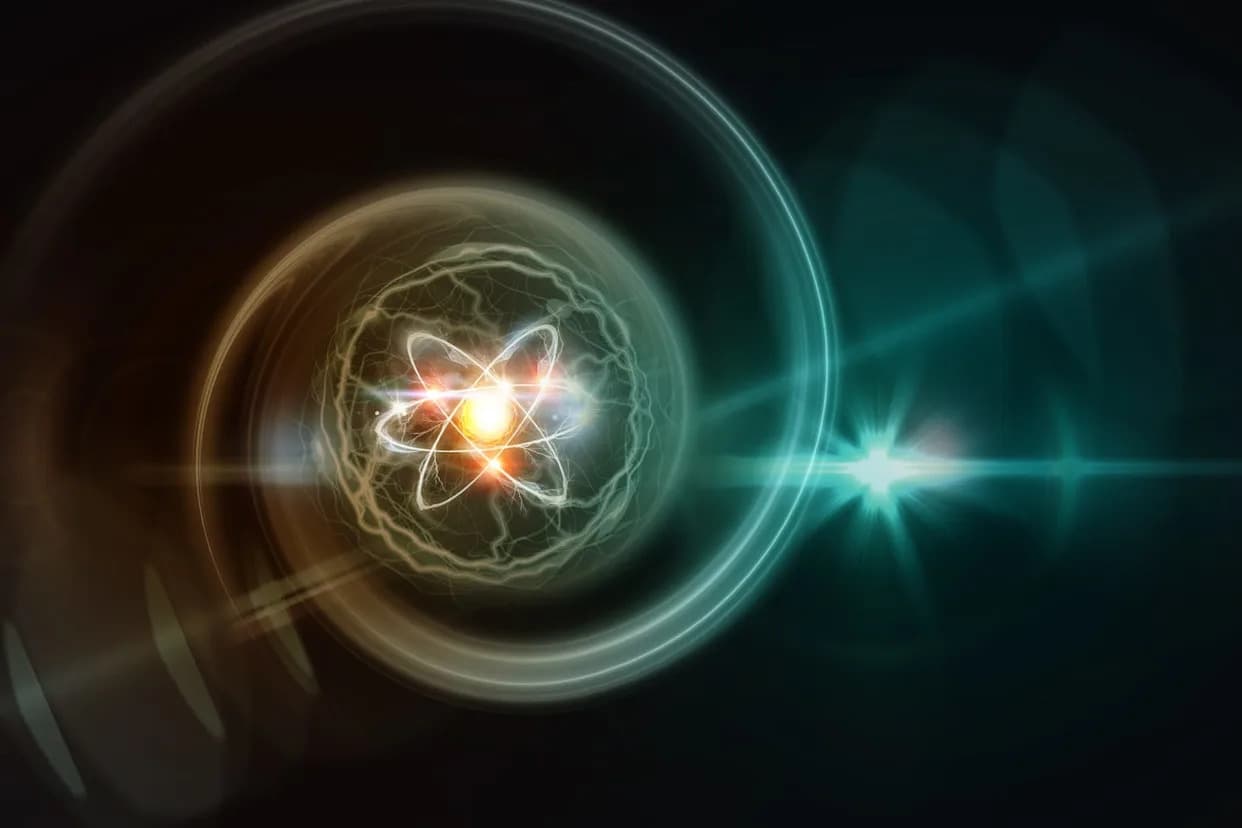
An illustration shows a spiral of hot dark matter spewing forward from the Big Bang . | Credit: Robert Lea (created with Canva)
New research suggests that dark matter — the unseen substance that outweighs ordinary matter by roughly five to one — might originally have been born extremely hot and moving at relativistic speeds. If confirmed, this idea would require revisions to the prevailing Lambda Cold Dark Matter (LCDM) framework and reshape our picture of how cosmic structure formed.
Dark matter is invisible because it does not interact with electromagnetic radiation: it neither emits nor absorbs light. That rules out ordinary atoms and has driven decades of searches for particle candidates beyond the Standard Model of particle physics. Until now, most models have favored "cold" dark matter, meaning particles that are non-relativistic (move much slower than light) by the time they influence galaxy formation.
The new study proposes an alternative origin. Dark matter particles could have been produced at very high energies and near-light speeds during the post-inflationary reheating era — the moment when the inflation field decayed and converted its energy into a hot, dense bath of radiation and particles — and then decoupled from ordinary matter while still relativistic.
"Dark matter is famously enigmatic. One of the few things we know about it is that it needs to be cold," said Stephen Henrich of the University of Minnesota's School of Physics and Astronomy. "For the past four decades, most researchers have believed that dark matter must be cold when it is born in the primordial universe. Our recent results show that this is not the case; in fact, dark matter can be red hot when it is born but still have time to cool down before galaxies begin to form."
If decoupling occurred during reheating, the particles would then have a long cosmological interval in which to cool and slow down, eventually becoming non-relativistic in time to seed galaxy formation. In that way, dark matter produced "hot" could later behave like conventional cold dark matter by creating the gravitational potential wells that gather ordinary matter and allow galaxies to assemble.
This scenario also reopens interest in one of the earliest dark matter candidates: low-mass neutrinos. Neutrinos were largely dismissed about four decades ago because, as relativistic particles, they were thought to erase structure on galactic scales. But if such particles were produced during reheating and then cooled sufficiently before structure formation, they could still play the role of dark matter under this mechanism.
"The neutrino became the prime example of hot dark matter, where structure formation relies on cold dark matter," said Keith Olive, also of the University of Minnesota. "It is amazing that a similar candidate, if produced just as the hot Big Bang universe was being created, could have cooled to the point where it would, in fact, act as cold dark matter."
The team plans to test the idea both experimentally and observationally: with high-energy particle-accelerator experiments on Earth and with cosmological searches for signatures from the early universe. Confirming this pathway would not only reveal more about the nature of dark matter but could also shed light on the poorly understood reheating era, a crucial chapter close to the Big Bang.
"With our new findings, we may be able to access a period in the history of the universe very close to the Big Bang," said Yann Mambrini of Université Paris-Saclay.
The study was published in November in Physical Review Letters.
Help us improve.