The Sun's extreme temperatures ionize atoms (strip electrons) but do not destroy atomic nuclei; nuclear transformations require much harsher conditions and occur mainly in the core. The star's enormous gravity (≈28× Earth's surface gravity) balances the outward pressure from hot gas and radiation, keeping the Sun stable. Compositionally, the Sun is ~70% hydrogen, ~28% helium and ~2% heavier elements (≈1% oxygen, ~0.3% carbon). Solar wind removes 1–2 million tons per second, an Earth-mass about every 150 million years, which is negligible relative to the Sun's mass.
How the Sun Keeps Oxygen, Carbon and Other Elements Despite Its Extreme Heat
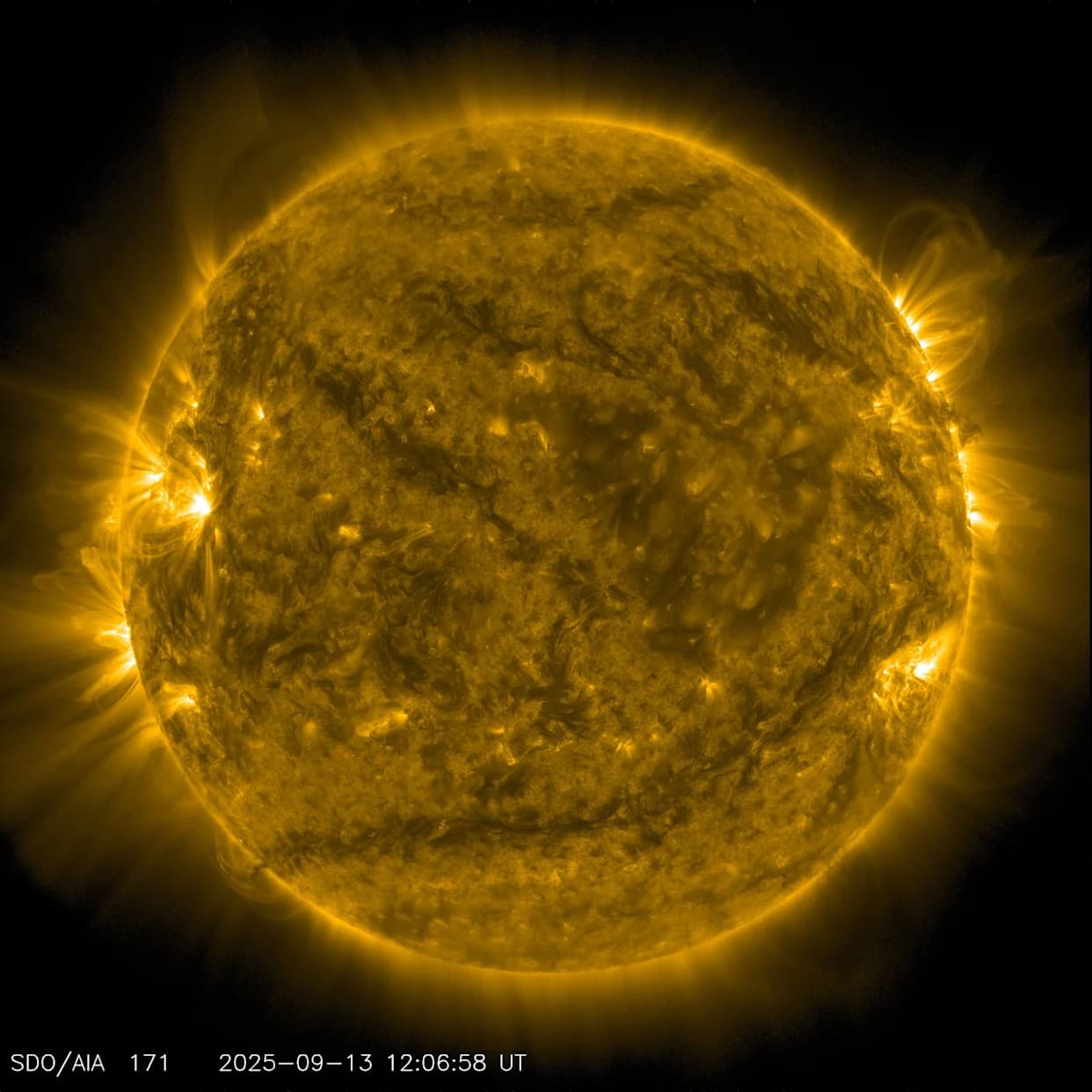
Question: Since the Sun is extremely hot, how can it still contain elements such as oxygen and carbon without those elements being destroyed? — Bob Found, Indian Harbour, Nova Scotia
If you heat a cloud of gas to temperatures like the Sun's surface (about 5,500 °C / ~10,000 °F) or its core (about 15 million °C / ~27 million °F), atoms lose their electrons and the gas wants to expand. That ionization and tendency to blow apart might sound like it would "destroy" heavier elements, but two key facts explain why the Sun still contains oxygen, carbon and other elements.
Ionization Versus Destruction
At solar temperatures, atoms are typically ionized — their electrons are stripped away — but the atomic nuclei (protons and neutrons) remain intact. Ionization changes how atoms behave electrically and chemically, but it does not break nuclei into different elements. Nuclear reactions that change one element into another require far more extreme conditions (or energetic collisions) than ordinary thermal ionization; in the Sun, significant nuclear fusion happens only in the very center, where conditions are right for hydrogen to fuse into helium.
Gravity Keeps the Sun Together
The Sun isn't a light puff of gas; it's enormously massive. Surface gravity on the Sun is roughly 28 times that on Earth, creating a powerful inward pull. The star remains stable because gravity pulling matter inward is balanced by outward pressure from hot gas and radiation. This tug-of-war — hydrostatic equilibrium — prevents the ionized gas from simply flying apart, allowing the Sun to retain its material for billions of years.
What the Sun Is Made Of
By mass, the Sun is about 70% hydrogen and 28% helium. The remaining ~2% are heavier elements (called "metals" in astronomy) — roughly 1% oxygen, ~0.3% carbon, and trace amounts of elements heavier than carbon. These heavier elements are largely leftovers from earlier generations of stars and supernovae and are carried into the Sun when the solar system formed.
Mass Loss: Solar Wind and Ejections
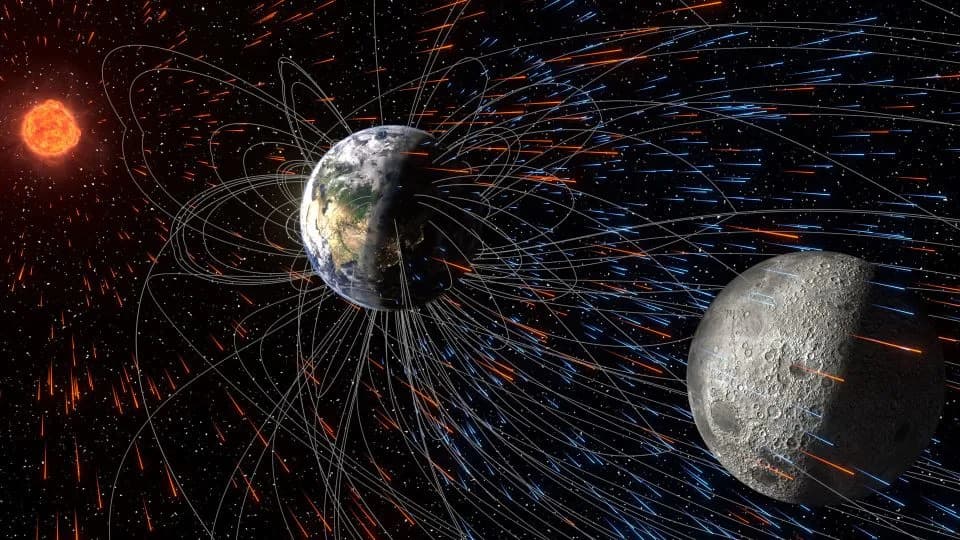
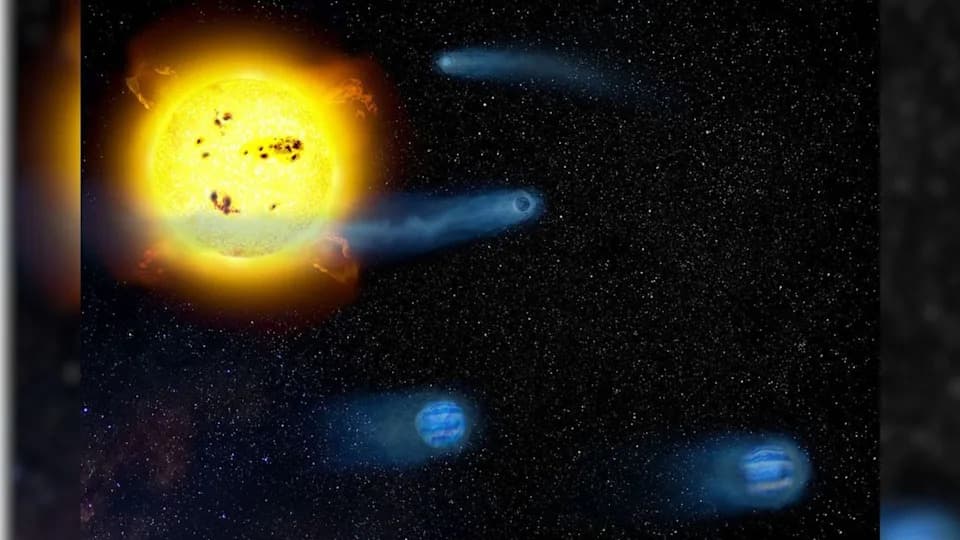
The Sun does lose material via the solar wind and occasional coronal mass ejections. Twisted magnetic fields accelerate charged particles so they can escape the Sun's gravity. The solar wind removes an estimated 1–2 million tons of mass per second — about an Earth's mass every ~150 million years — which is negligible compared with the Sun's total mass (more than 333,000 times Earth's mass).
Bottom line: The Sun's heat ionizes atoms and makes gas pressure strong, but its immense gravity and internal pressure balance prevent the star from blowing itself apart. Ionization strips electrons but does not destroy atomic nuclei, and nuclear changes of elements occur only under the Sun's extreme core conditions.
— Paul Sutter, Cosmologist, Johns Hopkins University, Baltimore, Maryland
Help us improve.