The Sun does rotate, but there is no single rotation period. Early observers like Galileo and Carrington tracked sunspots and found apparent synodic periods around 27–28 days as seen from Earth. Correcting for Earth’s motion gives sidereal rates: about 24.5 days at the equator and ~25.4 days near 30° latitude, while polar regions take about 34 days or more. Rotation also varies with depth — the radiative zone turns in ~26.6 days — and the core’s rate remains uncertain.
How Long Does the Sun Take To Rotate? The Surprising, Layered Answer
The sun's rotation rate varies by latitude and depth. The colors represent the rotation rate at each location on the sun. Red represents the slowest rotation and blue, the fastest. | Credit: NASA/Goddard Space Flight Center Scientific Visualization Studio
Many bodies in space spin. Earth turns once in about 24 hours, Venus requires roughly 243 Earth days for a single rotation, and the Moon rotates in about 27 days. The Sun also rotates, but the period depends on where on the Sun you measure and from which vantage point in space you observe it.
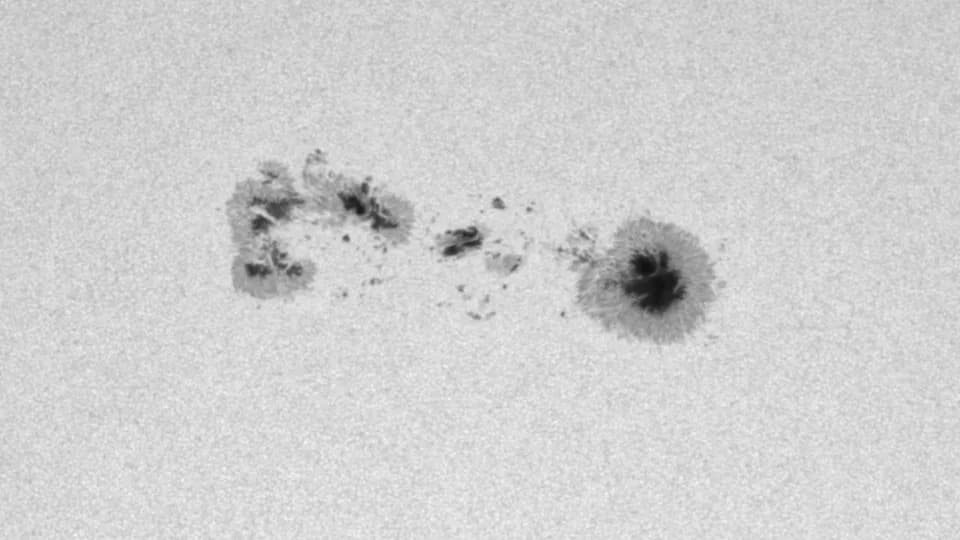
In 1612, Galileo Galilei used a telescope to sketch sunspots and noticed they drifted across the solar surface. By tracking those dark features he concluded the Sun was rotating and estimated a rotation period of roughly 28 days, according to solar physicist J. Todd Hoeksema of Stanford University.
Centuries later, English astronomer Richard Carrington made similar measurements with improved instruments. He tracked sunspot motion near about 30° solar latitude — the region where spots are most common — and calculated that these features would take about 27.3 days to circle the Sun. Because most sunspots last only a week or two, observers map their positions over several days to infer the Sun’s rotation.

The words 'Life Little Mysteries' over a blue background
Synodic vs. Sidereal: Observations from Earth introduce a complication. Earth orbits the Sun in the same direction the Sun rotates, so the Sun’s apparent rotation measured from Earth (the synodic rotation) is slower than the rotation relative to the distant stars (the sidereal rotation). Carrington’s 27.3-day figure is synodic and includes nearly two extra days due to Earth’s motion. The corresponding sidereal period at Carrington’s latitude is about 25.4 days.
Modern techniques go beyond visual spot-tracking. From the 1970s onward, researchers have used helioseismology (the study of sound waves traveling inside the Sun) and Doppler-shift measurements of sunlight to map rotation across different latitudes and depths. These methods reveal a much richer picture than a single rotation number.
Differential Rotation: The Sun is a gaseous ball, so it does not rotate like a rigid body. Instead, its rotation varies with latitude and depth — a behavior called differential rotation. Combining observations, scientists find that the Sun spins fastest at the equator and slowest at the poles:
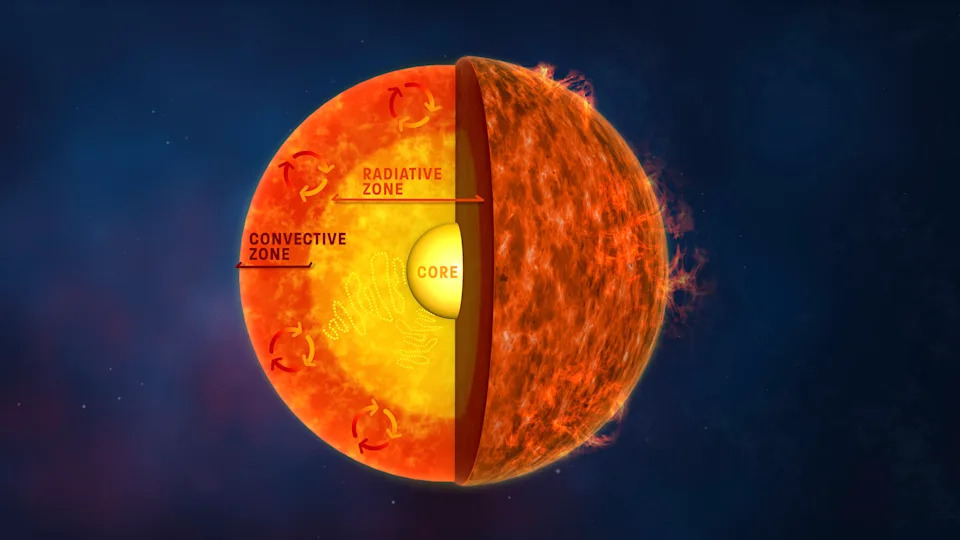
The sun's rotation rate varies by depth and latitude in its convection zone (also known as the convective zone), but its rotation is always the same in its radiative zone. | Credit: TUMEGGY/SCIENCE PHOTO LIBRARY via Getty Images
- Equator (sidereal): about 24.5 days
- Mid-latitudes (≈30°) — Carrington region (sidereal): about 25.4 days
- Poles: about 34 days or more
These latitude-dependent differences persist from the visible surface down through the convection zone (the outer third of the Sun by radius). Rotation also changes with depth: the deeper radiative zone (below the convection zone and above the core) rotates more uniformly, at about 26.6 days, largely independent of latitude.
The rotation rate of the solar core remains uncertain because current observations do not probe it well. Determining the core’s spin is an active area for future research.
In short: there is no single rotation period for the Sun. It depends on latitude, depth and whether you measure from Earth or against the stars.
Understanding solar rotation is important because it helps drive the Sun’s magnetic activity, sunspot cycles and space weather that affect Earth.
Help us improve.