The Norwegian People’s Aid report finds fallout from more than 2,400 nuclear tests (1945–2017) has contributed to at least four million premature deaths worldwide. Atmospheric testing alone is projected to cause about two million excess cancer deaths and a similar number of cardiovascular deaths over time. The report highlights secrecy, inadequate healthcare and weak compensation for affected communities, and calls on nuclear-armed states to disclose information, assist victims and remediate contaminated sites.
They Poisoned Us: The Lasting, Deadly Legacy of Nuclear Weapons Testing
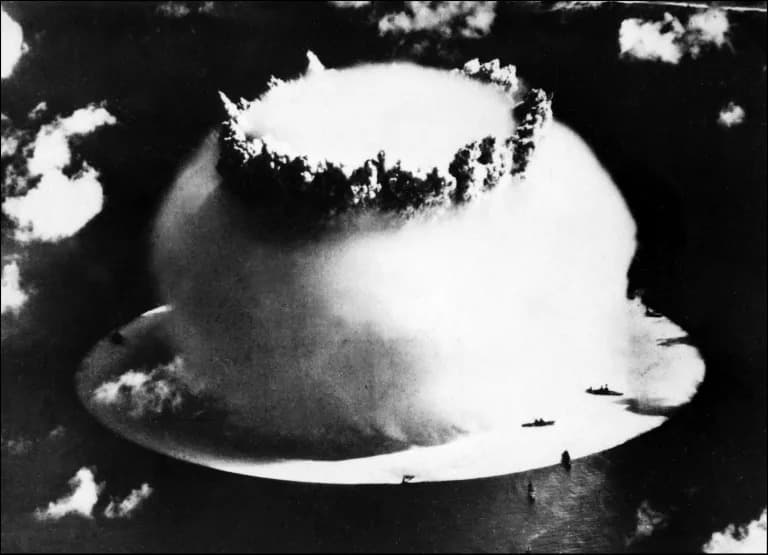
The US military conducted nuclear tests on Bikini Atoll in the Pacific Ocean in July 1946 (-)(-/US Defense Nuclear Agency/AFP)
A major new report from Norwegian People’s Aid (NPA), shared exclusively with AFP, documents how fallout from more than 2,400 nuclear tests between 1945 and 2017 continues to damage human health, ecosystems and communities worldwide. The report links past testing to millions of premature deaths and highlights persistent secrecy, inadequate compensation and gaps in health care for affected populations.
Key Findings
Scope and scale: More than 2,400 nuclear devices were detonated in tests from 1945 to 2017. Atmospheric testing — largely concluded by 1980 — deposited radioactive isotopes globally; every person alive today carries some of these isotopes in their bones.
Health impacts: The NPA report concludes that fallout has contributed to at least four million premature deaths from cancer and other illnesses over time. Atmospheric tests alone are projected to cause at least two million excess cancer deaths, with a similar number of additional early deaths from cardiovascular causes such as heart attacks and strokes. Evidence links ionising radiation to DNA damage, cancers, cardiovascular disease and genetic effects even at low doses; fetuses and young children are especially vulnerable.
Uneven burden: Communities near test sites — often located in 15 countries and including many former colonies of nuclear powers — carry the heaviest burden. Survivors face elevated rates of illness, congenital anomalies and psychological trauma. Notable examples include 193 French tests in French Polynesia between 1966 and 1996 (the largest roughly 200 times the Hiroshima bomb) and the 15-megaton Bravo test at Bikini Atoll in 1954, which devastated local islands and exposed nearby communities to severe fallout.
Secrecy, Neglect and Accountability
The report documents a culture of secrecy around testing programs: classified studies in Kiribati, undisclosed French burial sites for radioactive waste in Algeria, and limited or defensive compensation schemes that often appear intended to limit liability rather than genuinely help victims. None of the nuclear-armed states has issued a full apology for testing. Local communities frequently lack adequate healthcare, screening and risk education.
Voices of Survivors and Experts
'They poisoned us,' said Hinamoeura Cross, a Tahitian parliamentarian who was seven when France carried out its last test near French Polynesia in 1996 and later developed leukaemia.
Report contributors and experts warn that the effects of testing are long-lasting and under-recognised. 'Past nuclear testing continues to kill today,' said NPA chief Raymond Johansen. Public health experts highlight that 'there is no level below which there are no effects' from ionising radiation, and that women and girls face higher susceptibility to some radiation-induced cancers.
Calls to Action
The NPA urges nuclear-armed states to take responsibility: to disclose data, assess needs, provide meaningful support and remediate contaminated environments. Survivors and advocates demand transparency, healthcare and acknowledgement so communities can begin to heal.
What readers should know: The humanitarian consequences of testing are global, intergenerational and still unfolding. The report presses policymakers to recognise those harms and act to prevent future testing and address past damage.
Help us improve.