As New START nears expiry on February 5, the United States and Russia have not begun talks on a successor, leaving the future of bilateral nuclear limits uncertain. President Vladimir Putin has proposed a 12‑month extension of the treaty's 1,550‑warhead cap per side; Washington has not responded formally, and analysts are split. Critics warn an extension without stronger verification could let Russia develop systems outside the treaty and weaken leverage with China. Experts urge immediate risk‑reduction measures — notably restoring robust crisis communications — while longer, more complex arms‑control talks are pursued.
Last U.S.-Russia Nuclear Treaty Nears Expiry — What Comes Next?
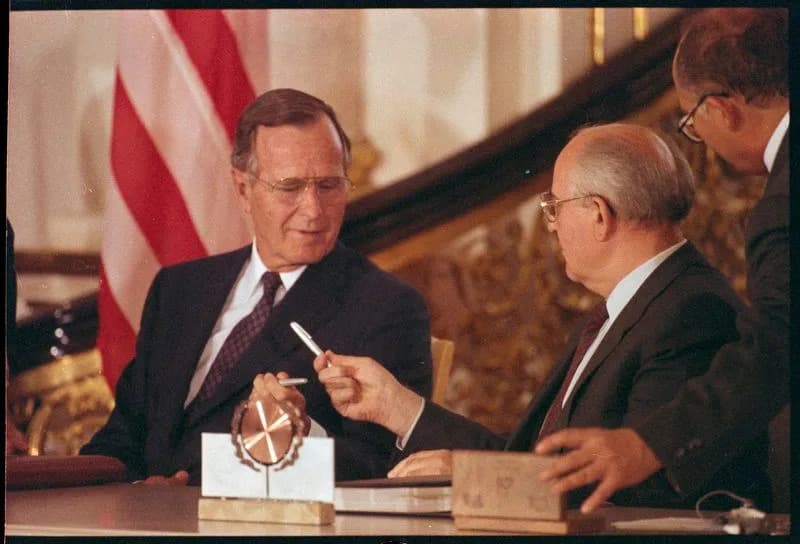
FILE PHOTO: US President George Bush and Soviet President Mikhail Gorbachev exchange pens after signing the START treaty. July 31, 1991 REUTERS/Mal Langsdon DISCLAIMER: The image is presented in its original, uncropped, and untoned state. Due to the age and historical nature of the image, we recommend verifying all associated metadata, which was transferred from the index stored by the Bettmann Archives, and may be truncated./File Photo
Even at the height of the Cold War, Washington and Moscow negotiated arms-control pacts to prevent their nuclear rivalry from spiralling out of control. From 1969 and long after the Soviet Union's collapse in 1991, leaders in both capitals saw value in talks that created a more stable, predictable framework to limit strategic arsenals.
Now the final remaining U.S.-Russia arms treaty, New START, is weeks away from lapsing on February 5. With both countries focused on the war in Ukraine, there have been no negotiations on a replacement, and the treaty's future is uncertain.
What Putin Has Proposed
In September, Russian President Vladimir Putin proposed that both sides agree to adhere to New START's limits for another 12 months. The treaty caps deployed strategic nuclear warheads at 1,550 for each side. The U.S. administration under President Donald Trump has not issued a formal reply, and analysts are divided about whether an extension is wise.
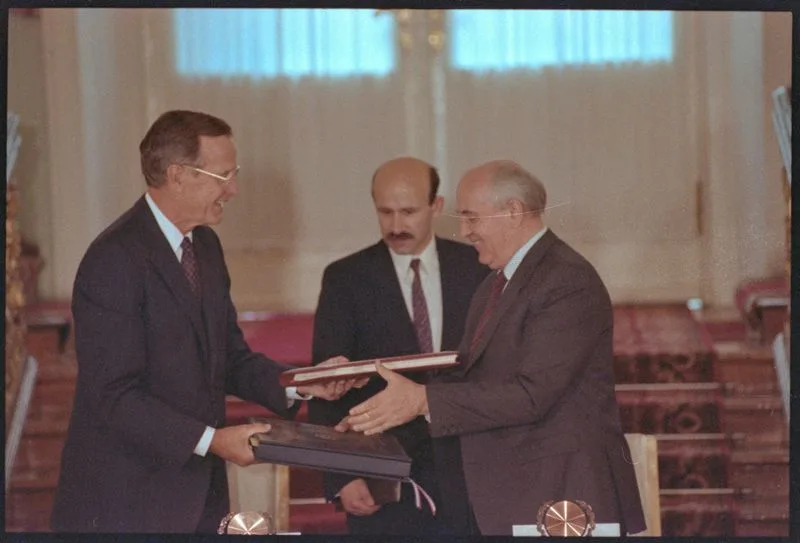
FILE PHOTO: US President George Bush and Soviet President Mikhail Gorbachev exchange documents after signing the START arms reduction treaty. July 31, 1991 REUTERS/Larry Rubenstein DISCLAIMER: The image is presented in its original, uncropped, and untoned state. Due to the age and historical nature of the image, we recommend verifying all associated metadata, which was transferred from the index stored by the Bettmann Archives, and may be truncated./File Photo
Arguments For and Against a Short Extension
Supporters of a brief extension argue it would buy time to chart a path forward and signal that both powers want to preserve at least a remnant of bilateral arms control. Critics say a short hold could allow Russia to continue developing new weapons systems that fall outside New START's verification regime — notably the Burevestnik nuclear-powered cruise missile and the Poseidon nuclear-capable autonomous torpedo.
Former U.S. defence planner Greg Weaver has warned that Russia declined mutual inspections since 2023 that would reassure Washington about compliance. Weaver also argued that accepting a simple extension without addressing verification and broader strategic trends could send China the signal that the United States will not respond to Beijing's rapid nuclear build-up, potentially undermining efforts to bring China to the negotiating table.
Global Nuclear Balance
Russia and the United States still possess the vast majority of the world's nuclear warheads. The Federation of American Scientists estimates Russian and U.S. inventories at about 5,459 and 5,177 warheads respectively — together nearly 87% of the global total. China has accelerated its programme and is estimated to hold roughly 600 warheads today, with U.S. officials projecting it could exceed 1,000 by 2030.
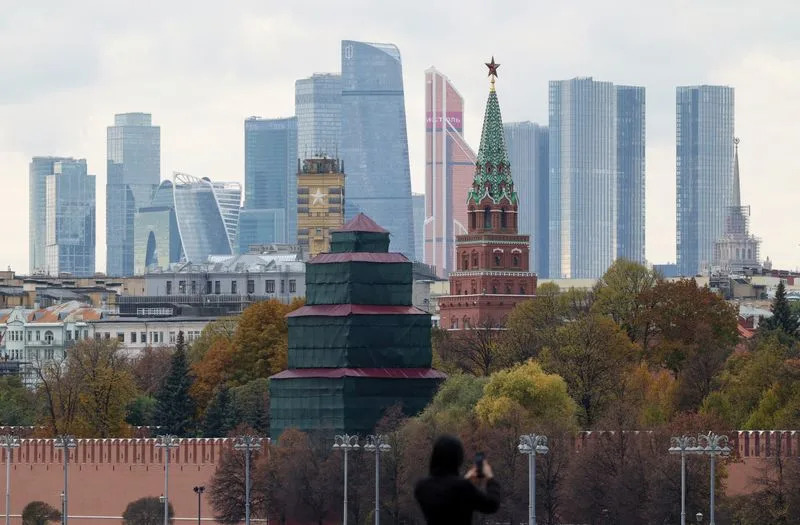
FILE PHOTO: A pedestrian uses a mobile phone while standing on a bridge near the Kremlin wall, with the skyscrapers of the Moscow International Business Centre, also known as Moskva-City, visible in the distance in Moscow, Russia, October 23, 2025. REUTERS/Ramil Sitdikov/File Photo
Multilateral Challenges And Practical Steps
Calls for three-way talks including China face steep political and technical hurdles: Beijing has rejected joining trilateral disarmament negotiations, calling the demand unreasonable given the much larger U.S. and Russian arsenals. Russia has also suggested bringing Britain and France into negotiations, a proposal those governments reject.
Nikolai Sokov, a former Soviet and Russian arms negotiator and senior fellow at the Vienna Center for Disarmament and Non‑Proliferation, said attempts to forge a broad multilateral treaty under current conditions are "almost a dead end" and would take a very long time. He advised prioritising faster, pragmatic risk‑reduction measures.
Sokov proposed one bilateral option: negotiate a New START successor with flexible warhead limits that reflect China’s growing arsenal. But he emphasised that the most immediate priority should be simple, tangible risk‑reduction and confidence‑building steps — for example, restoring or expanding reliable crisis communications. Currently, only Moscow and Washington maintain a 24/7 hotline dedicated to nuclear crises; no European capital or even NATO headquarters has a permanent direct line to Moscow.
As New START approaches expiry, policymakers face a difficult trade-off: accept a short extension to preserve predictability while addressing verification gaps and new weapons, or press for deeper, more complex agreements that will take time. In the near term, experts argue, practical measures to reduce the risk of accidental or unintended escalation should take precedence while diplomatic options are explored.
(Reporting by Mark Trevelyan; editing adapted from the original Reuters piece.)
Help us improve.