
NASA launched the first science balloon of its 2025 Antarctic campaign, carrying the General AntiParticle Spectrometer (GAPS) to about 120,000 feet from the Ross Ice Shelf near McMurdo Station. During the austral summer, stable winds and near-constant daylight allow long-duration flights that can last days to weeks. GAPS will search cosmic rays for rare antimatter nuclei — antideuterons, antiprotons and antihelium — any confirmed antideuteron could offer important clues about dark matter.
NASA Launches Antarctic Balloon Carrying GAPS to Hunt Rare Antimatter

NASA's new science balloon launched from Antarctica. . | Credit: NASA/Andy Hamilton
NASA has launched the first science balloon of its 2025 Antarctic Long-Duration Balloon campaign, lofting the General AntiParticle Spectrometer (GAPS) to stratospheric altitudes to search for rare antimatter nuclei.
The balloon lifted off from the Ross Ice Shelf near the U.S. National Science Foundation's McMurdo Station at 5:30 a.m. NZST on Tuesday, Dec. 16 (11:30 a.m. Monday, Dec. 15 U.S. Eastern Time). Once aloft, the vehicle reached a float altitude of roughly 120,000 feet (about 36 kilometers), placing the payload well above most of Earth's atmosphere.
Why Antarctica?
Antarctica's austral summer provides near-continuous daylight and stable polar wind patterns that can keep balloons aloft for extended durations. Operating from the Ross Ice Shelf launch site allows payloads to circle the continent on long-duration flights, giving experiments days to weeks of uninterrupted observations.
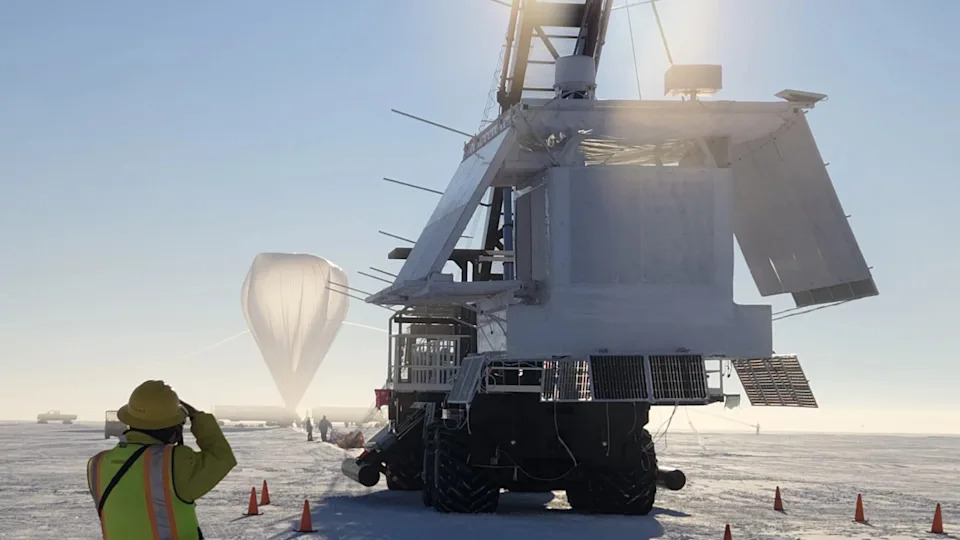
A massive payload (the GAPS instrument gondola) is suspended from a crane in the foreground while the balloon is set up in the background. | Credit: NASA/Andy Hamilton
About GAPS
The payload, GAPS (General AntiParticle Spectrometer), is designed to search cosmic rays for rare antimatter nuclei — specifically antideuterons, antiprotons and antihelium. To date, clear detections of antideuterons or antihelium in cosmic rays remain elusive. A confirmed antideuteron detection would be a major discovery because such a signal could provide crucial clues about dark matter, the invisible substance thought to make up most of the universe's mass.
GAPS combines a time-of-flight system to measure particle velocity with a dedicated tracker that records interactions when incoming antiparticles slow and annihilate inside the detector. These combined measurements help distinguish rare antimatter signals from the far more common cosmic-ray background.
Mission Outlook
With the balloon now floating near 120,000 feet above Antarctica, the GAPS team will collect data over the coming days and weeks as the instrument rides polar winds around the continent. The mission aims to improve our understanding of antimatter in cosmic rays and to search for potential indirect signatures of dark matter.
Photograph: The accompanying image was taken near the Rubilotta area close to the launch site on the Ross Ice Shelf.
You can learn more about antimatter and dark matter through NASA and partner science resources as GAPS begins its observations.


