Researchers used decades of optical and radar observations of asteroid Bennu, augmented by OSIRIS-REx radiometric data, to search for tiny anomalies that might indicate a hypothetical fifth fundamental force or ultralight dark matter. The analysis, published in Nature Communications Physics, found no evidence of such a force affecting Bennu and set new limits on possible interactions. Scientists hope upcoming observations — particularly of asteroid Apophis during its 2029 Earth flyby and data from proposed follow-up missions like OSIRIS-APEX — will provide even tighter constraints or the first hint of new physics.
Scientists Narrow Search for a Possible Fifth Force Using Precise Asteroid Tracking

Could Asteroids Help Us Find the Fifth Force?NASA - Getty Images
Physicists long have speculated that a fifth fundamental force beyond the four in the Standard Model might explain persistent observational anomalies. An international team has used decades of precise tracking data for the near-Earth asteroid Bennu to test that idea and place limits on interactions that could signal ultralight dark matter or new bosons.
Why a Fifth Force Matters
According to the Standard Model and general relativity, four fundamental forces govern known physics: gravity, electromagnetism, the strong nuclear force, and the weak nuclear force. Still, several puzzles in cosmology and particle physics have motivated proposals for additional interactions, often framed as a possible fifth force or as new, ultralight particles that would mediate subtle long-range effects.
How Asteroids Can Help
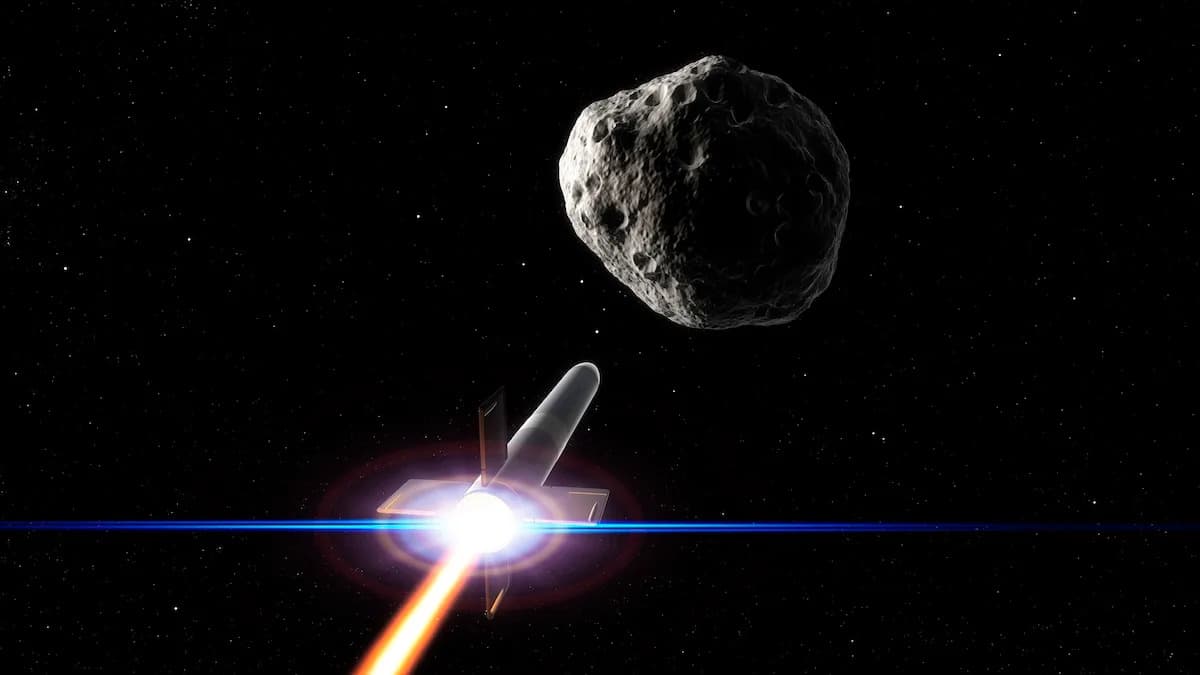
Tracking the motions of well-observed asteroids offers a nonlaboratory way to search for tiny deviations from predicted trajectories that might arise from unknown forces. Bennu is an ideal test case: discovered in 1999, it has been followed with high-precision optical and radar astrometry for decades, and the OSIRIS-REx mission added X-band radiometric and refined optical navigation data that significantly tightened constraints on its path.
The Bennu Study
An international team analyzed Bennu's trajectory to look for anomalies consistent with a fifth force or the influence of ultralight dark matter. Their work, published in Nature Communications Physics, compared the exceptionally precise observational record to detailed orbital models and searched for residual accelerations that cannot be explained by known forces or non-gravitational effects.
“Interpreting the data we see from tracking Bennu has the potential to add to our understanding of the theoretical underpinnings of the universe, potentially revamping our understanding of the Standard Model of physics, gravity and dark matter,” said lead author Yu-Dai Tsai. “The trajectories of objects often feature anomalies that can be useful in discovering new physics.”
Results and What Comes Next
The analysis found no evidence for a fifth force acting on Bennu at the level the data could probe, allowing the team to place new constraints on the strength and range of hypothetical interactions. The researchers note that follow-up observations of other asteroids could tighten those limits further.
In particular, a proposed follow-up mission, OSIRIS-APEX, aims to study the near-Earth asteroid Apophis, which will make a notably close approach to Earth in 2029. That flyby will present an opportunity for even more sensitive trajectory measurements and could either further restrict or, if nature surprises us, reveal tiny anomalies worth investigating.
“These results highlight the potential for asteroid tracking as a valuable tool in the search for ultralight bosons, dark matter, and several well-motivated extensions of the Standard Model,” said co-author Sunny Vagnozzi of the University of Trento.
Perspective
Using orbital anomalies to discover new physics has historical precedent: small deviations in Uranus's motion helped lead to Neptune's discovery. But the approach also carries risks—the long-sought planet Vulcan, proposed to explain Mercury's perihelion advance, was later shown not to exist once a better theory (general relativity) accounted for the effect. The Bennu study adds important constraints and demonstrates that precision asteroid tracking complements laboratory and accelerator searches as scientists continue to probe the deepest questions about forces and dark matter.
Help us improve.