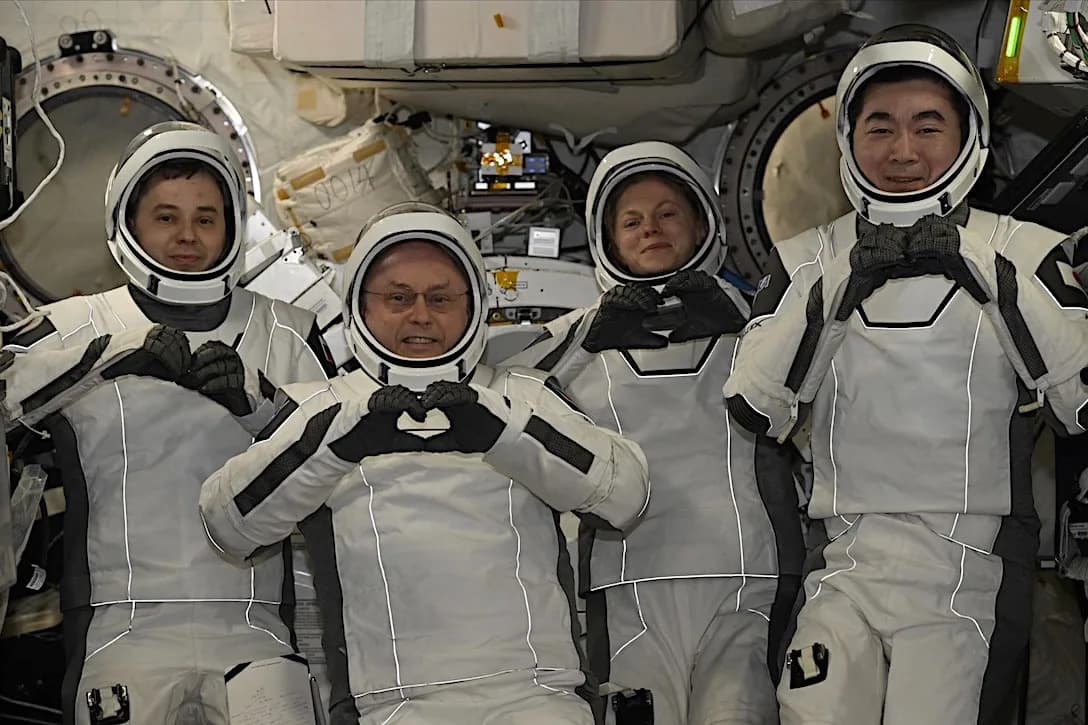
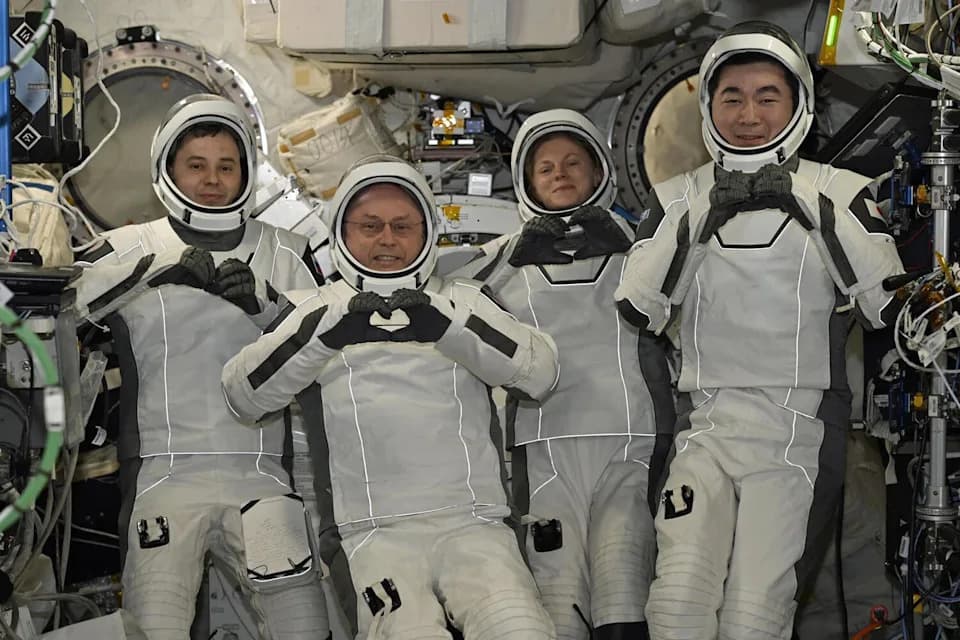
New PNAS research shows that during spaceflight astronauts’ brains shift upward and backward inside the skull, with sensory and motor regions most affected. MRI scans of 26 astronauts were compared with 24 volunteers in a six-degree head-down tilt bed-rest control; shifts correlated with mission duration, and longer missions produced larger effects. Many changes largely recovered within six months, but some deformations persisted for a subset of crew members. Researchers call for more study to determine long-term consequences and prepare for longer Moon and Mars missions.
Study Finds Astronauts’ Brains Shift Upward and Backward During Spaceflight — Some Changes Persist
Researchers found that the brain "shifts upward and backward within the skull following spaceflight," a new wrinkle for future space travel.
Researchers are increasingly documenting how long stays in microgravity affect astronaut health. In addition to well-known issues such as accelerated bone loss and vision changes, a new international study published in the Proceedings of the National Academy of Sciences (PNAS) shows that the brain itself can move and deform inside the skull during spaceflight.
Key Findings
The study analyzed MRI scans from 26 astronauts and compared them with scans from 24 volunteers who participated in a six-degree head-down tilt bed-rest study (a ground-based analog that simulates some effects of microgravity). Investigators report that spaceflight causes the brain to shift both upward and backward within the skull, with sensory and motor regions showing the largest displacements. The magnitude of displacement correlated with mission duration: longer missions produced larger shifts.
Although many changes largely recovered within six months after return to Earth, a subset of astronauts showed deformations that persisted beyond that period. Participants in the bed-rest control showed backward shifts but far less upward displacement than astronauts, suggesting that true microgravity produces stronger effects than head-down bed rest alone.
Study Details and Symptoms
The observed shifts were small in absolute terms — on the order of a few millimeters — but the researchers note these are meaningful when it comes to brain position and anatomy. Astronauts who spent longer stretches in orbit (including year-long missions) tended to have greater difficulty regaining balance after landing, consistent with the regions most affected being involved in sensory and motor function.
“The people who went for a year showed the largest changes,” said coauthor Rachael Seidler, professor of physiology and kinesiology at the University of Florida. “There were still some changes evident in people who went for two weeks, but duration seems to be the driving factor.”
Surprisingly, the team did not observe widespread, persistent headaches or clear cognitive decline tied to these shifts, either during missions or after return. Nevertheless, the functional consequences beyond transient disorientation remain unclear.
Limitations and Next Steps
Researchers stress several limitations: modest sample sizes, variability across individuals, and incomplete understanding of the mechanisms behind the displacements and deformations. More research is needed to map how specific brain regions are affected, whether structural changes affect function over the long term, and how different gravity levels (Moon, Mars) might alter recovery timelines.
“The health and human performance implications of these spaceflight-associated brain displacements and deformations require further study to pave the way for safer human space exploration,” the authors write.
Why It Matters
As space agencies and commercial operators plan longer missions and trips to the Moon and Mars, understanding how microgravity reshapes the brain will be crucial for protecting crew health and designing effective countermeasures. As Mark Rosenberg, assistant professor of neurology at the Medical University of South Carolina (not involved in the study), noted: If crews spend prolonged time in reduced gravity environments, recovery times and health impacts may scale in ways we don't yet understand.
These findings arrive amid ongoing astronaut health concerns — for example, a recent NASA decision to evacuate an astronaut from the International Space Station for an unspecified medical issue — underscoring why continued research into spaceflight effects on the body and brain is essential.
Help us improve.