The article argues that Iran is at a critical juncture: broad protests, harsh repression and external pressure have exposed an unsustainable trajectory. Supreme Leader Ali Khamenei and the IRGC anchor a parallel political and economic system that blocks major reforms. While a democratic transition seems unlikely for now, Khamenei’s eventual departure could create a narrow window for pragmatic reforms to stabilize the country.
Iran at a Crossroads: Khamenei, the IRGC and the Narrow Window for Reform
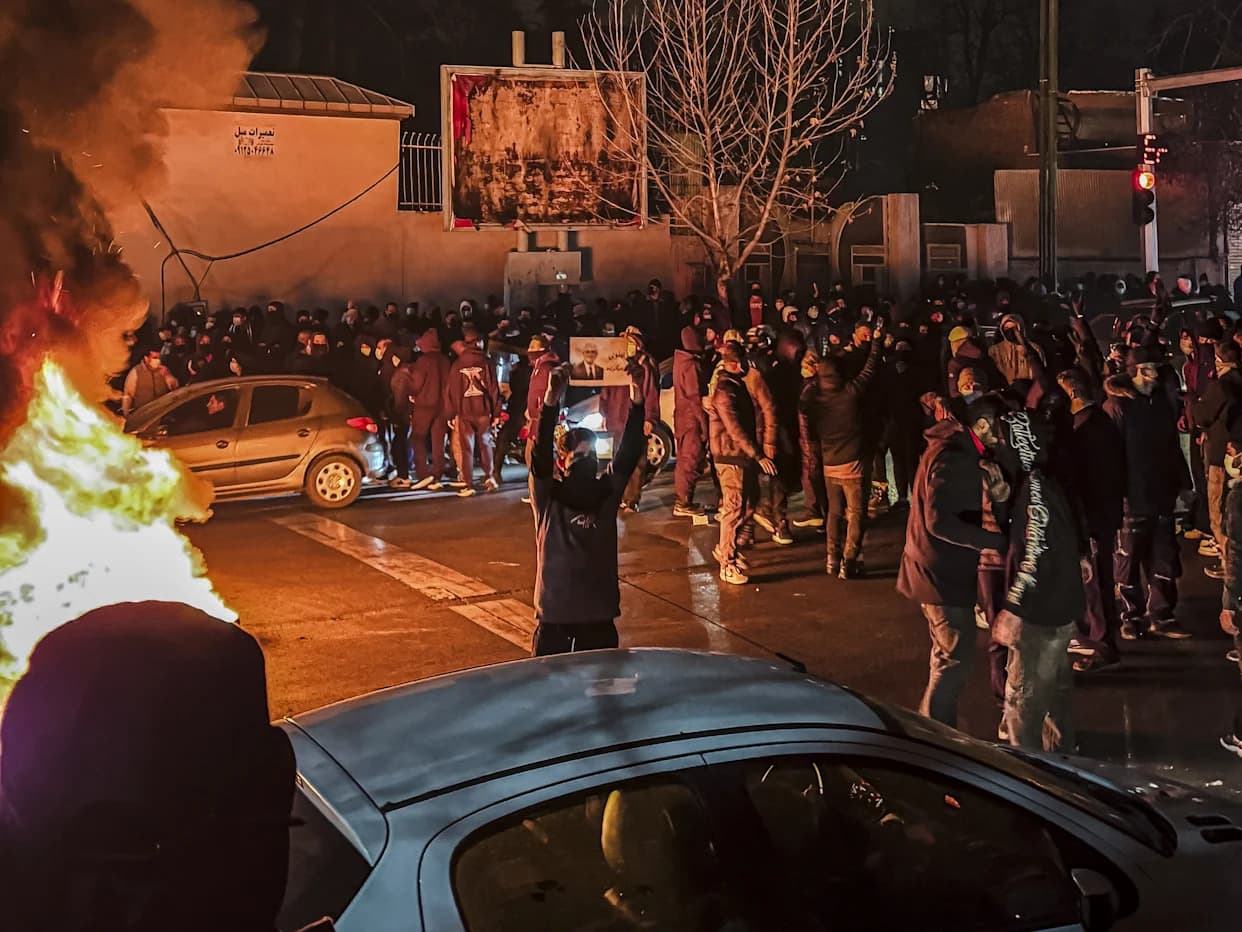
Iranians blocking a street during a protest in Tehran, Iran, on January 9, 2026. | MAHSA/Middle East Images/AFP via Getty Images
Iran’s government stands at a decisive moment. Sustained domestic protests, a violent state response and growing external pressure together mark a turning point in the Islamic Republic’s recent history. Unless leaders change course, a slow economic unraveling combined with increasing reliance on repression could consign the system to a protracted, damaging decline.
Why the Regime Is Under Strain
The protests reflect deep economic grievances and broad social frustration. The state’s brutal crackdown has weakened the government’s legitimacy while failing to extinguish dissent. International options for decisive intervention remain limited, and the opposition—passionate but fragmented—lacks a unified plan to seize power. These conditions make rapid, externally driven regime change unlikely.
Khamenei’s Parallel System
At the center of the regime’s resilience is Supreme Leader Ali Khamenei, now in his mid-80s. More than a titular head, Khamenei has constructed and sustained a parallel political and economic order. Through the bayt-e rahbari (the Office of the Supreme Leader) he has directed patronage into foundations and enterprises that operate alongside and often above the formal state economy.
Out of that network the Islamic Revolutionary Guard Corps (IRGC) has expanded from a revolutionary guard into a powerful military-industrial conglomerate. The IRGC is distinct from the regular army (the Artesh): it is better resourced, politically influential and embedded in media, energy, construction and other sectors. Those ties help explain Khamenei’s enduring leverage over Iran’s political class.
Why Reform Is Difficult Today
Several obstacles block an immediate shift. The security services have shown willingness to use lethal force; many elite actors prefer to preserve the system that benefits them; and the Guardian Council and other institutions limit political competition. Khamenei resists concessions he considers existential threats: he has opposed direct talks with the United States, insisted on preserving nuclear-enrichment rights, and maintained support for regional proxies such as Hezbollah—actions that many analysts say impose financial and strategic costs on Iran.
Possible Paths Forward
A fully democratic transformation under the Islamic Republic looks unlikely in the near term, but history shows that authoritarian systems can sometimes pursue pragmatic course corrections to survive. Examples include China under Deng Xiaoping, South Korea’s economic and political opening in the 1980s, and Gulf monarchies’ post-Arab Spring adjustments to deliver social and economic benefits.
Khamenei’s advanced age means a transition in the supreme leadership is increasingly probable. If that succession is managed smoothly and elite actors perceive reform as the best way to preserve their interests, a narrow window could open for pragmatic domestic and foreign-policy adjustments aimed at stabilizing the country and relieving economic pressure.
Risks Remain
There is no guarantee elites will choose moderation. A faction that doubles down on repression could push Iran deeper into crisis. The outcome will depend on elite calculations, the balance between coercion and concession, and whether a successor dynamic permits even limited reforms.
Conclusion: Iran faces an urgent choice between intensified repression and cautious, pragmatic reform. The most plausible opening for meaningful change may come after a managed transition at the top—if Iran’s powerful networks decide their survival depends on adaptation rather than further coercion.
Help us improve.