New at-home tests and oral treatments for common STIs have received FDA clearance, offering faster, more private screening and new options for treating gonorrhea. Visby Medical’s three-in-one at-home test provides results to an app and a telehealth consult, often within hours, while two oral drugs for gonorrhea expand treatment choices after decades without new options. CDC provisional 2024 data show declines in several STIs, but experts warn that high costs, potential gaps in surveillance and cuts to public health funding could limit access.
At-Home STD Tests and New Oral Drugs Expand Screening and Treatment Options
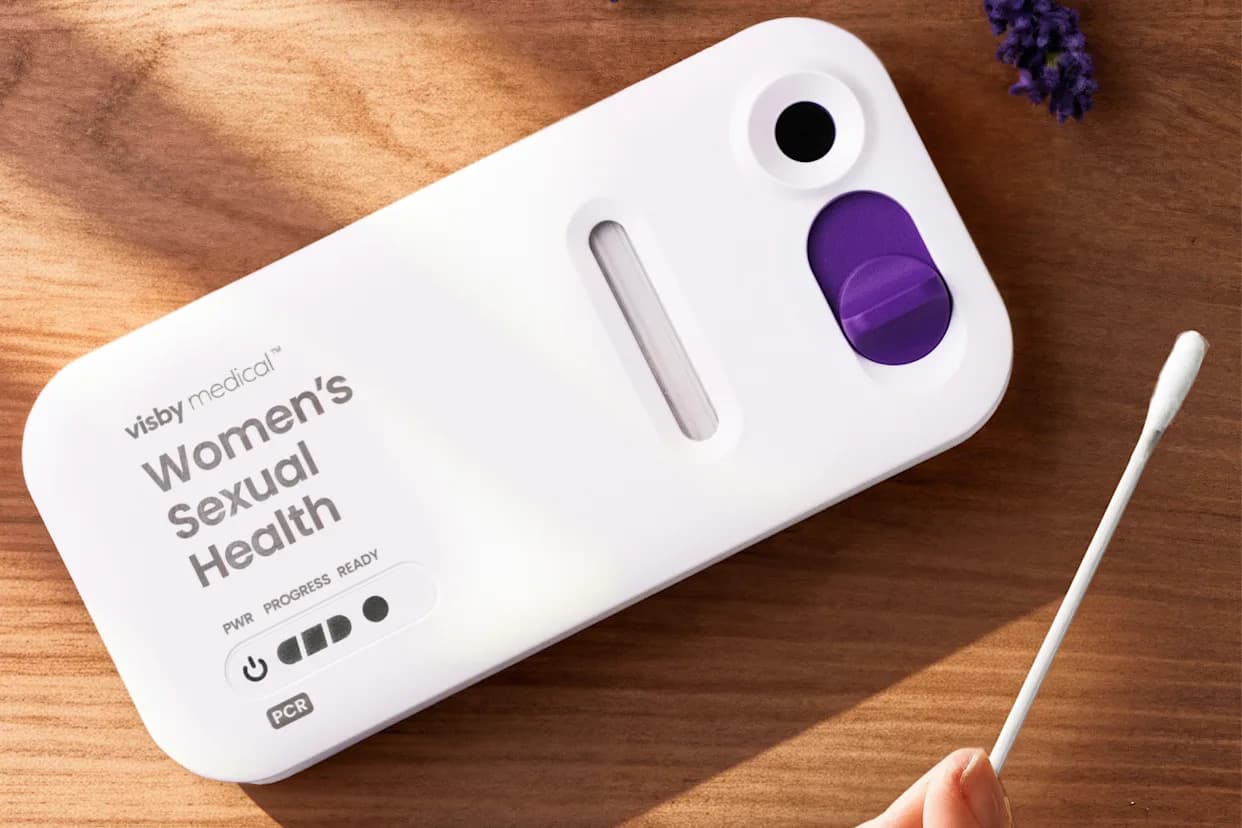
This photo provided by Visby Medical in January 2026 shows its three-in-one gonorrhea, chlamydia and trichomoniasis test for women. (Visby Medical via AP)
New at-home testing and treatment options for several of the most common sexually transmitted infections (STIs) are becoming widely available in the United States, a development public health experts say could help sustain recent declines in infection rates while also raising important access and surveillance questions.
Faster, More Private Testing
Last year the Food and Drug Administration (FDA) approved the first over-the-counter, at-home test that detects three common infections in women — gonorrhea, chlamydia and trichomoniasis — and also cleared the first home-based kit for human papillomavirus (HPV), the virus linked to cervical cancer.
Visby Medical launched the three-in-one, urine-based kit after FDA clearance in March. The kit includes a vaginal swab and a small electronic reader that processes the sample and sends results to an online app. The company pairs the test with a telehealth consultation so a provider can discuss results and prescribe medication when needed. Visby says the whole process — from purchase to prescription — can take as little as six hours, compared with several days under traditional clinic-and-lab testing models.
“Sexual health can be stigmatized and people can be hesitant about testing,” said Dr. Ina Park, a sexual health specialist at the University of California, San Francisco. “Now we have a lot of options for patients who may be wary of going into a provider’s office.”
How Accurate Are Home Tests?
The FDA approved Visby’s device based on studies showing it detected the three infections with accuracy rates around 98% or higher — comparable to tests used in hospitals and health clinics. Some other at-home kits, such as Teal Health’s Teal Wand for HPV, rely on self-collection at home followed by shipment to a laboratory for processing. Updated federal screening guidelines recently endorsed self-collection for HPV screening for the first time.
New Oral Treatments For Gonorrhea
On the treatment front, the FDA approved two new oral drugs for gonorrhea — the first new treatment options for the disease in decades. The causative bacterium has repeatedly developed resistance to antibiotics, and the standard of care had long relied on an injectable antibiotic, ceftriaxone. The new oral agents (reported as Nuzolven and Bluejepa in filings) represent a meaningful change because they can be taken by mouth, broadening options for clinicians and patients.
Nuzolven was developed through a public-private partnership and is supplied as granules that dissolve in water; Bluejepa, from GlaxoSmithKline, is an oral tablet also approved for certain urinary tract infections. The availability of new oral options is seen as an important advance given the disease’s growing resistance to older drugs such as azithromycin.
Trends, Trade-Offs and Access Concerns
Provisional Centers for Disease Control and Prevention (CDC) data for 2024 show a third consecutive year of fewer gonorrhea cases and a second straight year of declines in adult chlamydia and the most infectious forms of syphilis. Experts credit several factors, including changes in sexual behavior among young people, increased use of post-exposure antibiotics in some contexts, and wider at-home screening.
At the same time, experts warn of trade-offs. As more testing moves out of centralized labs and into homes, public-health surveillance could become more fragmented, complicating national tracking of infection trends. New diagnostics and drugs also carry higher price tags: for example, Visby’s test retails at about $150 and may not be covered by insurance, which could limit access for low-income and uninsured populations. Compounding access concerns are recent federal funding cuts to the CDC and other public health agencies, which could reduce services for the people least able to afford new, direct-to-consumer options.
“I’m optimistic that people have more testing options and that we now have access to new drugs,” Park said. “What I fear is that cuts to public health are going to decrease access to sexual health care for populations who can least afford to take advantage of these new options.”
What to watch next: whether insurers and public programs expand coverage for at-home diagnostics and new oral treatments, how reporting systems adapt to at-home test results, and whether the new drugs remain effective as bacteria evolve.
The Associated Press Health and Science Department receives support from the Howard Hughes Medical Institute’s Department of Science Education and the Robert Wood Johnson Foundation. The AP is solely responsible for all content.
Help us improve.