
The Atacama Cosmology Telescope (2007–2022) has released its sixth and final public dataset and three companion papers. ACT’s high-resolution CMB polarization measurements confirm the persistent Hubble tension: early-universe probes favor a lower Hubble constant than local measurements. The team tested roughly 30 extended cosmological models and found none that resolve the discrepancy, narrowing the field of viable theoretical solutions.
ACT’s Final Data Confirms the Hubble Tension and Rules Out Many Fixes

A photograph of the Atacama Cosmology Telescope in Chile overlaid with a figure from its final data release. The figure shows the direction of magnetic polarization in microwaves from some of the earliest epochs of the universe. . | Credit: Princeton University (background), The Atacama Cosmology Telescope collaboration (boxout)
After 15 years of observations from the high plateaus of northern Chile, the Atacama Cosmology Telescope (ACT) closed operations in 2022. Its sixth and final public data release — accompanied by three papers in the Journal of Cosmology and Astroparticle Physics (JCAP) — cements ACT’s scientific legacy: a high-resolution portrait of the cosmic microwave background (CMB) that reinforces a major cosmological puzzle.
What ACT Measured
ACT first recorded microwaves from the infant universe in October 2007. Those microwaves are the CMB, the relic radiation emitted roughly 380,000 years after the Big Bang. While space missions such as the European Space Agency’s Planck satellite mapped the full sky, ACT’s ground-based design targeted much smaller patches at far higher angular resolution, especially excelling at measurements of the CMB’s polarization.
Why Polarization Matters
The polarization patterns of the CMB encode precise information about the universe’s contents and dynamics at early times. Changes in quantities such as the amount and distribution of dark matter, the effective number of neutrino species, or other early-universe physics leave distinct imprints on polarization. That makes high-fidelity polarization data a powerful probe for testing modifications to the standard cosmological model.
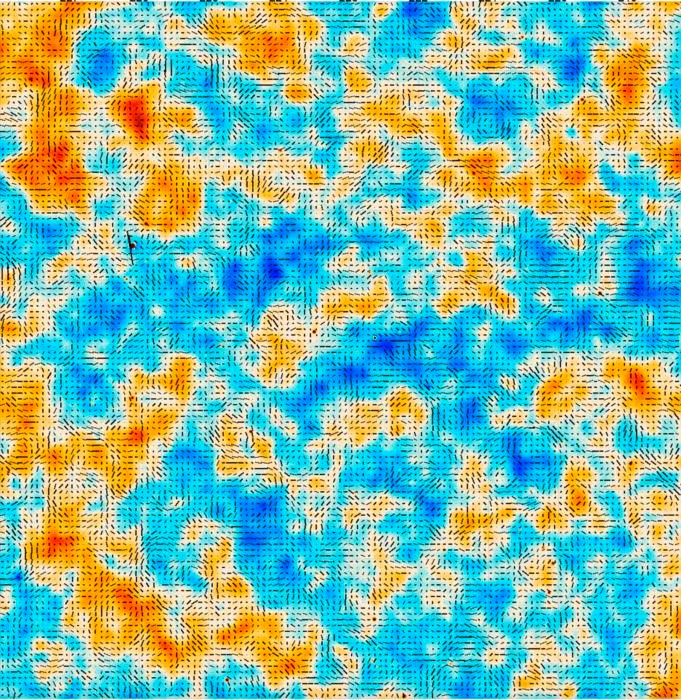
A map of microwave intensity (orange to blue) overlaid with the direction of magnetic polarization in those microwave emissions. Studying the cosmic microwave background (CMB) is helping astronomers fine tune measurements of the universe's expansion. | Credit: The Atacama Cosmology Telescope collaboration
Key Result: The Hubble Tension Persists
ACT’s final analyses agree with earlier CMB-based results: measurements derived from the early universe (Planck, ACT) prefer a lower Hubble constant (the present-day expansion rate) than direct, local measurements based on supernovae and other distance indicators. This discrepancy — the Hubble tension — remains one of modern cosmology’s most significant open problems.
Testing Proposed Solutions
The ACT team used its polarization and temperature data to confront roughly 30 “extended” cosmological models — theories that keep the standard framework but add extra fields, particles, or interactions to change early-universe physics. Because any new ingredient would have affected the CMB at recombination, these models leave testable signatures. ACT’s data disfavored or ruled out all of the tested extensions as viable solutions to the Hubble tension.
Negative results are progress. By eliminating many candidate explanations, ACT helps narrow the theoretical search and points researchers toward subtler or entirely different directions.
While the Hubble tension remains unresolved, ACT’s final data release provides a sharper constraint on what the solution can — and cannot — look like. The dataset will be mined further in the coming years, but for now it leaves the cosmology community with a clearer map of the remaining possibilities.


