A primary care physician associate recounts a patient who refused a chest X-ray to avoid a $3,000 deductible and later required ICU care for bilateral pneumonia. A 2025 Kaiser Family Foundation poll found up to 38% of insured adults skipped care because of cost, and 42% of those saw their conditions worsen. The Congressional Budget Office projects roughly 15 million could lose coverage by 2034, while millions more may shift to high-deductible plans — producing widespread "functional uninsurance" with serious public-health and economic consequences.
When Coverage Is Only On Paper: How High Deductibles Create 'Functional Uninsurance'
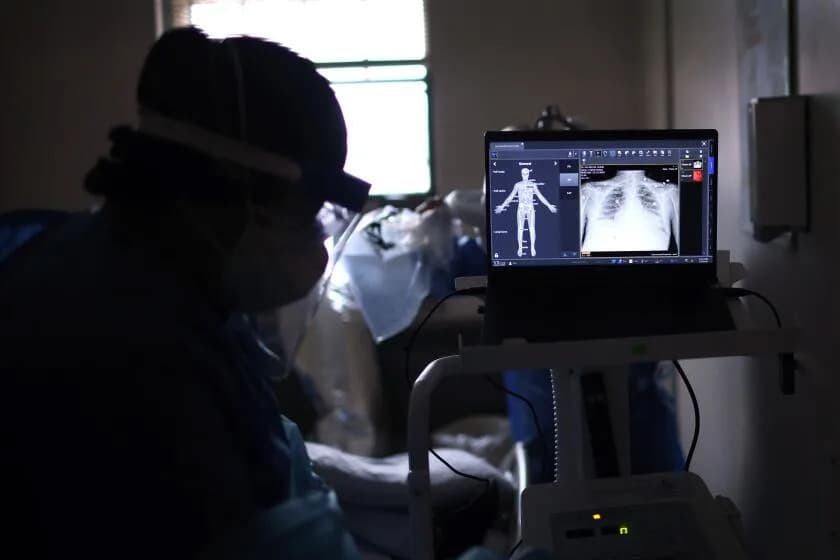
A chest X-ray is a simple diagnostic and generally affordable, unless a patient has to pay the full cost out of pocket.(Scott Olson / Getty Images)
I recently evaluated a patient with shortness of breath and a persistent cough. Concerned about possible pneumonia, I ordered a routine chest X-ray. He refused — he had not yet met his $3,000 deductible and feared paying most or all of the cost. He told me he would call if his condition worsened.
Five days later he lost that gamble and was admitted to the ICU with bilateral pneumonia. He survived, but what he saved by skipping the X-ray was eclipsed by a near-fatal hospitalization and a bill that could plausibly bankrupt him. He was fortunate not to become one of the roughly 55,000 Americans who die from pneumonia each year.
As a primary care physician associate working on the front lines, I see this pattern repeatedly. Clinicians are trained to treat biological threats — bacteria, viruses, genetics — but increasingly the largest barriers to health are financial and policy-driven. High-deductible health plans (HDHPs) often have lower monthly premiums, but they create incentives that discourage patients from seeking routine diagnostics, preventive care, and early treatment. Small, treatable problems can balloon into expensive, life-threatening emergencies.
“Skin in the game” sounds sensible in theory, but it fails at the patient’s bedside. A person gasping for air cannot comparison-shop for a lifesaving diagnostic, nor can most people judge the clinical urgency of symptoms without a clinician’s training.
Recent data underscore this reality. A 2025 poll from the Kaiser Family Foundation found that up to 38% of insured American adults reported skipping or postponing necessary health care or medications in the prior 12 months because of cost. Among those who delayed care, 42% said their health problem worsened as a result.
The outlook could get worse. The Congressional Budget Office projects roughly 15 million people could lose health coverage and become uninsured by 2034 because of cuts to Medicaid and Affordable Care Act marketplace subsidies. That estimate does not include the additional millions who might see their monthly premiums spike if premium tax credits expire; many of them could downgrade to "bronze" plans with very large deductibles to keep premiums affordable. The likely result: more people who are insured on paper but unable to use that insurance without financial devastation.
This phenomenon — which I call "functional uninsurance" — has human and economic consequences. Patients pay hundreds of dollars a month for a card they are afraid to use. They skip preventive visits, ignore suspicious symptoms, and ration essential medications like insulin. By the time they present for care, treatable conditions have often progressed to emergencies that are far more costly to the patient, the health system, and the economy.
Public spending on health care is not charity; it is an investment in a productive, resilient society. Failing to ensure usable coverage undermines our workforce, strains hospitals, and reduces economic stability. Inaction by lawmakers to address rising deductibles and shrinking subsidies is, in practical terms, a policy decision to accept worse health outcomes and higher downstream costs.
In medicine we treat root causes, not just symptoms. Skipped appointments and ignored prescriptions are symptoms; the disease is a policy framework that treats health care as an optional commodity rather than a fundamental necessity. If policymakers allow further cuts and subsidy erosion, we risk creating a preventable public-health and economic crisis.
Joseph Pollino is a primary care physician associate in Nevada.
Help us improve.