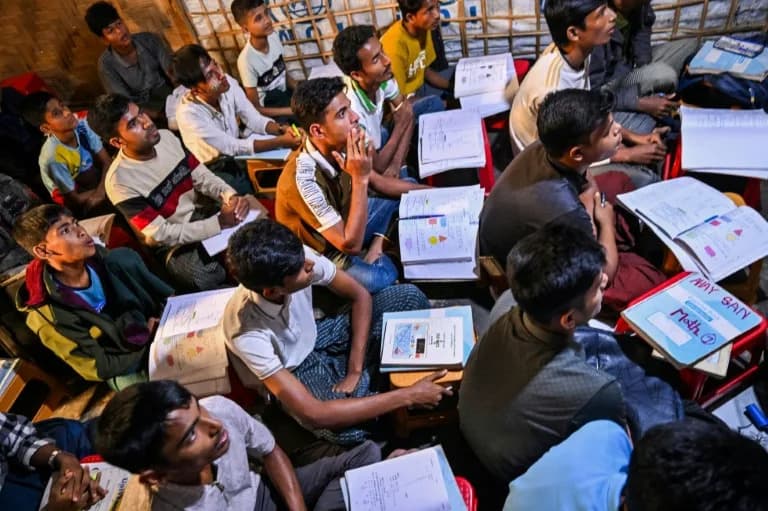
Villagers along Bangladesh's 271-kilometre border with Myanmar are being maimed and killed by landmines, turning forests and footpaths into deadly terrain. Survivors such as Ali Hossain and Mohammad Abu Taleb have lost limbs while collecting firewood or tending animals, forcing children to drop out of school and take on dangerous work. Human-rights monitors report a sharp rise in mine use in Myanmar — more than 2,000 casualties in 2024 — and Bangladesh says mines near the frontier have increased in 2024–2025. Despite warning signs and demining efforts, locals say economic necessity keeps them returning to hazardous border woods.
Landmines Maim Civilians Along Bangladesh–Myanmar Border, Forcing Children Into Dangerous Work
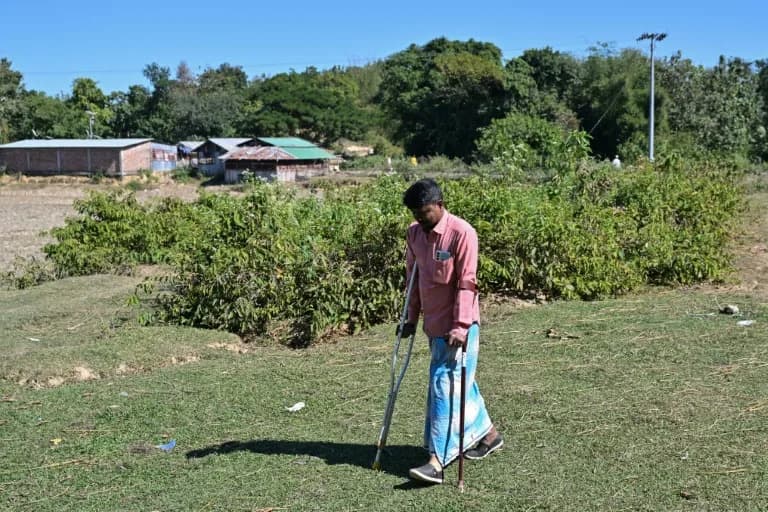
In the dense hill forests along Bangladesh's border with war-torn Myanmar, villagers are losing limbs to landmines (Munir UZ ZAMAN)(Munir UZ ZAMAN/AFP/AFP)
In the dense hill forests along Bangladesh's eastern border with conflict-hit Myanmar, villagers are being maimed and killed by landmines — victims of fighting they did not start. Daily tasks such as collecting firewood or tending animals have become life-threatening for communities that have crossed the frontier for generations.
Lives Shattered by a Single Step
Ali Hossain, 40, was gathering firewood in early 2025 when an explosion tore his life apart. "I went into the jungle with fellow villagers. Suddenly, there was an explosion, and my leg was blown off," he told reporters. Neighbours rushed to stop the bleeding. "They picked me up, gathered my severed leg and took me to hospital," he said.
Surgeons amputated Hossain's leg above the knee. "My wife had to carry me on her back," he recalled, pointing to the steep slopes around their home in Ashartoli — a small Bandarban settlement whose name translates as "haven of hope." A year on, Hossain moves with a prosthetic and a crutch but cannot return to work on the rubber plantation. Needing about 300 taka (roughly $2.50) a day for medicines, his two young sons now gather firewood after school to help the household survive.
Wider Toll On Families And Livelihoods
Stories like Hossain's are common across the border region. Mohammad Abu Taleb, 47, said he "learned no other trade" than collecting wood from the jungle. He stepped unknowingly into Myanmar and onto a mine hidden beneath dry leaves: "It took away my whole life," he said, now dependent on a crutch while his 10-year-old son dropped out of school to support the family. Another survivor, Nurul Amin, 23, lost a leg while trying to bring a cow across the line; his monthly income has fallen to about $25–$30.
Families also face steep medical and prosthetic costs. Taleb estimates repairs and follow-up care at around $80 — a heavy burden in an area with limited income opportunities.
Escalating Mine Use And Local Response
Human-rights monitors say Myanmar is the world's deadliest country for landmine victims. The International Campaign to Ban Landmines reported more than 2,000 casualties in Myanmar in 2024 — roughly double the previous year — and noted that mine use "appeared to significantly increase in 2024–2025," with a growing number of victims near the Bangladesh border.
Bangladesh accuses Myanmar's military and rival armed groups, including fighters from the Arakan Army, of laying mines. More than a million Rohingya refugees who fled Myanmar also live in Bangladesh's border regions and often find themselves trapped between the junta and insurgent forces.
Bangladesh police reported at least 28 people injured by landmines in 2025. In November, a Bangladesh border guard was killed when a mine blast severed both his legs. Lieutenant Colonel Kafil Uddin Kayes of the Border Guard Bangladesh condemned the attacks: "This cruelty cannot be legitimised." The border force has erected warning signs, flown red flags and conducts regular demining operations, but villagers say these measures provide limited protection when livelihoods force them into mined forests.
Dudu Mia, a 42-year-old farmer, summed up the dilemma: "The population is increasing, and people are moving closer to the border, as we have farmlands there. Planting landmines cannot be the solution. It can't go on like this."
The situation leaves communities on both sides of the frontier paying the human and economic price of armed conflict: disabled adults, children forced into dangerous labour, lost income, disrupted education and long-term insecurity in daily life.
Help us improve.