The U.S. announced a $45 million aid package for Thailand and Cambodia to support border stabilization, demining and efforts against scams and drug trafficking, Assistant Secretary Michael DeSombre said in Bangkok. The package includes $15 million for border recovery, $10 million for demining, and $20 million for anti‑fraud and counter‑narcotics initiatives. Details are being finalized as officials work to implement the October Kuala Lumpur ceasefire agreement and address recent displacement and casualties.
U.S. Pledges $45 Million to Thailand and Cambodia to Stabilize Border and Tackle Scams

FILE - Malaysia's Prime Minister Anwar Ibrahim, left, and U.S. President Donald Trump, right, watch as Thailand's Prime Minister Anutin Charnvirakul, second left, and Cambodia's Prime Minister Hun Manet hold up a document after the ceremonial signing of a ceasefire agreement between Thailand and Cambodia on the sidelines of the 47th Association of Southeast Asian Nations (ASEAN) summit in Kuala Lumpur, Malaysia, on Oct. 26, 2025. (Mohd Rasfan/Pool Photo via AP, File)
The United States will provide $45 million in aid to Thailand and Cambodia to help stabilize border communities and strengthen regional security, a senior U.S. State Department official said Friday.
Michael DeSombre, U.S. Assistant Secretary of State for East Asian and Pacific Affairs, announced the assistance during an online media briefing in Bangkok, where he met with senior Thai officials to discuss implementation of the ceasefire agreed last October under the Kuala Lumpur Peace Accords.
DeSombre said the package is intended to support recovery along the Thai‑Cambodian frontier after last year’s clashes and to deepen U.S. cooperation with both countries to promote stability and prosperity across the Indo‑Pacific.
“The restoration of peace at the Thai‑Cambodian border opens new opportunities for the United States to deepen our work with both countries to promote regional stability and advance our interests in a safer, stronger and more prosperous Indo‑Pacific,” DeSombre said.
The announced funds are broadly allocated as follows: $15 million for border stabilization to help affected communities and displaced people; $10 million for demining and clearance of unexploded ordnance; and $20 million for programs aimed at combating online scam operations and drug trafficking, as well as other initiatives. DeSombre said specific project details are still being finalized.
Fighting in July and December displaced hundreds of thousands of civilians in both countries and led to roughly 100 deaths among soldiers and civilians, officials say. Land mines left over from decades of conflict in Cambodia remain a persistent danger, while Thai authorities have reported incidents involving newly laid mines along frontier areas that wounded patrolling soldiers.
Online fraud operations originating in parts of Southeast Asia, notably Cambodia and Myanmar, have been identified as significant transnational crime problems that have defrauded victims of large sums internationally. The U.S. aid package seeks to address those criminal networks alongside humanitarian and stabilization work.
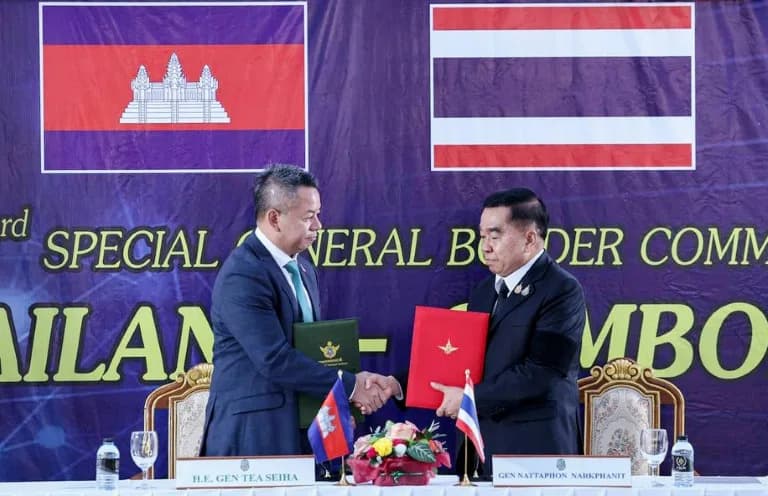
The ceasefire process began with a preliminary truce after clashes in July and was further formalized at a regional meeting in October. New fighting flared again early last month, but the defense ministers of Thailand and Cambodia signed a pact on Dec. 27 committing to implement the October agreement. DeSombre is scheduled to travel to Phnom Penh for follow‑up talks with Cambodian officials.
DeSombre concluded by emphasizing U.S. commitment to peace and development in the region and the link between stability and economic prosperity.
Help us improve.