Rohingya children in Bangladesh's Cox's Bazar camps face deep educational barriers. UNICEF and partners run over 6,500 learning centres serving up to 300,000 children, but instruction often amounts to just three hours a day and teacher shortages are widespread. Attendance drops sharply for older adolescents — to under 20% for ages 15–18 — and girls are disproportionately affected. Community-run classes and a few individual successes offer hope, but sustained funding and policy change are urgently needed.
Rohingya Children's Education Stalled in Bangladesh Camps as Opportunities Shrink
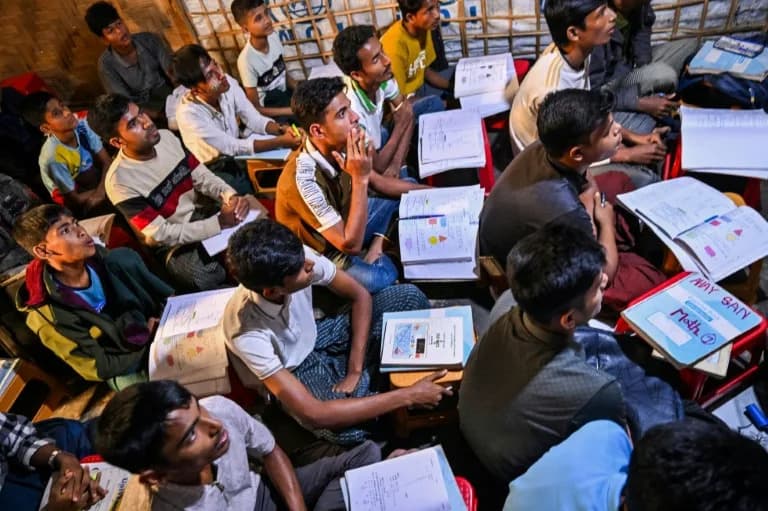
Rohingya refugees study inside a makeshift learning centre at the Kutupalong refugee camp in Ukhia on December 17, 2025 (Munir UZ ZAMAN)(Munir UZ ZAMAN/AFP/AFP)
Books clutched to their chests, children stream into a cramped classroom in Cox's Bazar, part of Bangladesh's sprawling refugee camps that now shelter more than a million Rohingya who fled neighbouring Myanmar.
"They still dream of becoming pilots, doctors or engineers," said teacher Mohammad Amin as he stood before an overcrowded class. "But with the scarce opportunities available, we do not know if those ambitions can be realised."
Around half a million of the camp residents are children, many of whom arrived during a brutal military crackdown in 2017. That campaign — marked by burned villages and killings of civilians — is the subject of a genocide case currently before the International Court of Justice in The Hague.
Severe Shortage
In the immediate aftermath of the 2017 exodus, international agencies and UNICEF moved quickly to open learning centres. The Bangladeshi government, however, has consistently resisted integrating Rohingya children into national schools and has barred instruction in Bangla, citing limited capacity to absorb refugees.
By 2024, UNICEF and partners were operating more than 6,500 learning centres across the Cox's Bazar settlements, reaching up to 300,000 children. Yet the system is stretched to breaking point. Funding cuts — notably to US assistance during the Trump administration — forced closures and service reductions that worsened existing gaps.
"The current system provides three hours of instruction per day for children," said Faria Selim of UNICEF. "Those daily contact hours are insufficient." Teacher shortages are acute: some schools run on shifts with a single instructor covering multiple subjects for dozens of pupils.
"I teach Burmese language, mathematics, science and life skills to 65 students in two shifts. I am not an expert in all subjects,"
said 30-year-old teacher Hashim Ullah, who works at an aid-run primary school.
For parents, education is seen as the best route out of the hazards of camp life — malnutrition, early marriage, child labour, trafficking, abduction or forced recruitment into armed groups involved in Myanmar's conflict. Many families top up aid-run classes with community-organised sessions held at dawn and dusk; these are typically low-cost but still out of reach for the poorest who may sell food rations to pay fees.
Justice and Peace — And Few Pathways
Fifteen-year-old Hamima Begum attends both an aid-run programme and a community high school. "I want to go to college," she said. "I aim to study human rights, justice and peace — and one day help my community with repatriation." Yet community schools are too few, particularly for older adolescents.
A 2024 assessment by a consortium of aid agencies and UN bodies found attendance drops sharply from about 70% among children aged 5–14 to under 20% for those aged 15–18, with girls disproportionately affected. Even for enrolled students, academic achievement is low: organisers reported that 75% of high-school students failed a mid-year exam administered this year.
There are exceptions. Jaitun Ara, 19, who arrived at age 12, secured a place at the Asian University for Women in Chittagong through a support programme that prepares students for degree study. Such success stories, however, are rare amid widespread economic strain and limited access to sustained, quality education.
Without renewed funding, better-trained teachers, and policy shifts that expand safe and certified learning pathways, many Rohingya children risk seeing their educational dreams put on hold for years — with consequences for their future prospects and for any eventual return and reintegration into Myanmar.
Help us improve.