
The governments of Thailand and Cambodia signed a ceasefire agreement that took effect at noon local time, stopping troop movements and military air operations. The pact includes a 72-hour verification period after which Thailand will repatriate 18 Cambodian soldiers it has held since July. Key provisions address land mines, joint humanitarian demining, restrictions on misinformation, and renewed border demarcation talks. Regional and international actors urged both sides to implement the deal in good faith to protect civilians and enable humanitarian returns.
Thailand and Cambodia Agree To Ceasefire After Weeks Of Deadly Border Clashes

Cambodian Defense Minister Tea Seiha, left, stands with Thai Defense Minister Nattaphon Narkphanit, right, at the General Border Committee Meeting in Chanthaburi Province, Thailand Saturday, Dec. 27, 2025. / Credit: Agence Kampuchea Press via AP
Thailand and Cambodia signed a ceasefire on Saturday aimed at halting weeks of intense fighting along their shared border. The agreement, signed by Cambodia's Defence Minister Tea Seiha and Thailand's Defence Minister Nattaphon Narkphanit at a border checkpoint, took effect at noon local time.
Terms Of The Agreement
The pact requires both sides to stop troop movements and to refrain from using their airspace for military purposes. It includes a 72-hour verification period: if the ceasefire holds for that time, Thailand has agreed to repatriate 18 Cambodian soldiers held since earlier clashes in July — a central demand from Phnom Penh.
Prisoners, Mines And Misinformation
The text reiterates commitments to previous ceasefire accords and contains clauses on land mines, joint humanitarian demining operations, and a commitment to refrain from spreading false information. Thailand has accused Cambodian forces of planting new anti-personnel mines; Cambodia says many explosives date from earlier civil conflict. The agreement calls for joint demining to protect civilians and troops.
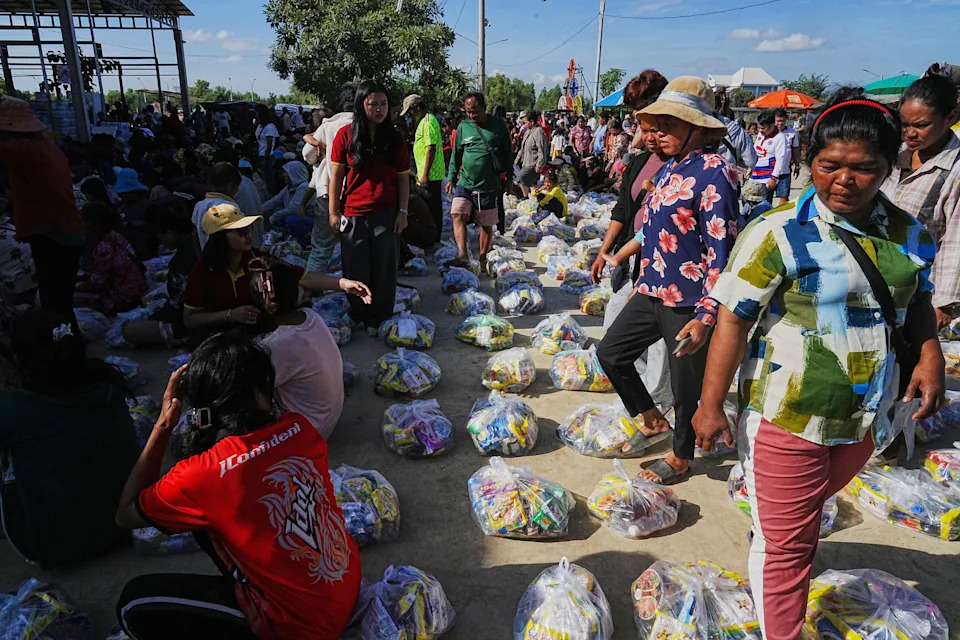
Evacuees wait to receive donation from local charity as they take refuge in Banteay Menchey provincial town, Cambodia, Saturday, Dec. 13, 2025, after fleeing homes following fighting between Thailand and Cambodia. / Credit: Heng Sinith / AP
"The 72-hour ceasefire is a time frame to tangibly prove whether Cambodia can truly cease the use of weapons, provocations and threats in the area," Thai Defence Ministry spokesman Surasant Kongsiri said after the signing.
Civilian Toll And Displacement
Officials say the latest round of fighting has killed dozens and created a major humanitarian crisis. Thai authorities reported roughly 26 military deaths and about 44 civilian fatalities; Cambodian authorities reported around 30 civilian deaths and about 90 injured. Together the clashes have displaced close to one million people, forcing mass evacuations on both sides of the border.
Context And Previous Diplomacy
The border dispute — long simmering over competing territorial claims — reignited this month after an earlier truce broke down. Previous ceasefires were mediated regionally and involved international pressure and meetings in Malaysia. Despite those efforts, periodic skirmishes and an intense propaganda campaign continued, culminating in heavy fighting in early December.
International Reaction
Regional and international actors welcomed the new agreement and urged full implementation. Malaysia's prime minister praised the pact as necessary restraint to protect civilians. The European Union and the United Nations' human rights office also called for faithful implementation and for humanitarian assistance to reach displaced communities. U.S. officials expressed support for steps that build confidence and de-escalate the situation.
Next Steps
The accord calls for renewed border demarcation talks and cooperation on suppressing transnational crimes, including organized online scams that have been linked to criminal networks in the region. Observers say the agreement's durability will depend on transparent monitoring, the safe return of displaced civilians, and tangible progress on demining and prisoner repatriation.


