Annie Jacobsen’s reissued Operation Paperclip exposes how the United States recruited hundreds of German scientists after WWII to exploit advanced military and aerospace know‑how. Figures such as Wernher von Braun and Hubertus Strughold were integrated into U.S. programs despite links to forced labour and lethal human experiments. Jacobsen uses newly declassified files, archives and interviews to trace the ethical compromises that shaped Cold War science and their long‑term consequences.
Operation Paperclip: How the US Recruited Nazi Scientists to Supercharge Its Cold War Edge
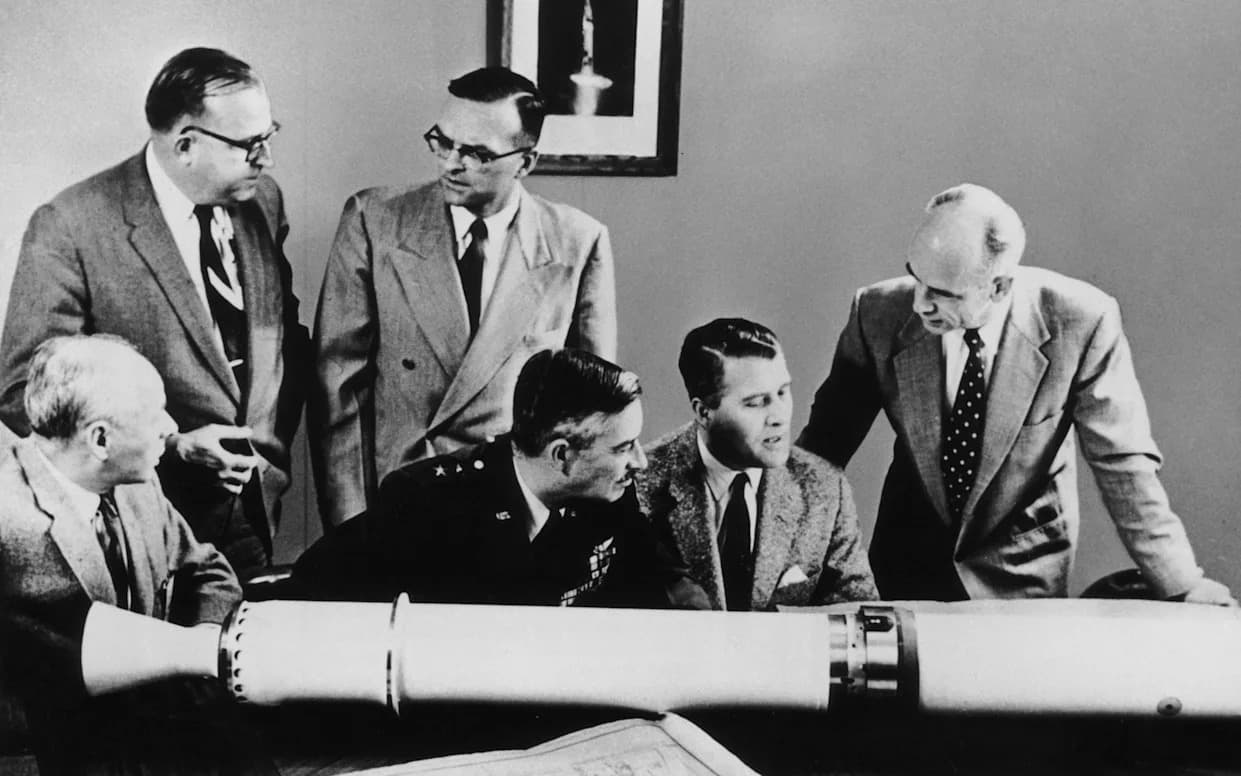
Wernher von Braun (second from right) was a Nazi physicist who later joined Nasa as a rocket scientist. (Pictured with members of the Army Ballistic Missile Agency in 1958) - Phil Burchman/Getty Images
The story of Operation Paperclip reveals a morally complex and consequential chapter in 20th-century science and intelligence: after World War II, the United States quietly brought hundreds of German scientists into American programs to secure technical advantages over the Soviet Union. Annie Jacobsen’s reissued Operation Paperclip (2014) draws on newly declassified files, archival letters and interviews to show both the strategic calculations and the ethical compromises behind that effort.
Von Braun and the Moral Paradox
Wernher von Braun — later celebrated as a leading architect of NASA’s Moon programme — once designed the Nazi V‑1 and V‑2 missiles that devastated parts of Britain in 1944–45. Although anecdotes about confrontations with reporters may be apocryphal, they capture a stark truth: von Braun and many others were not merely gifted engineers but figures whose work and wartime roles implicated them in systems that used forced labour and caused mass suffering. In 1944 von Braun arranged transfers of prisoners from Buchenwald to expand the workforce for his rocket programme.

Von Braun had been an ardent Nazi and designed the V-1 and V-2 rockets that targeted London in the Second World War - Bachrach/Getty Images
How Paperclips Marked More Than Files
At the end of the war, U.S. military and intelligence agencies diverted dossiers on top German scientists into special channels. A paperclip affixed to a file signaled urgency — especially when a scientist might be tied to war crimes. The goal was twofold: acquire technical expertise for an anticipated confrontation with the USSR, and deny that expertise to Soviet forces.
Chemical and Biological Research
The U.S. Army Chemical Corps employed former researchers from IG Farben — the conglomerate that produced synthetic rubber with forced labour at Auschwitz — to help create stockpiles of nerve agents such as sarin and tabun. The Naval Medical Research Institute recruited Dr. Theodor Benzinger, who had helped screen a film for Heinrich Himmler that documented lethal human experiments involving freezing and seawater ingestion.
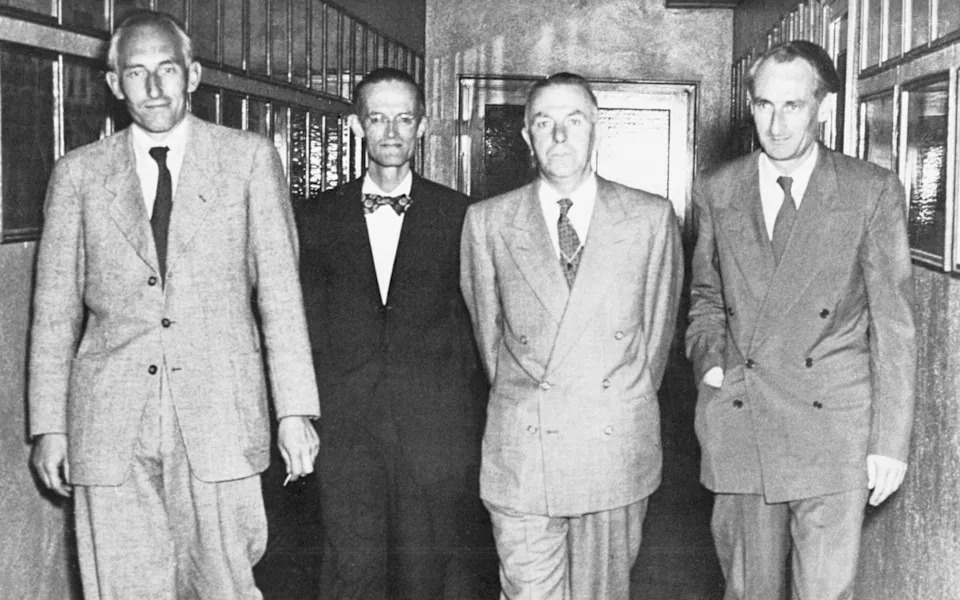
Original members of the first department of space medicine (L-R): Fritz Haber, Konrad JK Buettner, Hubertus Strughold and Heinz Haber - Bettmann
Human Experiments and Careers in America
Hubertus Strughold, an aviation‑medicine specialist linked to deadly experiments at Dachau, became known in the U.S. as a founder of space medicine and was honored for decades before his wartime record prompted controversy. Walter Schrieber was taken to the United States to work on classified biological‑warfare projects; after a Holocaust survivor later identified him as present for barbaric experiments at Auschwitz, U.S. authorities assisted his quiet emigration to Argentina.
Repurposing Science — And Its Consequences
Some American officials believed they could redirect German scientific advances toward less lethal purposes. For example, in 1947 Dr. L. Wilson Greene observed that small doses of captured nerve agents incapacitated but did not kill volunteers — an observation that fed thinking about incapacitating weapons. That logic also fed later CIA experiments into brainwashing and chemical manipulation, illustrating how technological reuse can spawn new ethical problems.
Turning Point and Legacy
Direct U.S. research inspired by Nazi chemical and biological developments was officially curtailed by President Richard Nixon in 1969. Over subsequent decades investigative reporting and declassification have revealed more about Operation Paperclip’s scope. Jacobsen’s reissue adds fresh material and family interviews that deepen our understanding of these decisions and their human costs.
Why it matters: Operation Paperclip forces a reckoning with how democracies balance national security, scientific progress and moral responsibility — a debate that remains resonant as contemporary public figures and technologists face scrutiny over historical associations and ethical conduct.
Publication note: The reissued Operation Paperclip includes a brief afterword connecting this episode of wartime pragmatism to later debates about nuclear strategy and Cold War policymaking.
Help us improve.