The evening of Nov. 29 offers a pleasant skywatching opportunity as a waxing gibbous Moon sits close to Saturn low in the southeastern sky after sunset. The Moon, one day past first quarter, will show strong terminator detail visible through a 6-inch backyard scope. Saturn will be visible to the naked eye and through an 8-inch telescope, which can reveal cloud bands though the rings appear nearly edge-on. Neptune lies about 2° below the Moon but will be difficult to spot because of its faintness and the Moon's glare.
Saturn and the Waxing Moon Stage a Sunset Show — Look Southeast on Nov. 29

Look to the southeastern horizon in the hours after sunset on Nov. 29 to catch a lovely close pairing: the waxing gibbous Moon shining near the gas giant Saturn, with distant Neptune lurking nearby but invisible to the unaided eye.
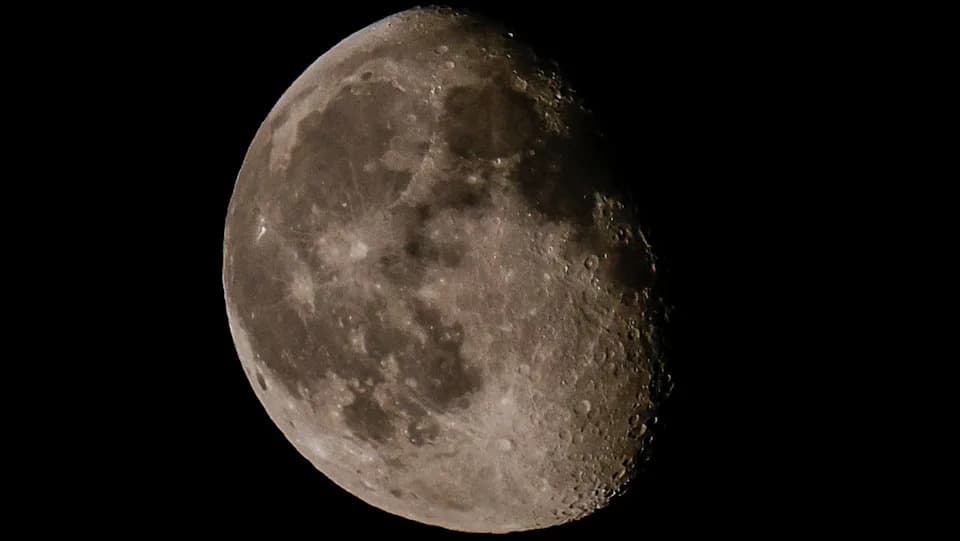
The Moon will be roughly one day past first quarter and about half-illuminated, glowing with reflected sunlight beneath the stars of Pisces. Saturn will stand out as a bright "evening star," sitting less than about 5 degrees — roughly the span of a clenched fist at arm's length — to the lower right of the Moon.
Nights around first quarter are prime for lunar observing because the terminator (the line between lunar day and night) casts crater rims and mountain ranges into sharp relief. Through a backyard telescope with an aperture near 6 inches, the Moon's ancient, cratered terrain and darker maria will show excellent contrast and detail.
Saturn will be attractive both to the naked eye and through telescopes on Nov. 29. An 8-inch (200 mm) telescope should reveal the planet's horizontal cloud bands. Its famous ring system, however, is currently oriented nearly edge-on to Earth and will appear only as a thin line bisecting the planet through an eyepiece.
Why Saturn appears to change direction
That night Saturn finishes a period of apparent westward motion (retrograde) among the stars of Pisces and will resume its usual eastward drift. This apparent backward motion happens when Earth, on a tighter, faster orbit around the Sun, overtakes more distant planets — briefly making them seem to move in reverse against the background stars.
Neptune lies roughly 2 degrees below the Moon on Nov. 29 but is far too faint to see without magnification. Under ideal, dark-sky conditions a telescope of about 8 inches or larger may reveal Neptune as a tiny blue point; however, the Moon's nearby glare on this night will make it more challenging than usual to spot.
Practical observing tips
- Allow your eyes to adapt to the dark for at least 15–20 minutes for the best naked-eye viewing of Saturn and surrounding stars.
- Use a low- to medium-power eyepiece (longer focal length) to frame both the Moon and Saturn in the same field if you want them in one view, then switch to higher power to study lunar detail or Saturn's bands.
- Bring a moon filter or reduce exposure if photographing the Moon to avoid blown-out highlights; use longer exposures and careful stacking for faint Neptune (if attempting to image it).
Whether you enjoy naked-eye stargazing, backyard telescopes, or astrophotography, the evening of Nov. 29 offers a compact and rewarding skywatching opportunity low in the southeastern sky.
Help us improve.