Kepler-56, a red giant, has an outer envelope rotating about ten times faster than normal and a core whose spin axis is misaligned with the envelope. Takato Tokuno (University of Tokyo) argues in an Oct. 29 arXiv preprint that ingestion of a hot Jupiter (roughly 0.5–2 Jupiter masses, 1–6 day orbit) could explain both the spin-up and the tilt. Tidal interactions from the remaining planets are unlikely to be efficient enough, and a birth-origin spin still leaves the misalignment unexplained. This case illustrates how planet engulfment can reshape stellar rotation and inform planetary lifecycles.
Kepler-56's Odd Spin: Evidence the Red Giant May Have Devoured a Hot Jupiter

Kepler-56, a red giant star, shows an unusual rotation pattern that may be explained if it swallowed a close-in giant planet. Takato Tokuno, a doctoral student at the University of Tokyo, argues in an arXiv preprint (Oct. 29) that the star’s outer envelope was spun up and tilted when it ingested a “hot Jupiter.”
What astronomers observed
Kepler-56’s outer envelope rotates roughly ten times faster than typical red giants, while its core’s spin axis is misaligned with the envelope’s — effectively the outer layers spinning faster and at a different orientation than the interior. The system also hosts two known exoplanets, but their presence alone does not easily account for these anomalies.
Why known planets are unlikely culprits
Massive planets can transfer angular momentum to their host stars via tidal interactions, gradually spinning up stellar envelopes and producing misalignments if orbital planes are tilted. However, Tokuno shows that explaining Kepler-56’s rotation this way would require tidal coupling and angular-momentum transfer efficiencies orders of magnitude larger than those observed in other systems, making the tidal-spin hypothesis implausible.
Planet engulfment: a compelling explanation
An alternative, and more economical, explanation is that Kepler-56 engulfed a giant planet. When a star consumes a planet, the planet’s orbital angular momentum and kinetic energy are deposited into the star, which can rapidly spin up the outer layers. If the ingestion were oblique, it could also tilt the envelope relative to the core, producing the observed misalignment.
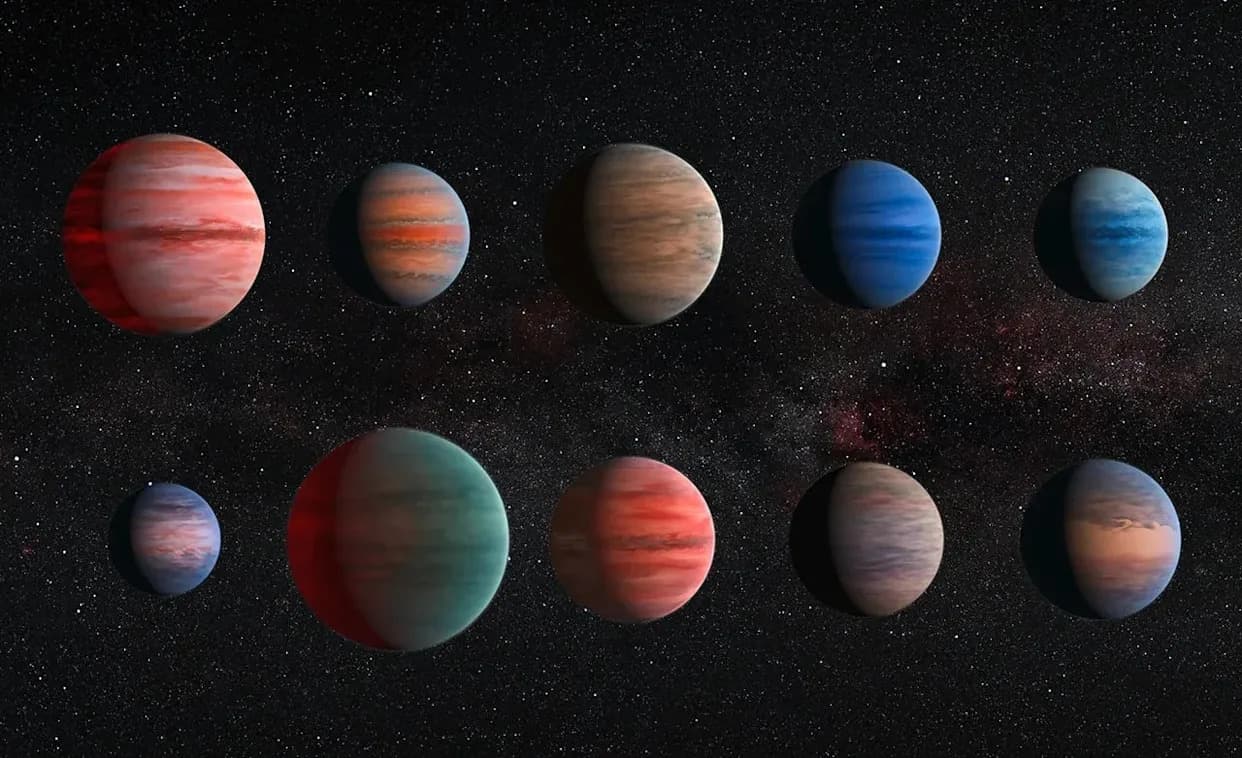
Tokuno’s calculations indicate the consumed planet would need to have had a mass of roughly 0.5–2 times Jupiter’s mass and an orbital period of about 1–6 days immediately before engulfment — properties consistent with typical hot Jupiters orbiting very close to their stars.
Other possibilities and caveats
Tokuno also notes that Kepler-56 might simply have been born with an unusually rapid rotation. That idea, however, does not readily explain the core–envelope misalignment and raises the further question of why the star would be born spinning so quickly. One resolution is that an earlier planetary ingestion occurred while the star was young.
Why it matters
Planet engulfment is an important process for understanding how planetary systems evolve as their stars age. Cases like Kepler-56 show that star–planet interactions can be violent and transformative, reshaping stellar rotation and providing clues to the fate of close-in giant planets.
Note: The results discussed are based on a preprint posted to arXiv and have not yet undergone peer review.
Help us improve.