The University of Florence team has demonstrated persistent quantum entanglement between the centre-of-mass motion of a levitated 100 nm glass nanosphere and light that exits its trap — all achieved at room temperature. A two-colour optical tweezer combined a red-detuned laser for cooling and a blue-detuned laser for entangling while the system operated in near vacuum inside an optical cavity. Measurements of the outgoing light fell below the separability threshold, indicating robust entanglement that could in future enable mechanical–optical interfaces for quantum networks.
Room-Temperature Quantum Entanglement Between a Levitated Glass Nanosphere and Escaping Light
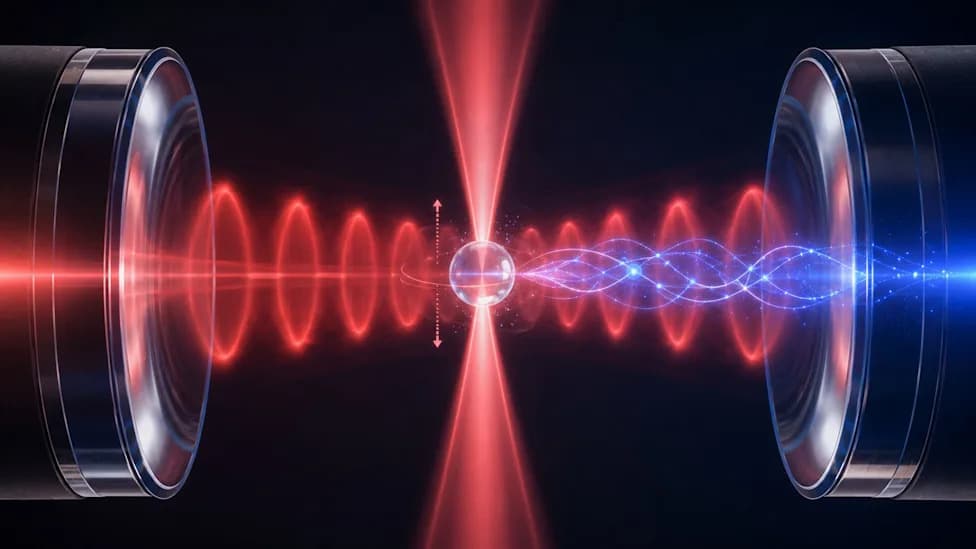
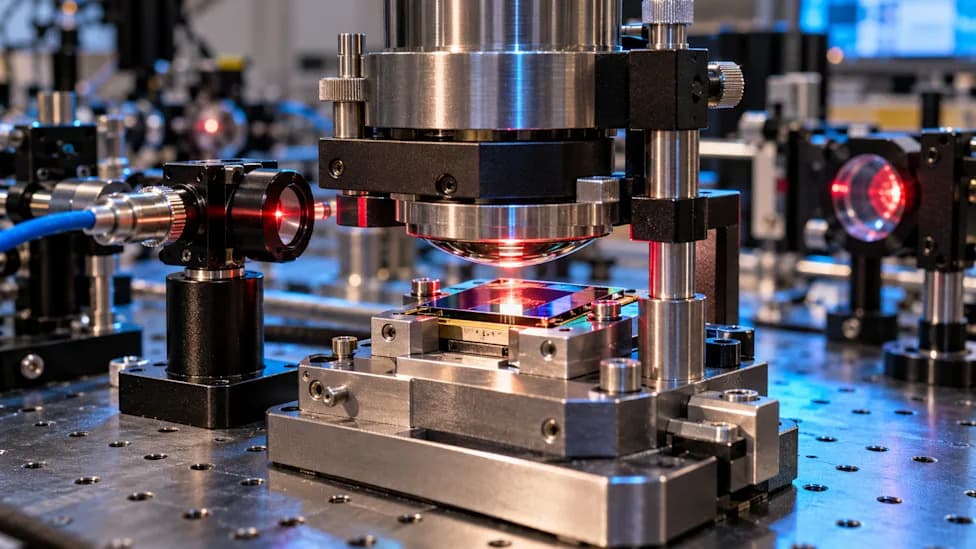
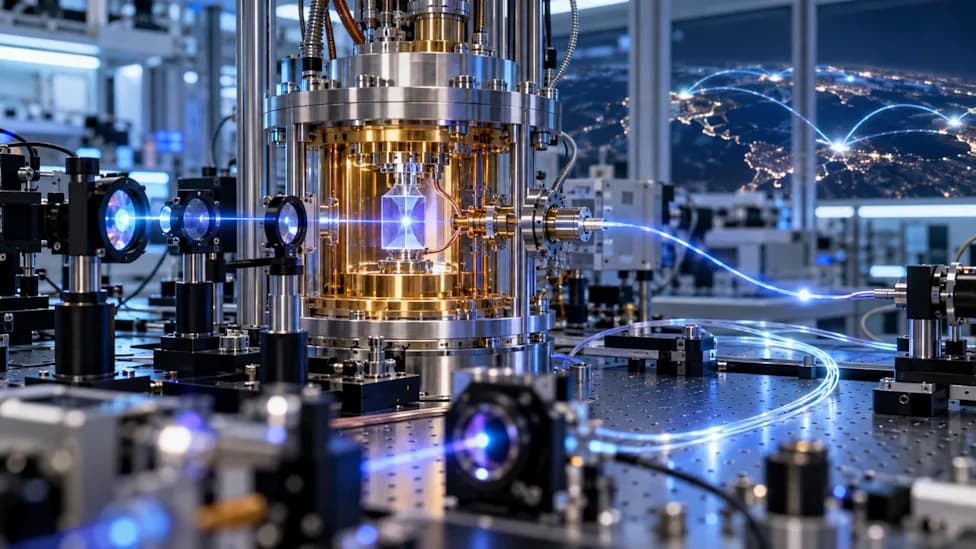
AI-generated impression of a nanosphere levitated in an optical tweezer inside an optical cavity, where its motion becomes entangled with light. (Francesco Marin/OpenAI)
A microscopic grain of glass levitated in a beam of light has enabled researchers to observe persistent quantum entanglement between a mechanical object and light that leaves its trap — and they did it at room temperature. The experiment, led by Francesco Marin at the University of Florence, demonstrates that a levitated 100-nanometre glass sphere can become quantum-correlated with propagating light without the need for cryogenic cooling of the whole apparatus.
How the experiment worked
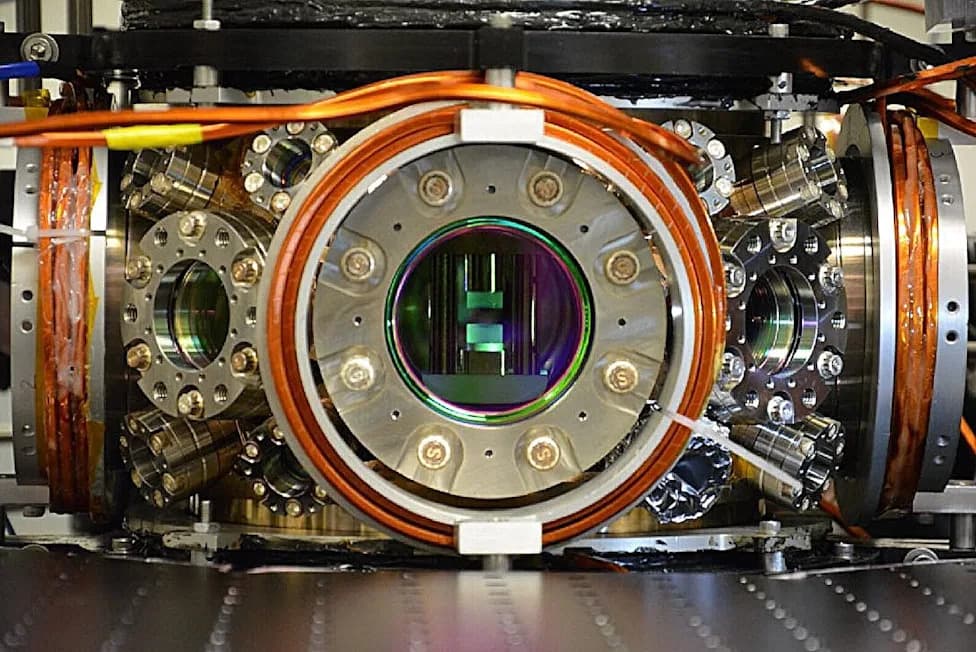
The team trapped a roughly 100 nm-diameter glass nanosphere — about the size of a virus but containing tens of millions of atoms — in an optical tweezer formed by a tightly focused laser beam and confined it inside an optical cavity. The setup operated in near vacuum to minimize collisions with gas molecules and other environmental disturbances that rapidly destroy fragile quantum effects.

YouTube Thumbnail
To overcome a key technical challenge, the researchers used a two-colour approach. A red-detuned laser cooled and stabilized the centre-of-mass oscillation of the trapped sphere, bringing that mechanical mode close to its quantum ground state. A blue-detuned laser provided the interaction that can create entanglement between the sphere’s motion and the electromagnetic field. Combining both beams in a single two-colour tweezer separated the tasks of cooling and entangling, enabling a steady-state regime in which quantum correlations could build up.
What was entangled
The entanglement linked the mechanical oscillator’s position and momentum (the centre-of-mass oscillations of the sphere) with the light’s quadratures, which are optical analogues of amplitude and phase. In practical terms, fluctuations measured in the outgoing light could not be explained without also accounting for the state of the mechanical motion — a hallmark of quantum entanglement.
YouTube Thumbnail
How the team proved it
Information about the sphere’s motion was imprinted on the light leaking from the cavity. By measuring the quadratures of the outgoing optical field and reconstructing the correlation matrix, the researchers compared their results to a quantum separability threshold. The reconstructed correlations fell below that threshold, and they remained robust after accounting for measurement uncertainty and different analysis assumptions. Long data runs and careful stability (three laser systems acting stably while the chamber reached low pressure) were essential to accumulate statistically significant evidence.
Why this matters
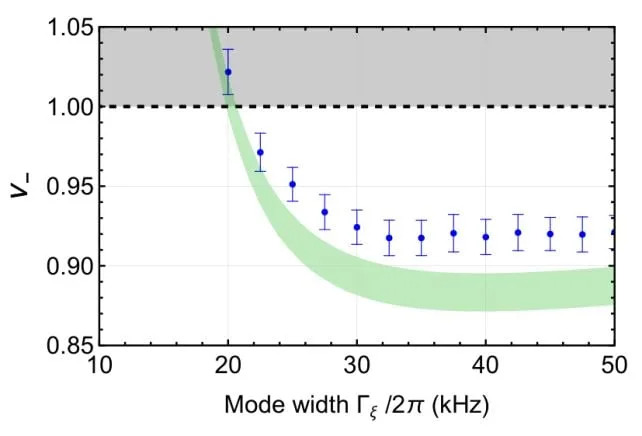
Once the optical mode is wide enough, the experimental measurements fall below the threshold of 1 (dashed line), indicating entanglement between the nanosphere's motion and the light. (Deplano et al.,Science, 2026)
Crucially, the entanglement survives in the light that escapes the cavity, producing a propagating quantum field. Unlike a mode confined inside a cavity, that traveling light can, in principle, be routed through optical networks, measured at distant stations, or made to interact with other quantum devices. This makes the system a promising candidate for building mechanical–optical interfaces in future quantum communication and sensing applications.
"The propagating field is essentially the channel that could connect the mechanical system to the outside world," said Marin. "The next challenge is to turn that interface from something we observe into something we can actively use."
Remaining challenges and outlook
Important next steps include strengthening the entanglement, exerting dynamic control rather than observing a stationary state, and developing protocols to write, store, and retrieve quantum information in the mechanical oscillator. Scaling the technique to link multiple levitated spheres in separate tweezers could enable distributed mechanical-quantum networks. The work is reported in Science (2026).
Note: The experiment cooled only the mechanical degree of freedom (via optical cooling); the room surrounding the apparatus remained at ambient temperature.
Help us improve.