ICFO researchers have demonstrated a solid-state quantum memory that preserves nonclassical correlations of single photons for up to 180 μs. The device combines a Pr3+:Y2SiO5 atomic frequency comb with RF dynamical-decoupling (XY4/XY16) to reverse spin dephasing, while a telecom herald at 1,436 nm simplifies fiber integration. Classical-light tests showed echoes beyond ~3 ms; improved magnetic control could push single-photon storage toward millisecond scales needed by quantum repeaters.
Solid-State Quantum Memory Stores Single Photons for 180 μs — A Step Toward the Quantum Internet
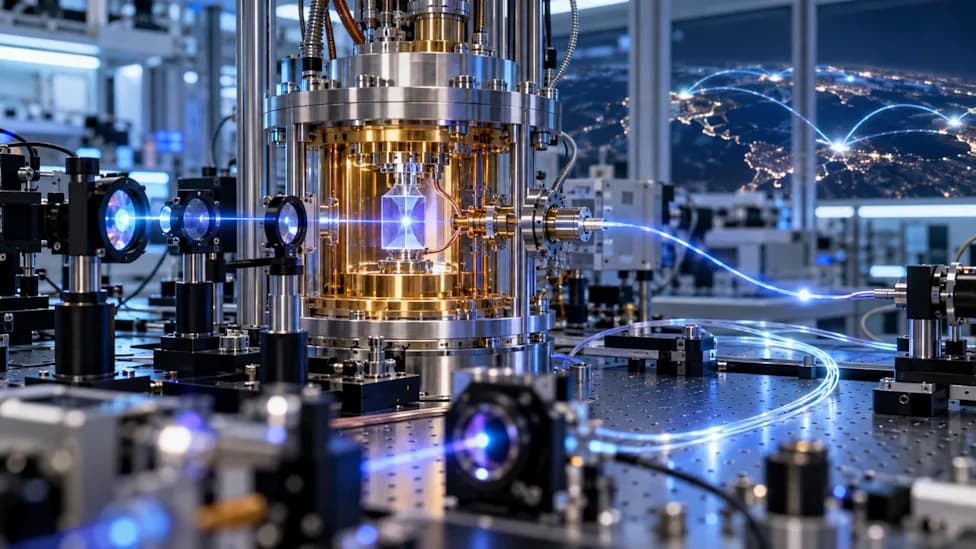
A solid-state quantum memory stored single photons for 180 microseconds while preserving nonclassical correlations. (CREDIT: Shutterstock)
Researchers at ICFO in Barcelona have demonstrated a solid-state quantum memory that preserves the quantum properties of individual photons for up to 180 microseconds — a record for absorptive spin-wave memories using spin rephasing. The result, reported in Physical Review Letters, moves one step closer to the storage times needed for practical quantum repeaters connecting long-distance quantum networks.
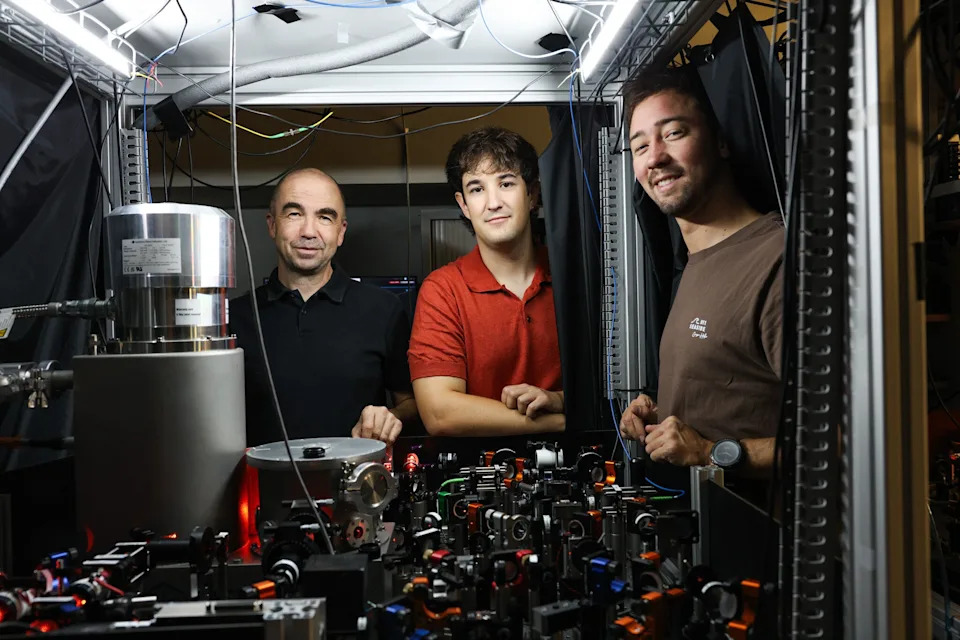
From left to right: Prof. Hugues de Riedmatten, Alberto Rodríguez Moldes and Jonathan Hänni at their lab at ICFO. (CREDIT: ICFO)
How the Memory Works
The device uses a praseodymium-doped yttrium orthosilicate crystal (Pr3+:Y2SiO5) cooled to about 3 K inside a cryostat. Photon pairs are generated by a cavity-enhanced spontaneous parametric down-conversion source: the signal photon at 606 nm is matched to the memory's optical transition, while its telecom partner at 1,436 nm serves as a herald when detected. The herald at telecom wavelengths simplifies future fiber deployment by avoiding an additional frequency-conversion step for the heralding channel.
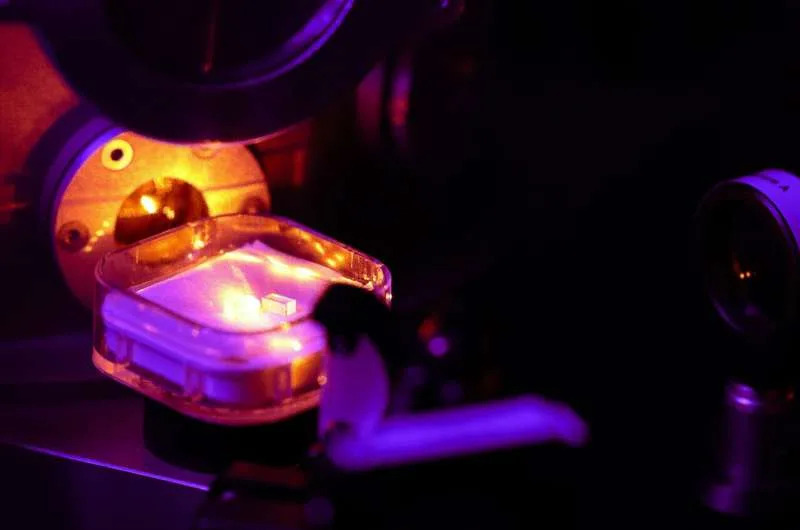
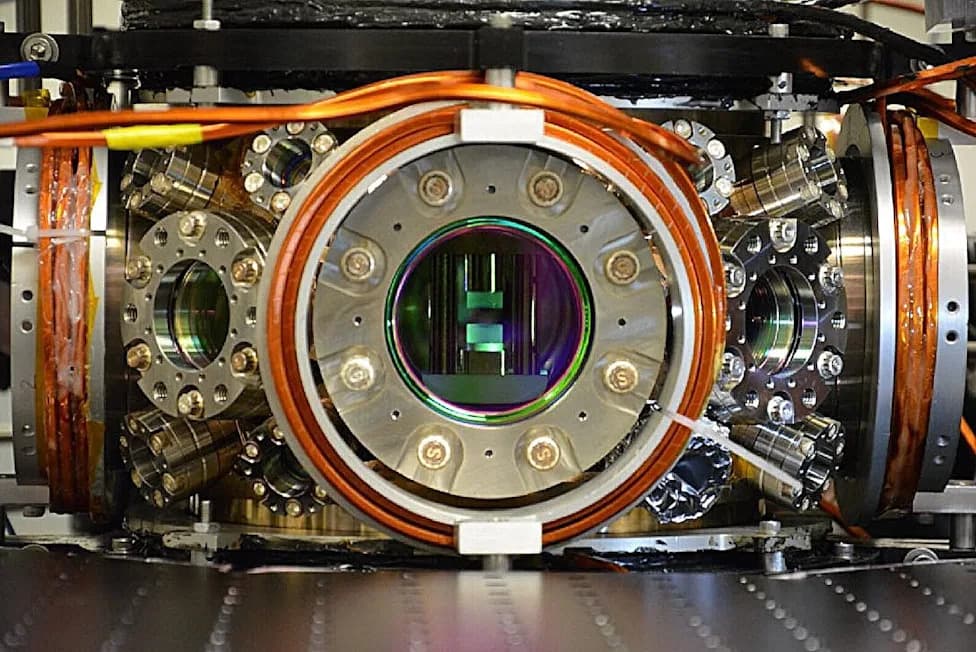
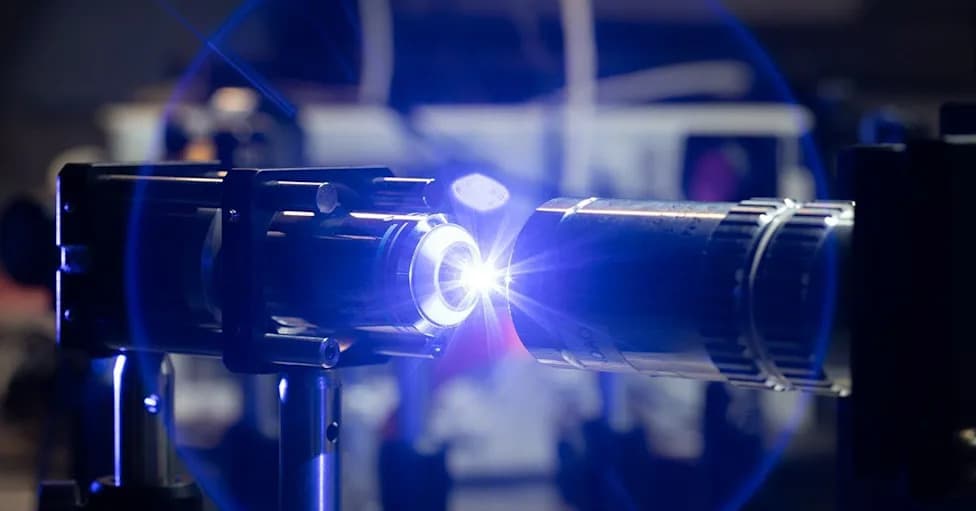
Close-up of the quantum memories. (CREDIT: ICFO)
Atomic Frequency Comb and Spin Storage
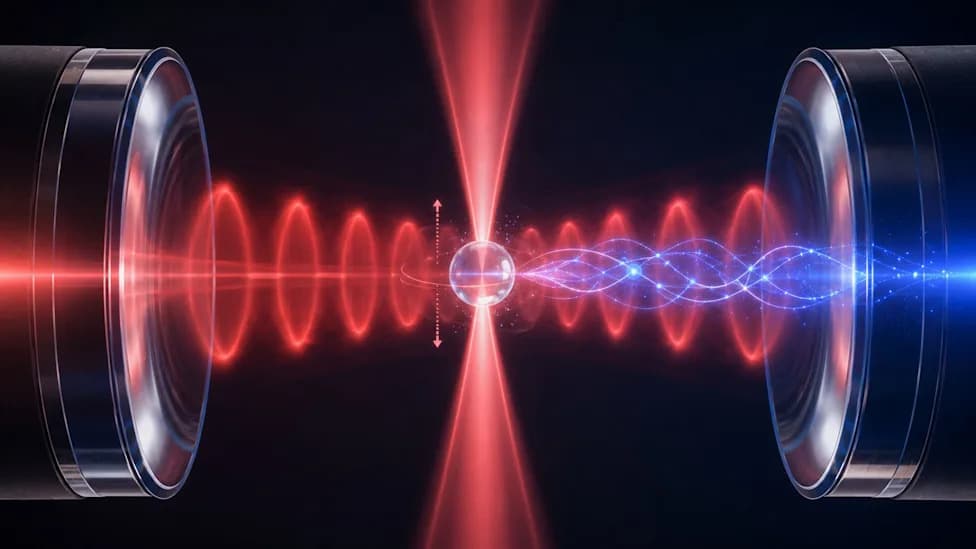
Inside the crystal, researchers prepared an atomic frequency comb (AFC) — a periodic pattern of absorption peaks across the inhomogeneously broadened ensemble of praseodymium ions. An incoming 606 nm photon is collectively absorbed by many ions, creating a shared excitation. Optical control pulses then transfer that excitation into a long-lived hyperfine spin state, pausing optical re-emission and enabling on-demand retrieval with a later control pulse.
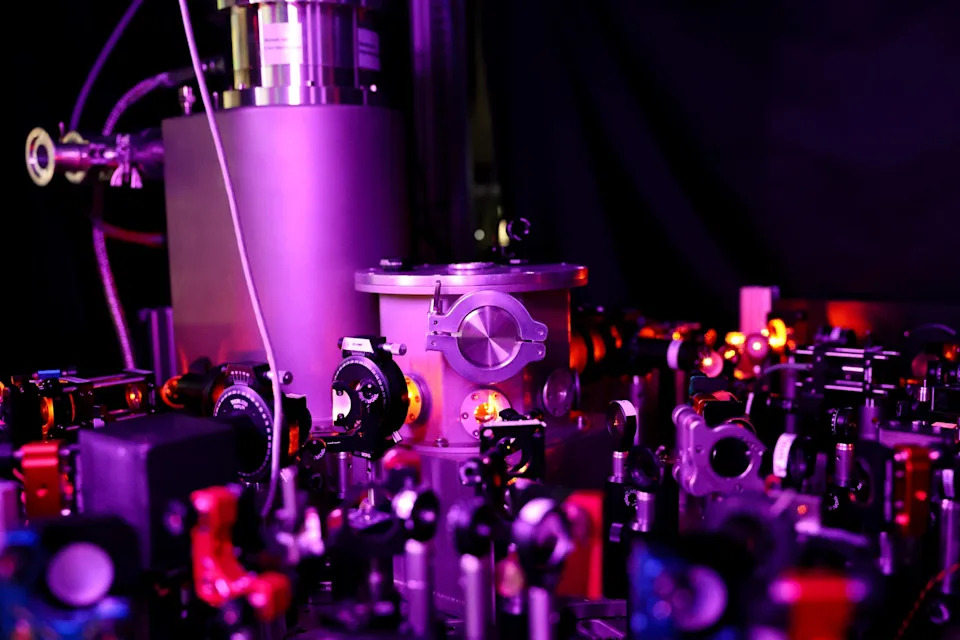
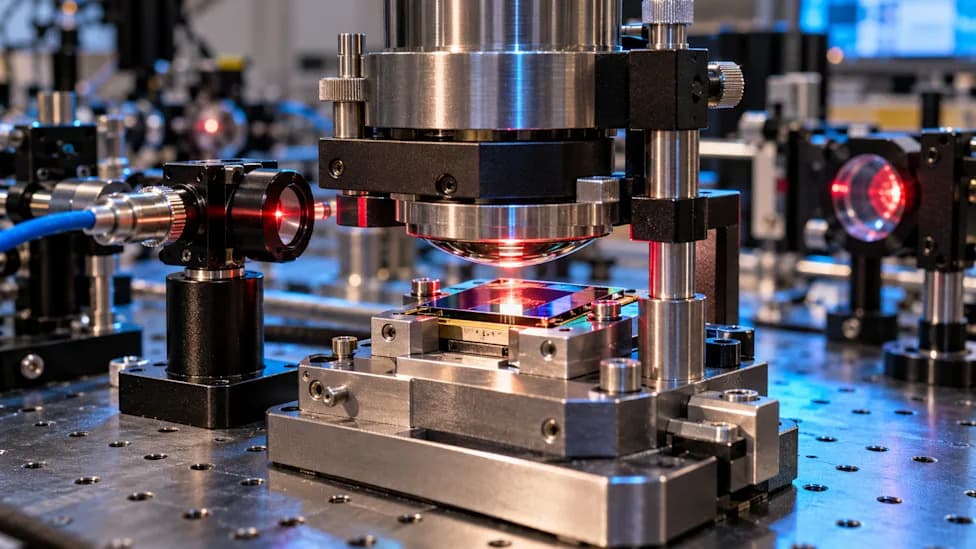
Image of the experimental set-up. (CREDIT: ICFO)
Counteracting Dephasing With RF Sequences
Storing the excitation as a spin wave reduces optical decay but introduces spin dephasing because each ion experiences slightly different local fields. To refocus the ensemble, the team applied radiofrequency dynamical-decoupling sequences (XY4 and XY16). These RF pulses reverse accumulated phase differences among ions, effectively rephasing the spins so the collective excitation can reconstitute the original photon.
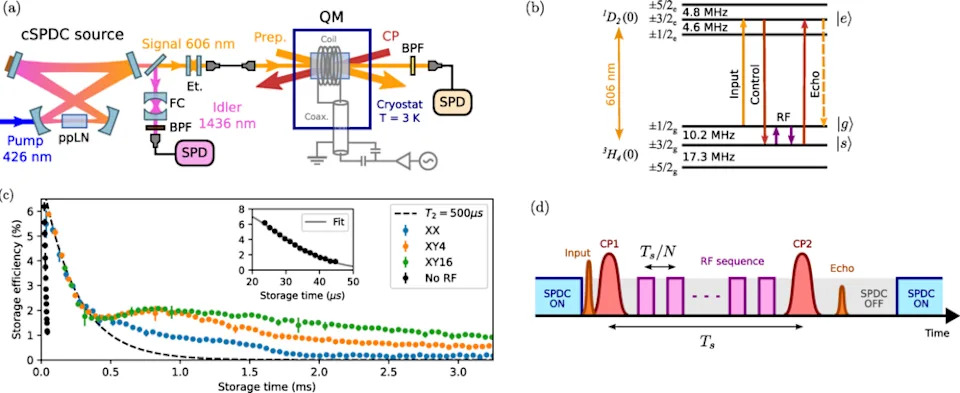
Experimental setup. In single-photon storage experiments, a second Pr³⁺:Y₂SiO₅ crystal is used for spectral filtering before detection (not shown). (CREDIT: Hugues de Riedmatten et al, Physical Review Letters)
Results: Quantum and Classical Tests
With genuine single-photon-level input, the memory preserved nonclassical signal–idler correlations up to 180 μs. The highest measured signal–idler cross-correlation was 4.6 ± 0.4, above the classical threshold used in the experiment. Complementary tests with classical light showed that advanced decoupling sequences produced measurable echoes beyond ~3 milliseconds — nearly two orders of magnitude longer than earlier spin-wave AFC storage in the same material without rephasing.
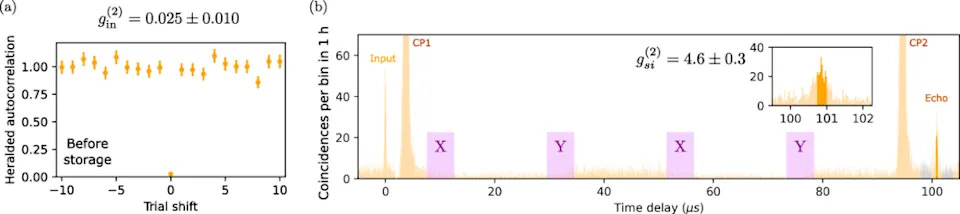
(a) Heralded autocorrelation of signal photons without storage. The signal mode goes through a broad transparency window prepared in both the QM and the filter crystal. (b) Time-correlation histogram between the detection of idler and signal photons after storage in the QM with a single XY4 sequence for 100.9 μs. (CREDIT: Hugues de Riedmatten et al, Physical Review Letters)
Because 180 μs corresponds to the time light would take to travel roughly 36 km in optical fiber, this storage interval is directly relevant to repeater synchronization: a memory must hold quantum states long enough for entanglement generation and heralding signals to propagate between nodes.
Limitations and Paths Forward
The authors emphasize this is not yet a working quantum internet. Quantum performance was limited by falling retrieval efficiency and increasing noise for longer delays. Some of the extra noise appears related to small residual magnetic fields interacting with the RF sequence. The team estimates that improved magnetic-field control, moderate applied fields, or engineered zero first-order Zeeman (ZEFOZ) configurations could extend spin coherence toward millisecond timescales and substantially improve single-photon storage lifetimes.
Why This Matters
This experiment demonstrates that a well-established solid-state memory platform — praseodymium-doped AFCs — can retain genuine quantum features of single photons while using spin rephasing techniques that are compatible with much longer storage. The combination of a telecom herald, a 2.5 MHz photon bandwidth matched to the memory, and dynamical decoupling makes this architecture a strong candidate for scalable quantum-repeaters and future long-distance quantum networks.
"Our scheme thus establishes praseodymium-doped quantum memories as a major candidate for the scalable implementation of quantum networks," said senior researcher Hugues de Riedmatten.
Research findings appear in Physical Review Letters.
Help us improve.