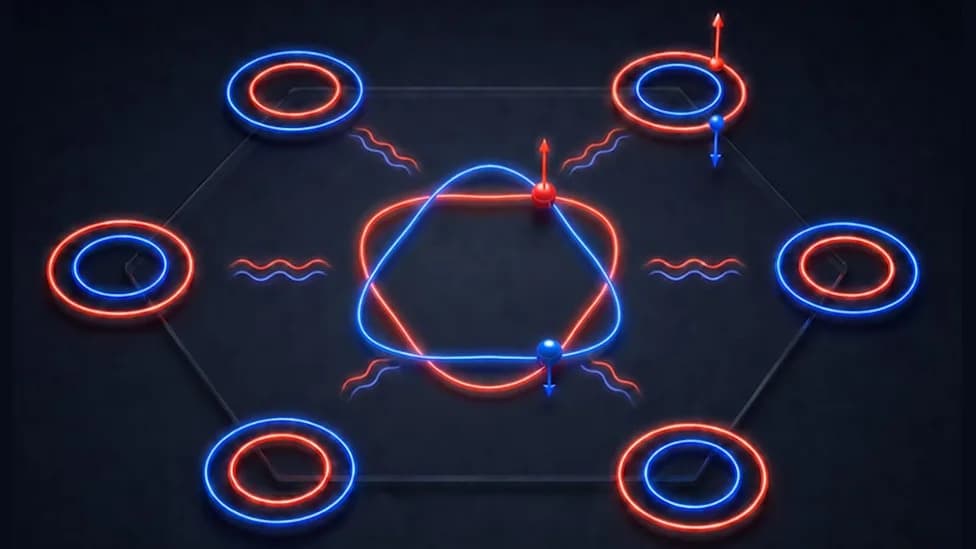
Researchers used a pair of ultrafast laser pulses to disrupt and then monitor how two perpendicular charge density waves in erbium tritelluride rebuild. The dominant CDW recovered uniformly, while the secondary CDW reappeared as isolated pockets that grew and merged, resembling ice nucleation. These distinct pathways point to different microscopic formation mechanisms and offer a new, time-resolved method to study phase competition in quantum materials with potential relevance to superconductors and future electronics.
Physicists Watch a Quantum Material Rebuild Like Freezing Ice After Ultrafast Laser Blasts
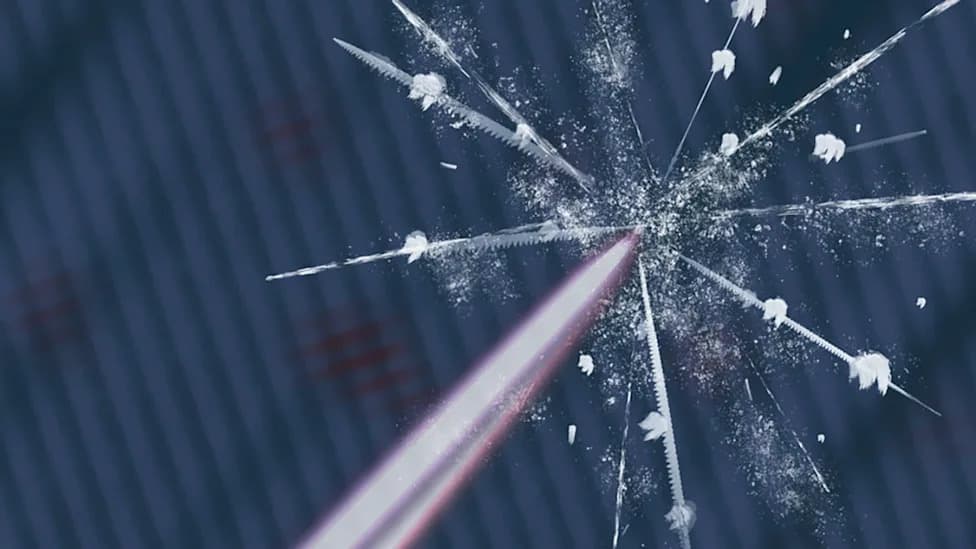
Illustration showing the two phases (uniform blue stripes and subtle red stripes) in the material, plus the pump (red) and probe (purple) laser beams. (Xinyue Lu)
An international team of researchers has directly observed how competing electronic orders reconstruct themselves in a quantum material after being disrupted by ultrafast laser pulses. Using a time-resolved pump–probe approach, the study reveals two fundamentally different recovery pathways for coexisting charge density wave (CDW) phases in the rare-earth compound erbium tritelluride (ErTe3). The results are published in Nature Physics (Su et al., Nat. Phys., 2026).
Material and Experimental Approach
Erbium tritelluride is known to host two perpendicular CDW patterns at low temperatures: a dominant CDW that appears below roughly −8 °C (18 °F) and a second, orthogonal CDW that emerges only below about −113 °C (−171 °F), producing an intersecting "checkerboard" of electron density within the crystal.
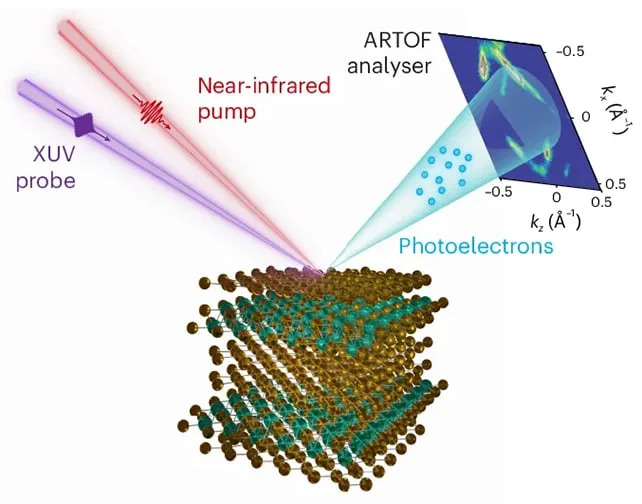
Two laser pulses were used to disrupt the CDW order and then track how the electronic structure recovered. (Su et al.,Nat. Phys., 2026)
Because these coexisting orders are fragile and difficult to probe at thermal equilibrium, the team used two short, intense laser pulses in a pump–probe configuration. The first pulse (pump) disrupted the preexisting checkerboard order so the CDWs would have to reform; the second pulse (probe) tracked the electronic-structure reconstruction in real time with ultrafast resolution (Su et al., Nat. Phys., 2026).
Key Findings
The dominant CDW recovered gradually and spatially uniformly across the sample, consistent with a collective re-establishment of order. The secondary, lower-temperature CDW returned by nucleating in isolated pockets that then expanded and merged — a process the authors liken to the nucleation and growth of ice crystals as water freezes.
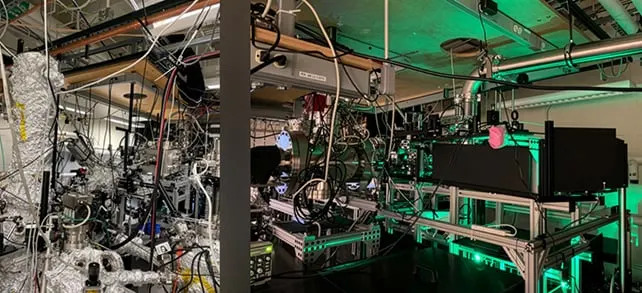
The setup used to study the rare-earth material erbium tritelluride. (MIT)
These contrasting recovery pathways indicate that the two CDW phases are established by fundamentally different microscopic mechanisms. In other words, one phase reforms via a coherent, collective process, while the other proceeds through localized nucleation-and-growth dynamics.
Why This Matters
Charge density waves are a simpler example of collective electronic order and serve as a model for the more complex phase competition seen in technologically important quantum materials, including high-temperature superconductors, where magnetism, superconductivity, and charge order can coexist or compete. Understanding how distinct phases form and interact is essential for decoding emergent behaviors and, ultimately, for developing materials with tunable quantum properties.

Subscribe to ScienceAlert's free fact-checked newsletter
"Charge density waves, like superconductivity, are collective electronic phenomena where electrons move in lockstep. The advantage of CDWs is that they are simpler to model than superconductivity and provide a clearer playground for fundamental study," said Yifan Su (MIT). "Our time-resolved method offers a powerful new window on the hidden physics that govern phase transitions in quantum materials," added Nuh Gedik (MIT).
Co-leader Alfred Zong (formerly at MIT, now at Stanford) noted the longer-term implications: controlling multiple coexisting phases is widely seen as a possible route to materials that could complement or eventually outperform silicon in some applications. The authors suggest the same laser-pulse approach could be extended to study more complex materials and the interplay between superconductivity, magnetism, and charge order.
Reference: Su et al., Nature Physics, 2026.
Help us improve.