Summary: A team led by Jietai Jing at East China Normal University teleported the continuous-variable quantum states of a 10 × 10 array of spatial optical modes—effectively a 100-pixel image—across 100 independent channels in parallel. The all-optical system avoided per-channel electronic feedforward and achieved an average fidelity of 0.60, surpassing the classical limit of 0.52 for all modes. Limited mainly by ~1 W of pump laser power, the demonstration was published in Physical Review Letters and suggests a scalable path toward higher-bandwidth quantum communication.
Breakthrough: Scientists Teleport a 100-Pixel Image Across 100 Quantum Channels Simultaneously
(FotografiaBasica/Creatas Video/Getty Images)
Quantum teleportation—transferring the quantum state of one system to another using shared entanglement and classical communication—has taken a major step toward practical, high-capacity quantum networks.

YouTube Thumbnail
What the team did
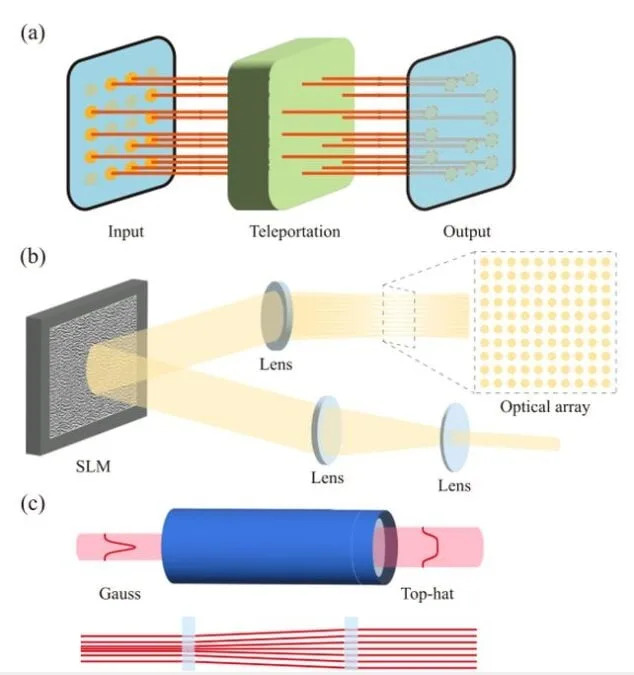
A schematic of the team's approach to parallel quantum teleportation. A 10 × 10 array of spatial optical modes is paired with a matching entangled-light array. (Lou et al.,Phys. Rev. Lett., 2026)
Researchers led by Jietai Jing at East China Normal University demonstrated quantum teleportation across 100 independent channels at once. They encoded quantum information into a 10 × 10 array of spatial optical modes (each mode acting like a pixel) that together formed the letter "Q." Using a matching entangled-light grid and an all-optical processing system, they teleported the continuous-variable quantum state (amplitude and phase quadratures) of each spatial mode in parallel and reconstructed the pattern at the receiving end.
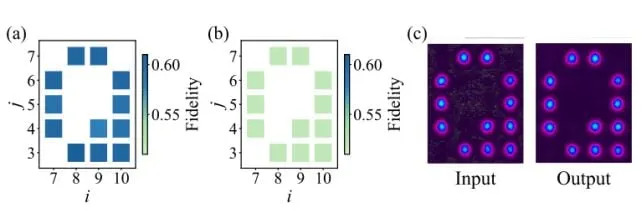
Quantum teleportation of the letter "Q". The teleportation fidelities (a) exceeded the corresponding classical limits (b), while the input and reconstructed output patterns are shown at right (c). (Lou et al.,Phys. Rev. Lett., 2026)
How this differs from previous work

Subscribe to ScienceAlert's free fact-checked newsletter
Most prior teleportation experiments used a single channel or only a few multiplexed channels, often requiring separate detection and electronic feedforward hardware for each channel. Jing's team avoided per-channel electronic feedforward by developing an optical architecture that handles all 100 modes in parallel, reducing the complexity that normally scales with channel count.

YouTube Thumbnail
Results and significance
The researchers measured fidelity—the standard metric for how closely the output quantum state matches the input—reporting an average fidelity of 0.60 across the 100 modes. This exceeds the corresponding classical fidelity limit of 0.52 (the best average achievable without entanglement), and each of the 100 modes individually surpassed its classical bound. That consistent advantage across a large, independently addressable array demonstrates that teleportation capacity can scale without becoming prohibitively cumbersome.
Limits and next steps
The current 10 × 10 array size was primarily limited by available pump power (about one watt of laser power). The authors note that more powerful lasers and further engineering could increase the number of spatial modes and thus the number of parallel teleportation channels. The approach targets continuous-variable optical modes; scaling to different hardware or integrating with quantum repeaters and networks will be important future steps.
Publication and context
The work was published in Physical Review Letters. Jing described the demonstration as, to their knowledge, the largest number of independently addressable quantum teleportation channels shown simultaneously. The result marks a notable advance toward higher-bandwidth quantum communication networks by showing a practical route to parallel teleportation across many modes.
Bottom line: The team demonstrated parallel quantum teleportation across 100 spatial modes—effectively teleporting a 100-pixel quantum image—and achieved fidelities that beat classical limits for every pixel, pointing to a scalable architecture for higher-bandwidth quantum networks.
Help us improve.