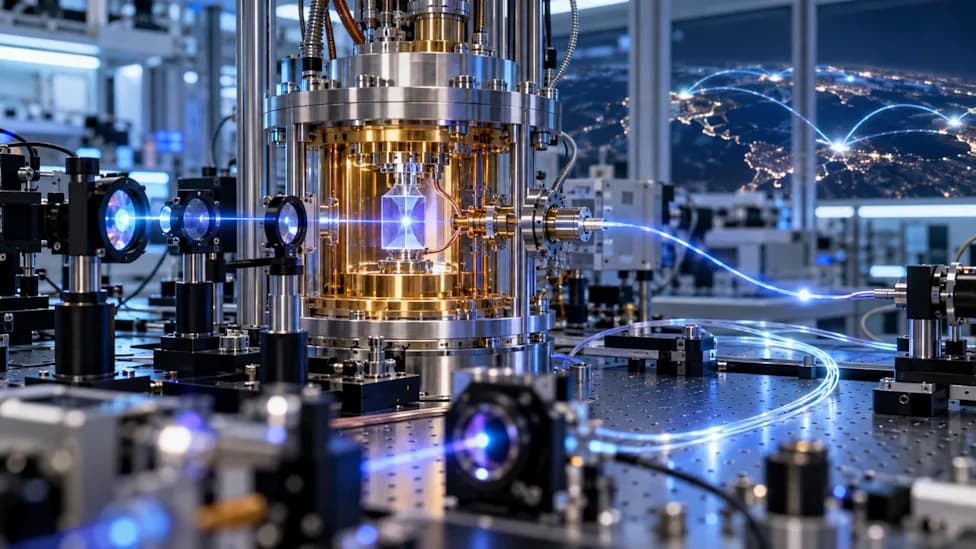
The team used a tunable open microcavity to selectively speed transitions in an indium gallium arsenide quantum dot's biexciton cascade, raising the first photon's raw two-photon interference visibility to about 90% (≈94% after purity correction). Shortening the first emission reduces timing jitter and improves indistinguishability; accelerating the second emission has the opposite effect. Remaining challenges are phonon-assisted cavity feeding and inefficient extraction of the second photon—issues the authors propose to address with modified dot designs and grating-based collection schemes.
Microcavity Boosts Quantum-Dot Photon-Interference Visibility to 90%, Revealing Key Trade-Offs
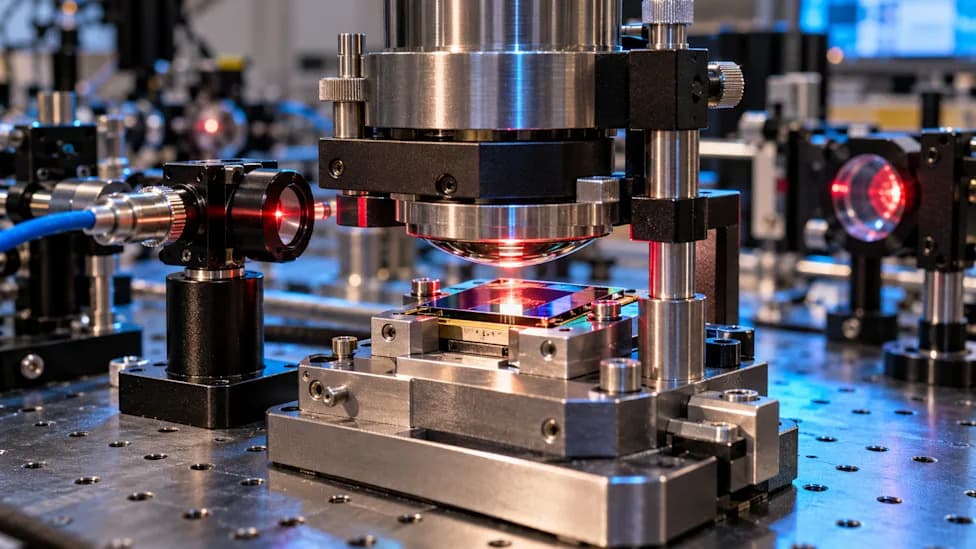
An optical cavity improves quantum-dot photon indistinguishability by controlling the timing of two successive light emissions. (CREDIT: Shutterstock)
An open optical microcavity has pushed the measured two-photon interference visibility of the first photon in a quantum-dot biexciton cascade to about 90%, compared with a typical unmodified value near 60%. The experiment demonstrates precise control over cascade timing yet highlights remaining obstacles—phonon processes and unequal photon extraction—that must be solved to make practical entangled-pair sources.
What the Team Did
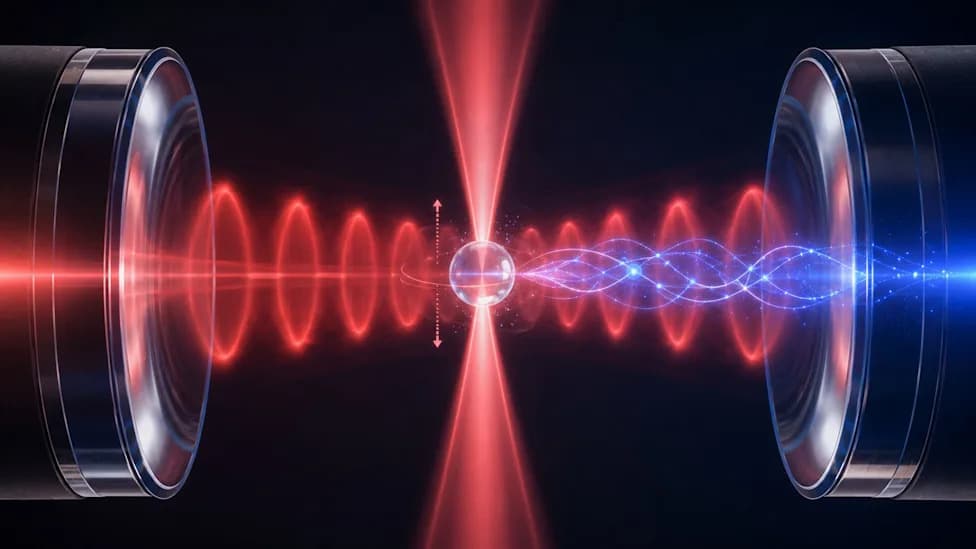
Researchers from the University of Basel, Paderborn University and Ruhr University Bochum placed an indium gallium arsenide quantum dot inside a tunable open microcavity and used the cavity resonance to selectively accelerate either the biexciton-to-exciton (XX→X) or the exciton-to-ground (X→0) transition. By changing mirror separation they tuned the Purcell-enhanced radiative decay rates and thereby varied the ratio of the biexciton and exciton lifetimes over two orders of magnitude.
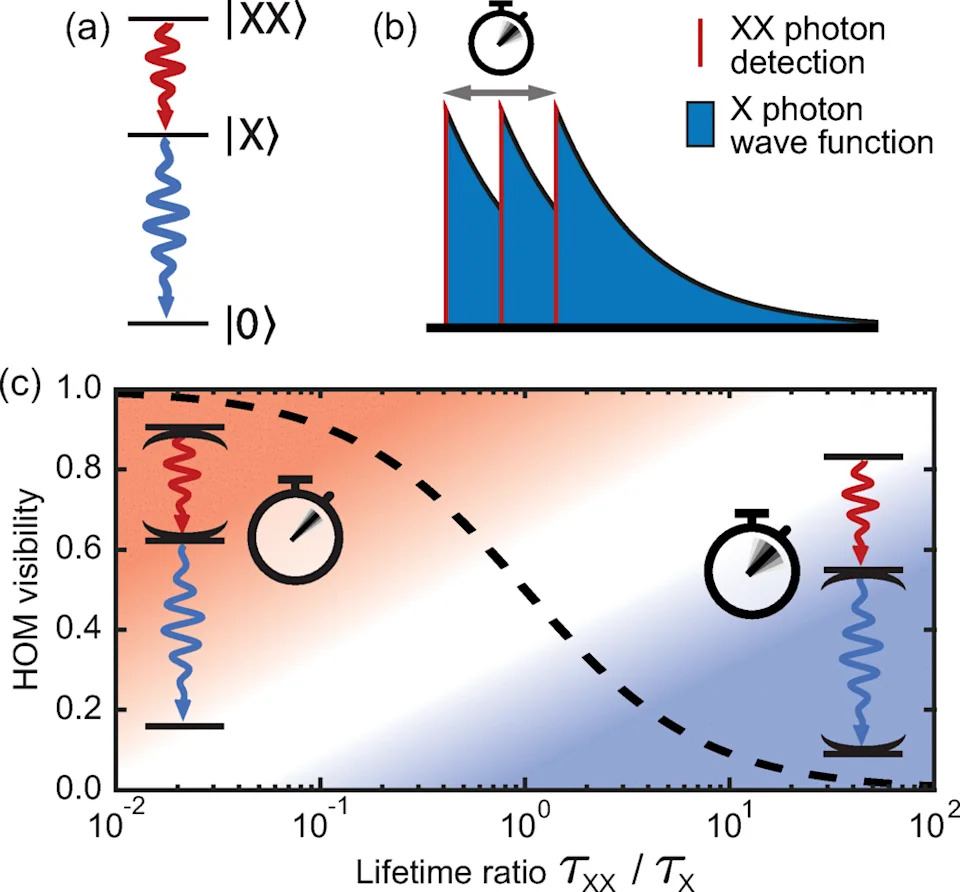
The biexciton cascade emits two time-correlated photons, creating timing jitter that limits their indistinguishability. Shortening the biexciton lifetime reduces this jitter and improves photon coherence. (CREDIT: Stefan Schumacher et al, Physical Review Letters 2026)
Why This Matters
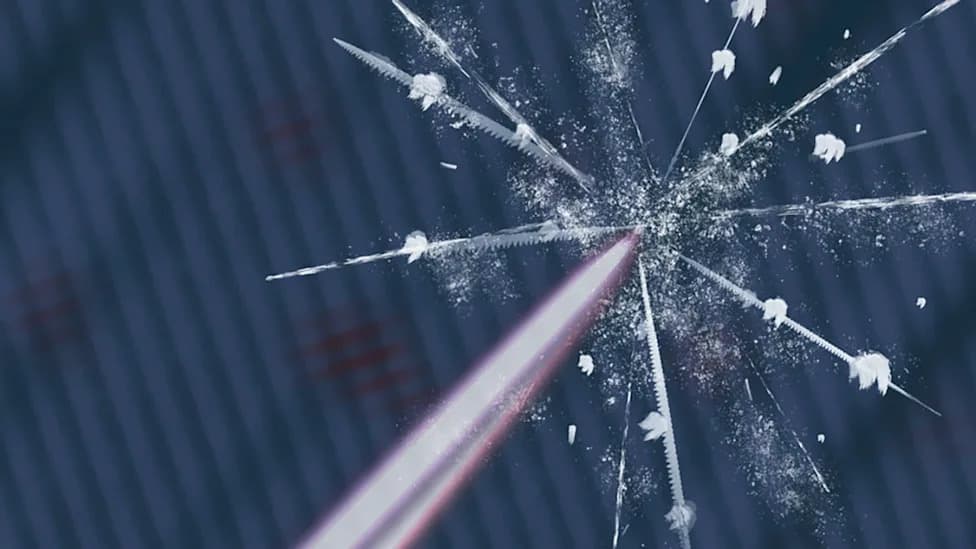
A biexciton cascade emits two time-ordered photons: the first photon is produced when the biexciton decays to a single-exciton state, and the second when that exciton decays to the ground state. That ordering creates timing jitter—the uncertainty in exactly when the first photon is emitted—which reduces the photons' indistinguishability and therefore their ability to interfere. Theory predicts, and the experiment confirms, that making the first emission much faster than the second reduces the contribution of that jitter and improves interference visibility.
Key Results
With the cavity tuned to enhance the first (XX→X) transition, the first photon reached a raw two-photon interference visibility of 90% ± 2 percentage points, while the second photon reached 80% ± 6 percentage points under the same setting. After correcting for imperfect single-photon purity (removing occasional multi-photon contributions) the visibilities were ≈94% for the first photon and ≈82% for the second.
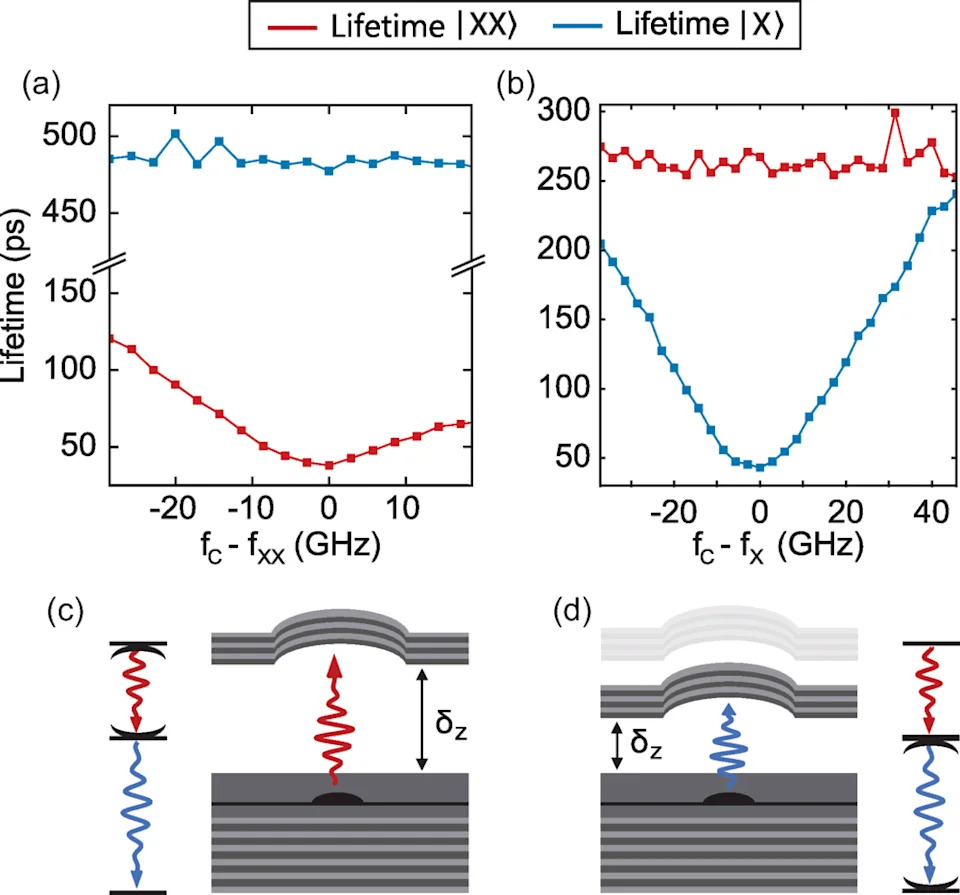
Scanning the cavity resonance tunes the XX and X photon transition lifetimes by two orders of magnitude. The open microcavity selectively enhances either the |XX⟩ → |X⟩ or |X⟩ → |0⟩ transition. (CREDIT: Stefan Schumacher et al, Physical Review Letters 2026)
Accelerating the second (X→0) transition had the opposite effect: it increased the lifetime ratio and reduced coherence. Thus, which transition the cavity enhances matters more than simply increasing overall emission rates.
Limitations and Mechanisms
The team observed that indistinguishability and single-photon purity respond differently to cavity tuning. When the cavity enhanced the biexciton transition the measured zero-delay photon correlation g(2)(0) was 2.3% (≈98% single-photon purity). When the exciton transition was resonant, the zero-delay correlation dropped below 0.1%—a contrast the authors attribute to cavity feeding.
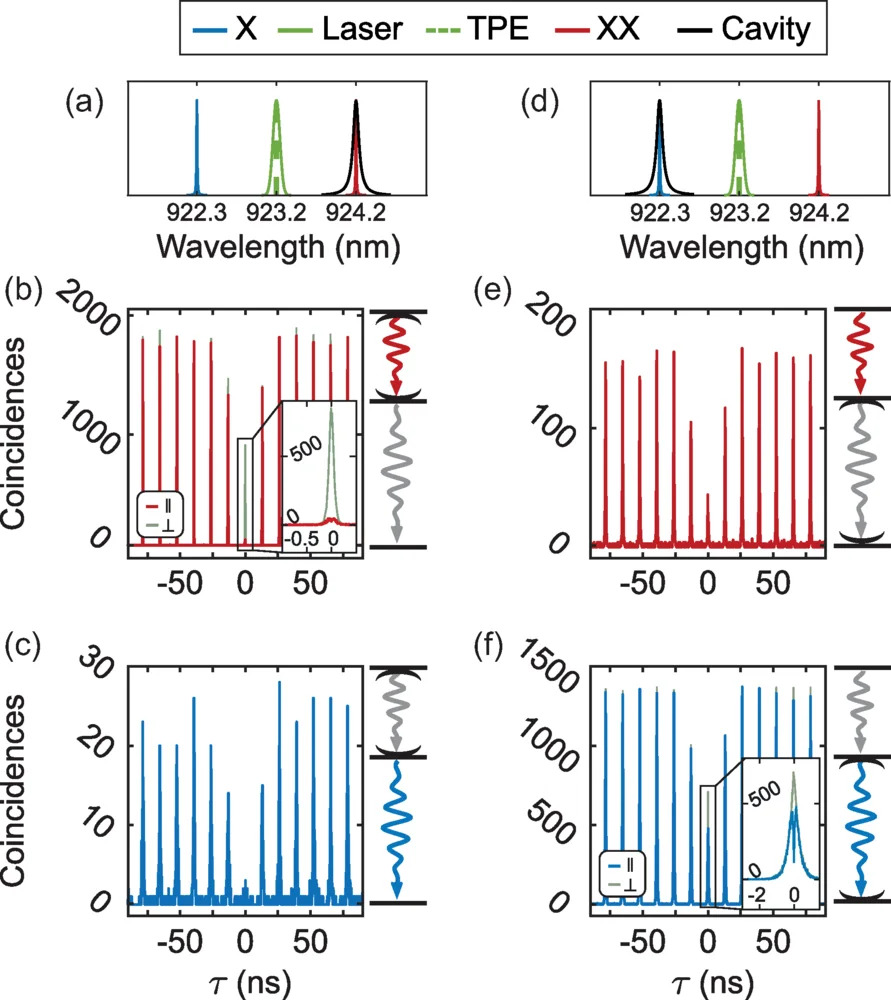
Characterization of the photon coherence using two-photon interference. (CREDIT: Stefan Schumacher et al, Physical Review Letters 2026)
Cavity feeding occurs when the exciton emits into the cavity while simultaneously creating a phonon (a crystal lattice vibration) that compensates the energy mismatch. That phonon-assisted, otherwise off-resonant emission can allow both cascade photons to enter the cavity output together, increasing multiphoton contributions and lowering purity in that configuration.
Practical Challenges And Proposed Fixes
Two main hurdles remain before this control can be turned into a practical entangled-pair source: (1) reducing phonon-assisted cavity feeding and exciton-phonon coupling, and (2) efficiently collecting both photons, which may fall into different optical modes because the open cavity favors a narrow frequency range.
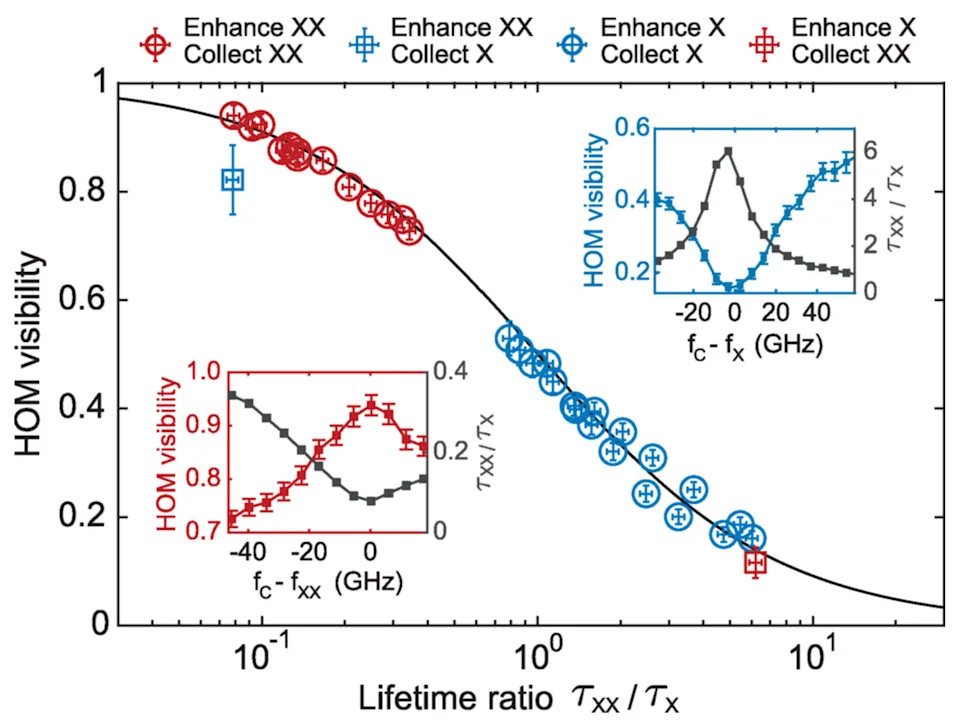
Photon coherence is shown as a function of the XX-to-X lifetime ratio, corrected for beam-splitter imperfections and two-photon emission. Insets show how HOM visibility and lifetime ratio vary with cavity detuning. (CREDIT: Stefan Schumacher et al, Physical Review Letters 2026)
Suggested engineering routes include quantum dots with larger biexciton binding energies, larger GaAs dots engineered for weaker exciton-phonon coupling, and optical-collection solutions such as on-chip gratings or circular Bragg gratings that combine selective emission enhancement with broader collection bandwidth.
Experiment Details And Context
Interference tests measured Hong-Ou-Mandel visibility between successive photons of the same transition separated by 13.1 ns, with spectral filtering used to isolate the first or second emission. The experimental trends closely followed quantum-optics predictions for how indistinguishability depends on the XX-to-X lifetime ratio, validating the lifetime-ratio control approach in a solid-state platform despite phonon-related complications.
Reference: Stefan Schumacher et al., Physical Review Letters (2026). The original reporting appeared in The Brighter Side of News.
Help us improve.