A team led by Sukanya Chakrabarti at the University of Alabama in Huntsville reports the strongest evidence yet for a dark matter subhalo a few thousand light-years from the Sun, based on precise timing of nearby pulsars. Two binary pulsars, J1640+2224 and J1713+0747, show a shared excess acceleration that cannot be explained by observed stars or gas. From this acceleration the authors infer an unseen mass of roughly 25 million solar masses; statistical tests favor a dark matter interpretation, though more data are needed to confirm and localize the object.
Astronomers Report Strongest Evidence Yet for a Dark Matter Subhalo Near the Sun

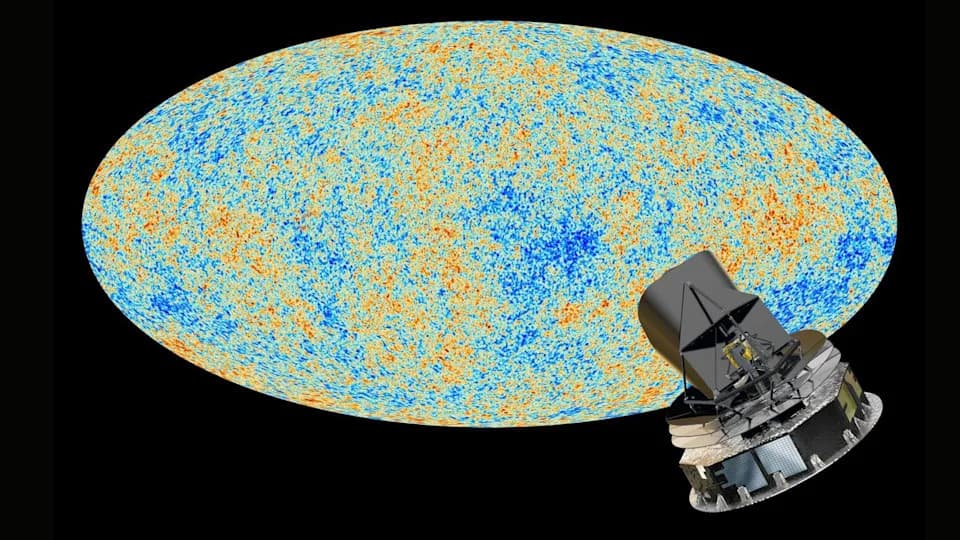
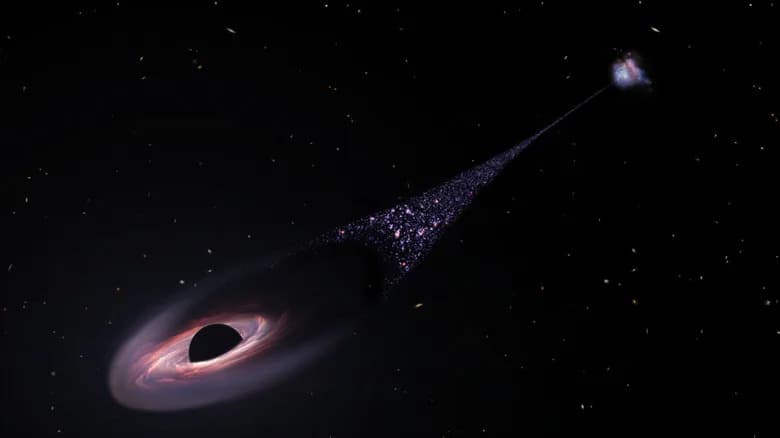
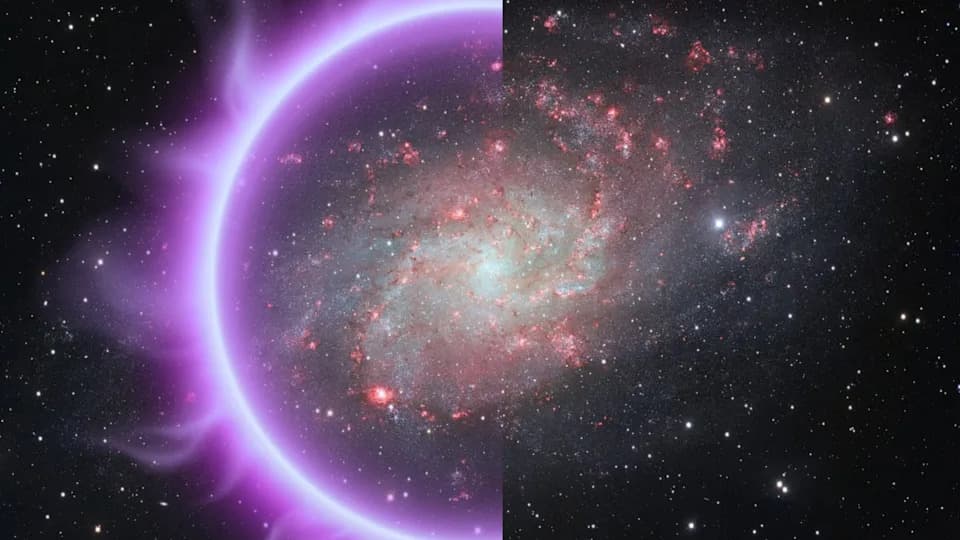
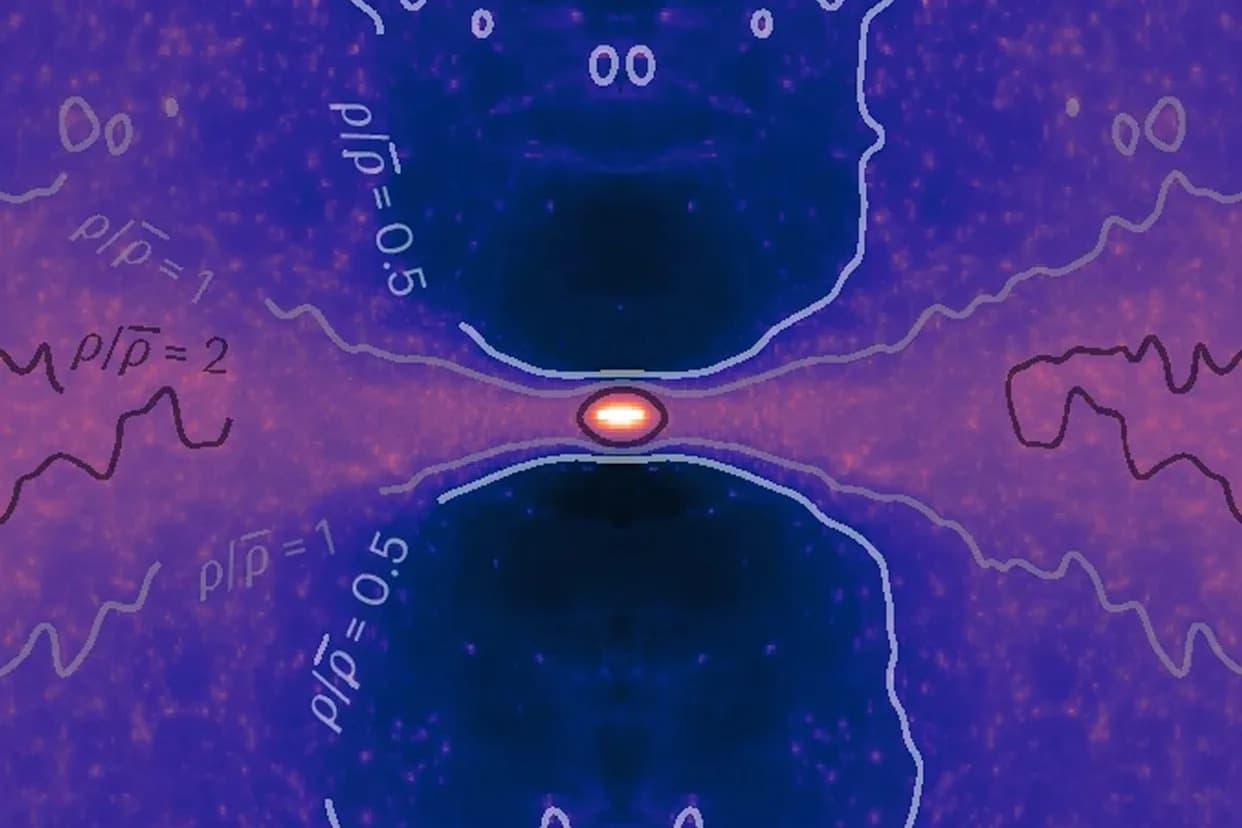
Precise pulsar timing reveals possible evidence of a dark matter clump lurking near our solar neighborhood. (CREDIT: AI-generated image / The Brighter Side of News)
A team of astronomers at the University of Alabama in Huntsville, led by astrophysicist Sukanya Chakrabarti, reports what may be the clearest evidence to date of a dark matter subhalo lurking a few thousand light-years from the Sun. Their analysis, published in Physical Review Letters, finds an unseen mass producing a subtle, shared gravitational tug on nearby pulsars — ultra-regular rotating neutron stars that act as exceptionally precise clocks.
How Pulsars Were Used as Gravity Probes
Pulsars emit beams of radiation that sweep past Earth with extraordinary regularity; some rival atomic clocks in stability. Small accelerations along our line of sight change the arrival times of those pulses. Chakrabarti and collaborators focused on binary pulsars (pulsars orbiting another star, typically a white dwarf) because their orbital-period evolution can be measured precisely. After correcting for known contributions — intrinsic pulsar motion and orbital energy loss, including gravitational-wave emission — any remaining systematic timing residuals reveal the local gravitational acceleration imposed by the Milky Way and by any nearby mass concentrations.
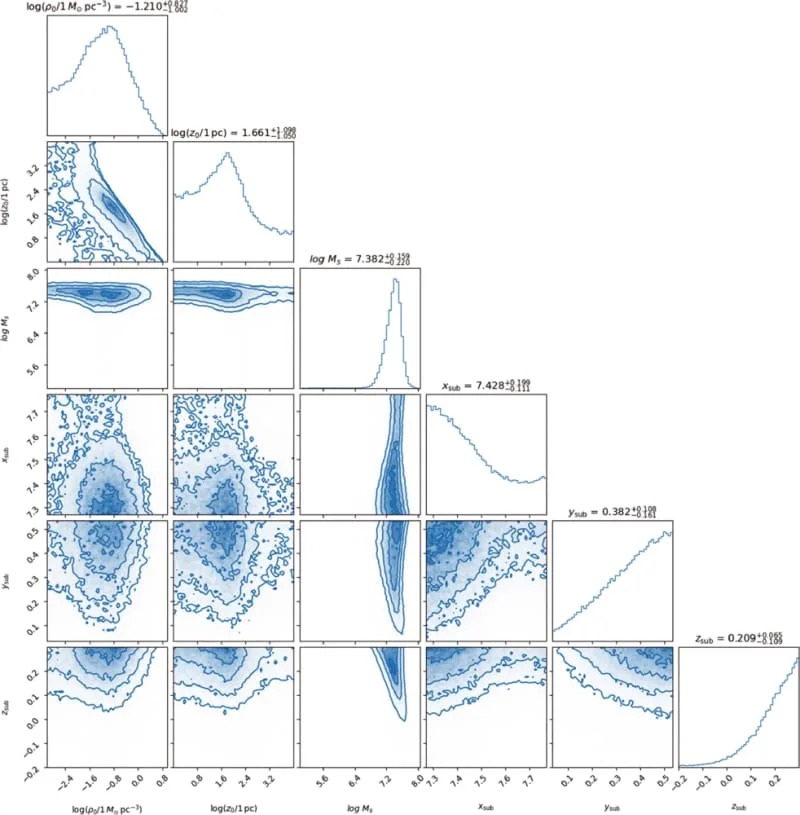
Posterior distribution showing derived properties of a dark matter sub-halo. The panels show the PDFs that display our constraint for the mass of the subhalo (in solar masses). (CREDIT: Physical Review Letters)
What The Study Found
The team analyzed 27 binary pulsars with high-quality timing data and compared pulsar pairs separated by less than 1,600 light-years, a scale consistent with the expected influence of a dark matter subhalo. Two systems, J1640+2224 and J1713+0747, stood out: both show a common excess acceleration that cannot be explained by known distributions of ordinary matter.
Using the magnitude of the measured acceleration, the authors infer an unseen object with a mass of roughly 25 million solar masses located a few thousand light-years from Earth — a mass and distance compatible with theoretical predictions for a dark matter subhalo.
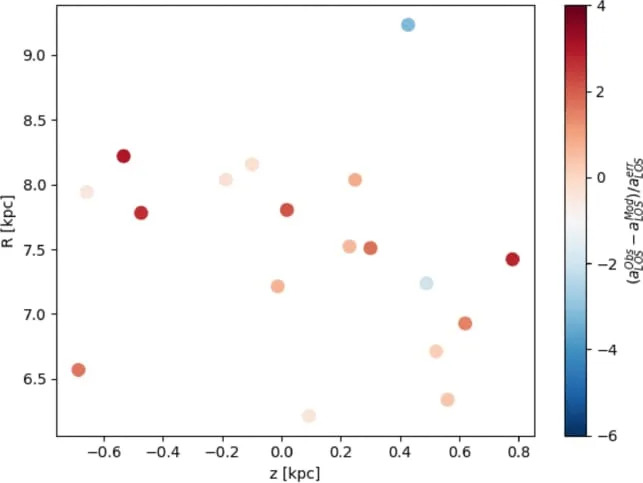
The fractional difference in the observed LOS acceleration relative to the model considering an exponential disk in Galactocentric coordinates R, z. (CREDIT: Physical Review Letters)
Ruling Out Ordinary Matter
To check for conventional explanations, the researchers searched for nearby concentrations of stars using Gaia star counts and for gas clouds using hydrogen surveys. They found no stellar overdensity or gaseous structure capable of producing the observed acceleration. Concentrating tens of millions of solar masses into a small enough volume composed of ordinary matter would require densities far higher than are observed locally, making a baryonic explanation unlikely.
Robustness, Models, and Statistics
The authors extended the analysis to include additional nearby pulsars (both solitary and binary) and applied several statistical techniques. Results were consistent with the initial signal and tightened the mass estimate, though the exact position of the perturber remains uncertain. The team tested both compact (point-like) and more extended mass geometries; both types of models prefer additional unseen mass. Model comparisons yield statistical support described by the authors as ranging from moderate to strong for a dark matter interpretation.
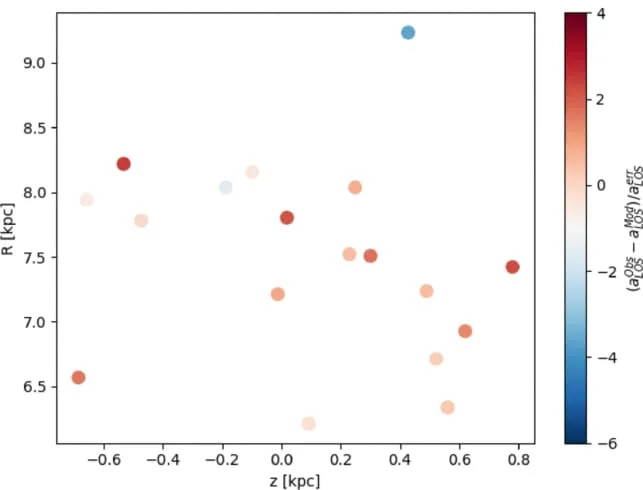
The fractional difference in the observed LOS acceleration relative to the model considering an exponential disk and a subhalo with a NFW profile. (CREDIT: Physical Review Letters)
Caveats and Next Steps
The researchers emphasize caution. Past interactions between the Milky Way and dwarf galaxies have left ripples and large-scale nonuniformities in the Galactic disk, and such structures could in principle mimic or contribute to the signal. Continued pulsar timing, additional high-precision observations of the region, and independent probes will be needed to confirm whether the signal persists and to better localize the mass.
Why This Matters
If confirmed, this would be the first detection of a dark matter subhalo inside the Milky Way — a landmark step toward mapping dark matter on small scales and reconciling models of galaxy formation with observations. The study also highlights a powerful technique: using pulsars as direct probes of local gravitational acceleration to map invisible mass without assuming global symmetry.
Reference: Full research paper available in Physical Review Letters.
Help us improve.