In January 2025, more than 90 critically endangered North Atlantic right whales gathered on Jeffrey's Ledge, prompting Maine lobstermen to voluntarily modify gear (dropping some endlines, using breakaway ropes, longer trawls, and purple tracers) to reduce entanglement risk. Scientists led by Camille Ross improved habitat models by adding prey (Calanus) distribution, showing prey data can reveal unexpected whale aggregations. Because of cooperation and timely reporting, no entanglements were reported; teams aim to add more recent data and faster communication tools to better protect whales as ocean conditions change.
Maine Lobstermen and Scientists Unite to Protect Critically Endangered Right Whales
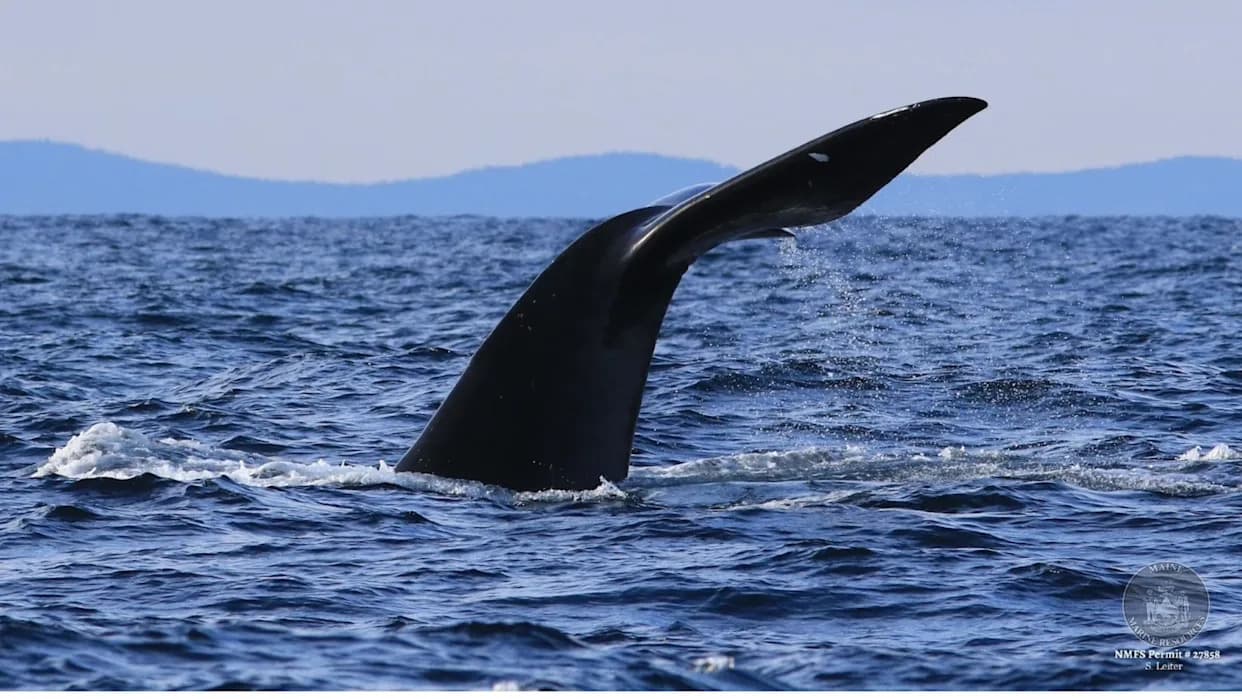
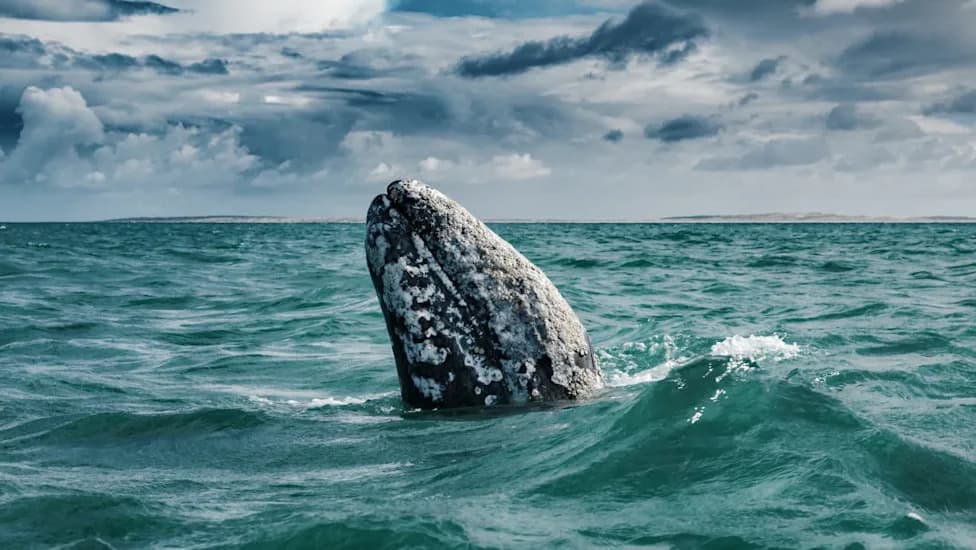
North Atlantic right whales sometimes gather at Jeffrey’s Ledge, a 62-mile-long underwater ridge about 25 miles off the coast of Portsmouth, New Hampshire.
On a cold, windy week in January 2025, more than 90 critically endangered North Atlantic right whales (Eubalaena glacialis) unexpectedly congregated on Jeffrey's Ledge — a 62-mile underwater ridge about 25 miles off Portsmouth, New Hampshire. The rare aggregation halted some lobstermen from hauling traps and spurred an urgent, cooperative response between fishermen and scientists to reduce entanglement risk and improve whale-forecasting tools.
What Fishermen Did
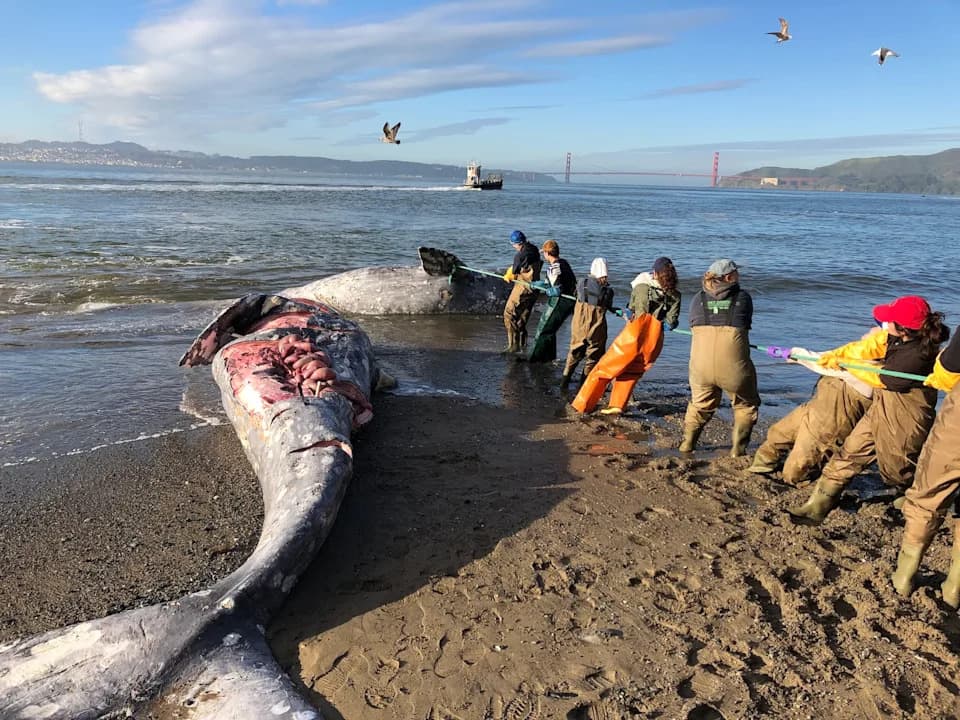
After confirming they had followed state and federal rules — including using breakaway ropes, setting longer trawls to reduce the number of endlines, and adding purple tracers to gear so any entanglements could be traced — Maine lobstermen convened an emergency meeting. To reduce the number of vertical lines in the water, fishermen voluntarily dropped several northeast endlines, a deviation from normal practice designed to lower the chance of whale entanglement.
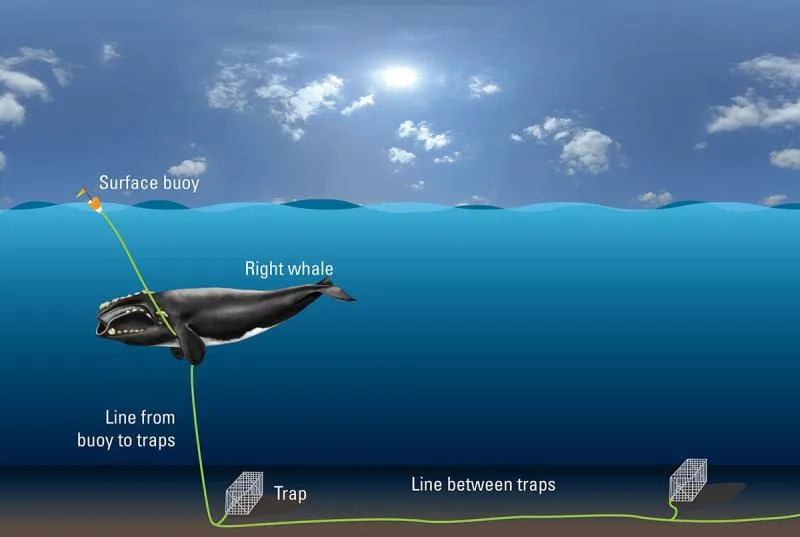
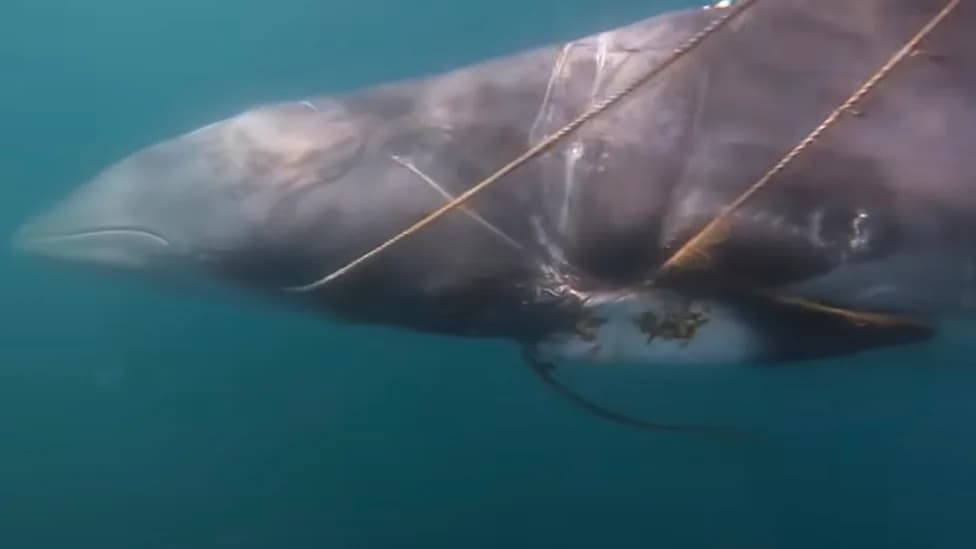
Illustration of how North Atlantic right whales get entangled in fishing gear. Entangled whales sometimes tow fishing gear for hundreds of miles.Image: WHOI Graphic Services, Woods Hole Oceanographic Institution via NOAA.
"We had to do something more to lower the risk. No fisherman wants to harm a right whale, so we're willing to bend over backwards to make this work," said lobsterman Chris Welch.
How Science Helped
Research scientist Camille Ross and collaborators at the New England Aquarium, Bigelow Laboratory for Ocean Sciences, Duke University, and the University of Maine are refining habitat models to better predict where right whales will appear. In a study published in Endangered Species Research, the team improved predictions by incorporating data on the whales' prey — small, krill-like zooplankton in the genus Calanus — whose distribution is highly sensitive to small shifts in ocean temperature.
"What we did was incorporate right whale food directly into right whale habitat models to help improve the prediction, and it appears it did, which is really exciting," Ross said.
Why Prey Matters
Right whales follow dense patches of Calanus to feed. As ocean temperatures change, Calanus populations shift in time and space, so whales can appear in unexpected places. Ross notes that warming and other changes have made it harder to predict where most of the population will be at any moment — which is why finding the prey first can make habitat models far more informative.
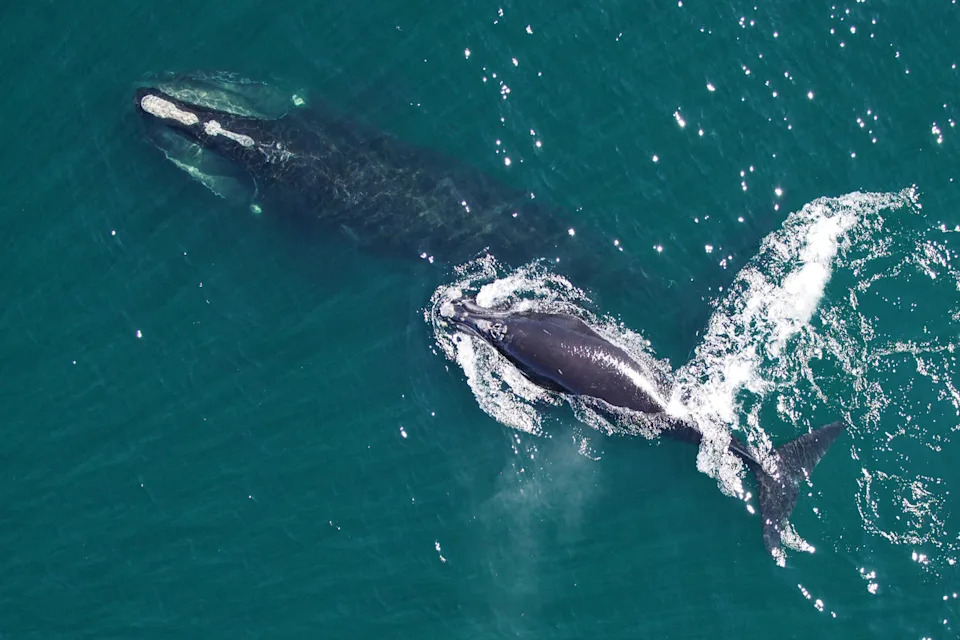
A North Atlantic right whale mother and calf as seen from a research drone called a hexacopter. Hexacopters allow researchers to conduct right whale photo identification and photogrammetry studies. Photogrammetry techniques allow scientists to get body measurements from aerial photographs.Image: NOAA Northeast Fisheries Science Center/Lisa Conger and Elizabeth Josephson.
Outcomes and Challenges
Because fishermen alerted authorities and cooperated on-site, zero entanglements were reported on Jeffrey's Ledge in January 2025. Observers estimated that roughly 25% of the species' population — more than 90 animals — were present during the aggregation. With an estimated total population of about 380 right whales and only ~70 reproductively active females, avoiding entanglement is crucial to the species' recovery.
However, communication remains imperfect: fishermen rely on informal phone chains and group texts to share whale sightings because some state systems lack a fast, targeted way to notify distributed fishing crews.
Broader Collaboration
Programs such as NOAA’s Cooperative Research in the Northeast and the Study Fleet demonstrate how fishermen and scientists can work together long-term: commercial fishers collect environmental and fishing-effort data that improve models and management. Ross and colleagues plan to incorporate more recent and near-real-time data into predictive models so managers and fishermen can receive better advance notice of whale hotspots.
Looking Ahead: Continued collaboration between the fishing community, scientists, and agencies — paired with improved predictive tools that include prey dynamics and faster communication systems — can reduce entanglement risk and help protect this critically endangered species while supporting coastal livelihoods.
Help us improve.