Researchers followed Geoffroy’s spider monkeys in Mexico’s Yucatán Peninsula from 2012 to 2017 and found that their fission-fusion social structure spreads detailed information about fruit locations and ripening times. Individuals carry local foraging knowledge between subgroups, allowing the population to pool distributed resources. Mathematical models show this dynamic maximizes collective awareness, an emergent form of intelligence without language. Protecting large, connected forests is crucial to preserve the social networks that enable this information sharing.
How Spider Monkeys Share ‘Insider Knowledge’ to Find the Best Fruit
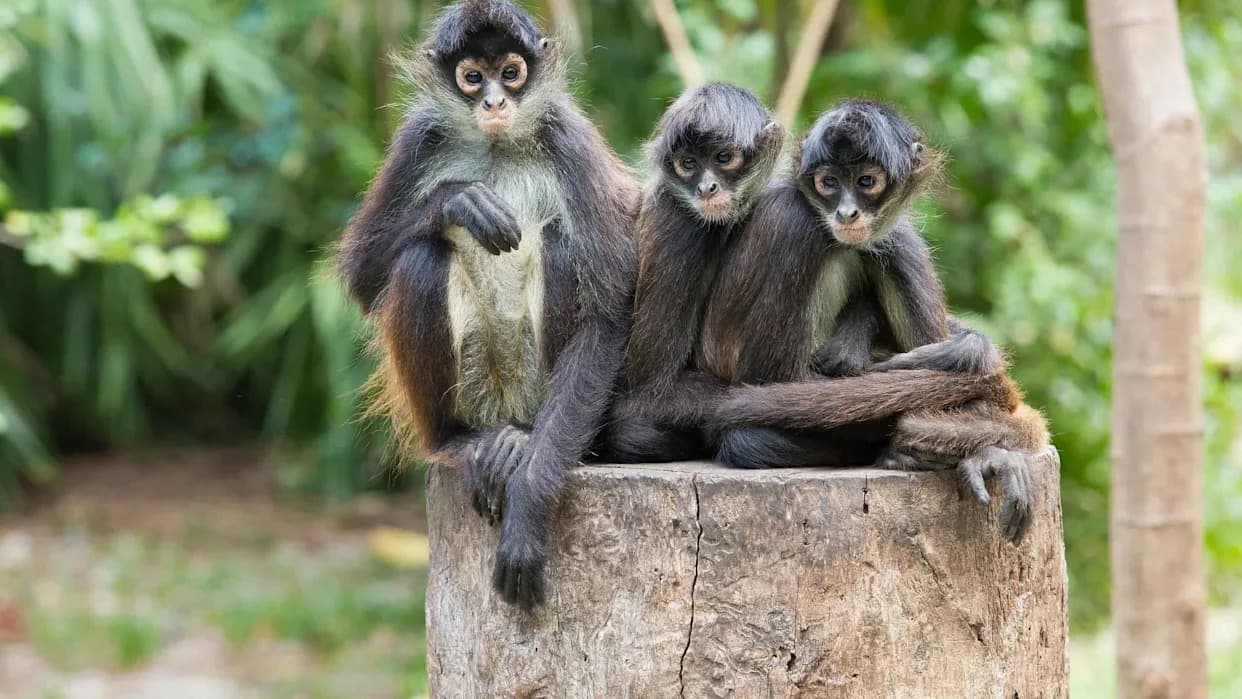
Spider monkeys on a tree.© Pakhnyushchy/Shutterstock.com
Deep in Mexico’s Yucatán Peninsula, researchers discovered that Geoffroy’s spider monkeys use their fluid social lives to spread precise, nonverbal information about where and when fruit ripens. Over seven years of fieldwork, scientists found that the monkeys’ repeated pattern of breaking into and recombining small subgroups—known as a fission-fusion social system—acts like a natural information network, allowing knowledge from different parts of the forest to circulate across the entire population.
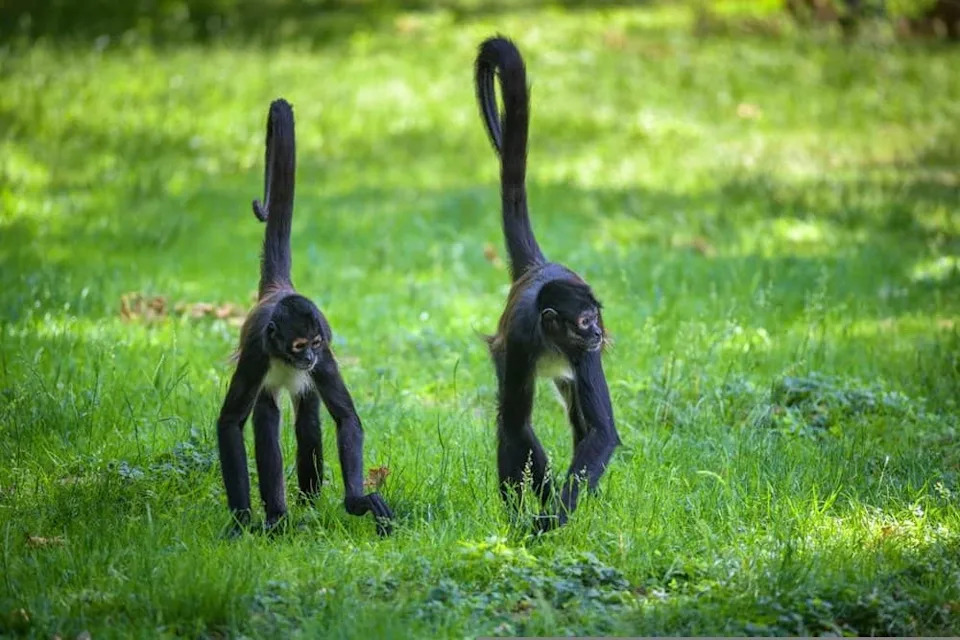
Spider monkeys spread food knowledge through constantly changing subgroup memberships rather than direct communication or teaching.©Nick Fox/Shutterstock.com(Nick Fox/Shutterstock.com)
Fission-Fusion: A Living Information Network
Rather than moving as a single, stable troop, spider monkeys drift between small, changing subgroups throughout the day. Field teams from Heriot-Watt University, the University of Edinburgh, and the National Autonomous University of Mexico tracked groups from 2012 to 2017, recording who traveled together, which forest areas they visited, and when trees bore ripe fruit. The pattern that emerged was consistent: different subgroups tended to exploit different patches of the forest and thus held distinct foraging knowledge.
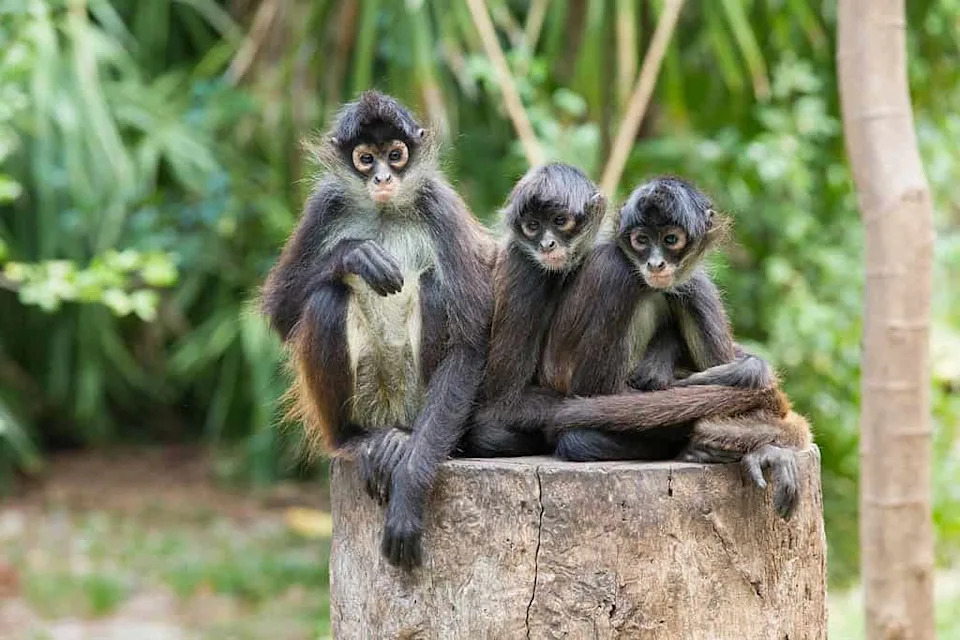
Spider monkeys demonstrate collective intelligence, where group structure itself helps solve complex foraging problems.©Pakhnyushchy/Shutterstock.com(Pakhnyushchy/Shutterstock.com)
How Knowledge Moves
When an individual switches subgroups, the foraging experience it carries becomes available to its new companions. A monkey familiar with fruiting trees in one sector may join animals that know ripening schedules in another sector; together they pool that information. Over time, repeated mixing spreads localized discoveries through the social network, much like gossip moving through a human social circle.
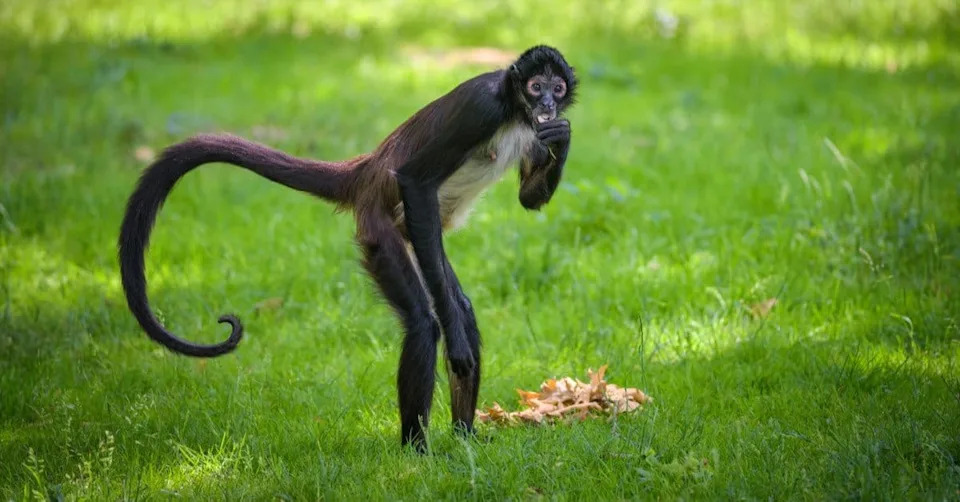
Protecting large, connected forests may be critical for maintaining the social systems spider monkeys depend on to survive.©Nick Fox/Shutterstock.com(Nick Fox/Shutterstock.com)
Mathematical Models and Collective Intelligence
Researchers complemented observations with mathematical models showing that this pattern of fragmenting and reconnecting increases the population’s overall awareness of fruit availability. Because ripe fruit is patchy and unpredictable across a large landscape, no single monkey or fixed subgroup can monitor every patch. The fission-fusion dynamic lets the population aggregate distributed information, an emergent form of collective intelligence that does not require language or symbolic communication.
Why This Matters
These findings deepen our understanding of animal cognition and social learning. They show that intelligent outcomes can arise from patterns of interaction: social structure itself becomes a cognitive tool. The results also have clear conservation implications. Spider monkeys are endangered in parts of their range, and their ability to share critical foraging information depends on access to wide, connected forest areas. Habitat fragmentation could break the social links that enable effective information flow, reducing foraging efficiency and resilience.
Broader Context
Spider monkeys are part of a larger suite of species that share information to improve survival. Honeybees perform waggle dances to direct nestmates to nectar, ravens and parrots use calls to signal food, and meerkats combine vocalizations with coordinated behavior to locate food and warn of predators. Each example highlights a common advantage: when one individual possesses reliable information about a resource, sharing or transmitting that information benefits the wider group.
"Minds need not be isolated to function. What one spider monkey learns in one patch of forest becomes accessible to others through movement, curiosity, and cooperation."
By combining careful long-term observation with modeling, the study offers a convincing account of how simple social rules can produce sophisticated collective outcomes. For conservationists and behavioral scientists alike, these results underscore the importance of preserving both animals and the social environments that sustain their adaptive behaviors.
Help us improve.