The Department of Energy is asking states to volunteer to host permanent geological repositories for spent nuclear fuel as part of multi-purpose nuclear campuses that could include reactors, reprocessing and data centers. The RFI packages long-term waste disposal with large investment incentives to secure local consent, even as the U.S. stockpile grows to about 100,000 tons and adds roughly 2,000 tons yearly. While advanced reactors and reprocessing are part of the plan, experts warn the waste disposal challenge remains unresolved and could take decades to settle.
Wanted: Volunteers To Host U.S. Nuclear Waste — DOE Offers Billions, Reactors and Data Centers
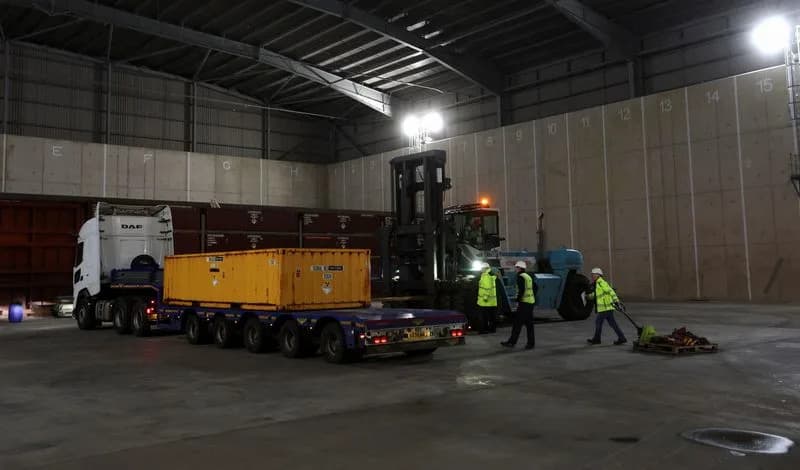
A truck delivers a container to the low-level waste vaults at the Dounreay nuclear site in Dounreay, Scotland, Britain November 25, 2025. REUTERS/Russell Cheyne
The U.S. Department of Energy (DOE) has issued a request for information (RFI) inviting states to volunteer to host permanent geological repositories for spent nuclear fuel as part of multi-purpose 'nuclear campuses' that could also include new reactors, reprocessing facilities, uranium enrichment and even data centers. The move pairs a long-standing waste disposal challenge with major investment incentives as Washington pushes to expand nuclear power for the AI and electrification era.
Policy Shift and The Pitch
The RFI signals a notable policy shift: instead of trying to impose a single site, the administration is packaging permanent waste disposal with local economic benefits and putting the choice in the hands of communities. DOE officials say the package could bring tens of billions of dollars in investment and thousands of jobs to host states. States have 60 days to respond to the RFI.
'By combining this all together in a package, it is a matter of big carrots being placed alongside a waste facility which is less desirable,' said Lake Barrett, a former NRC and DOE official.
Why The Push Now
President Donald Trump has set a target to roughly quadruple U.S. nuclear capacity to about 400 gigawatts by 2050, citing rising electricity demand from data centers supporting artificial intelligence and the electrification of transport. In 2025 the DOE selected 11 advanced small modular reactor (SMR) designs for fast-track licensing and aims to have three pilot reactors operating by July 4, 2025.
Waste Remains The Central Problem
But public acceptance of new reactors hinges on credible plans for long-term waste disposal. The United States currently stores roughly 100,000 tons of radioactive waste at reactor sites and other locations and adds about 2,000 tons per year. To date, U.S. taxpayers have paid utilities about $11.1 billion to compensate them for interim storage of spent fuel.
Past attempts to site a permanent repository ran into political opposition. The federal search that began in 1983 led to Yucca Mountain in Nevada, where nearly $15 billion was spent before funding was halted in 2010 amid state and local resistance.
New Reactors, Same Waste Problem
SMRs are promoted for speed and cost advantages because much of their construction can be factory-built. Yet experts warn new SMR designs do not solve the underlying waste challenge. Designers are typically not required to eliminate long-term waste needs at the design stage beyond outlining management plans. A 2022 study in the Proceedings of the National Academy of Sciences found many SMR concepts could produce similar or greater volumes of waste per unit of electricity than today's large reactors.
Because SMRs can be sited in locations lacking heavy infrastructure, critics caution the technology could lead to many more sites that effectively serve as long-term interim storage. In the U.S., 'interim' storage can persist for more than a century after a reactor closes, according to regulators.
Reprocessing Debate
The DOE says advanced recycling and reprocessing technologies could dramatically reduce the volume of material requiring disposal, but stresses reprocessing would not eliminate the need for a permanent repository. Nuclear security experts caution reprocessing brings cost, proliferation and security challenges; historical efforts have struggled to meet early promises of high reuse rates.
'Every time it has been attempted, it creates security and proliferation risks, the costs are enormous, and it complicates waste management,' said Ross Matzkin-Bridger, a former DOE official.
Global Progress And Lessons
No country yet operates a fully deployed, permanent geological repository for high-level waste, but several nations are advancing projects. Finland's Olkiluoto site is closest to operation after moving test canisters more than 400 metres underground in 2024; it expects to begin commercial operations pending final regulatory sign-off. Sweden, Canada, Switzerland, France and the U.K. are at various stages of site selection, construction or planning with operational targets ranging from the 2030s to the 2050s and beyond.
These projects underscore the technical complexity and long timelines required: community consent, extensive geological studies (including groundwater flow and rock stability down to roughly 1,000 metres) and multi-decade permitting and construction phases.
Next Steps And Stakes
The DOE says the RFI has generated interest but declined to comment on specific states. Utah and Tennessee have been mentioned as showing interest in nuclear investments. The decision process that follows will hinge on local buy-in, regulatory approvals and complex trade-offs among economic benefits, security concerns and long-term environmental safety.
As the U.S. weighs a rapid expansion of nuclear capacity, resolving where and how to store the most dangerous waste remains the defining political and technical hurdle.
Help us improve.