Camp Century was a secret U.S. Arctic research base built in 1959 and powered by a small nuclear reactor; it operated for six years and extracted nearly mile‑deep ice cores before being abandoned in 1966. Renewed attention to Greenland — driven by strategic concerns, melting ice and interest in rare earth minerals — has revived debates over access, sovereignty and environmental risk. Geologist Paul Bierman explains on The Conversation Weekly why engineering limits, environmental impacts and geopolitics make simple narratives about mining and ownership misleading.
Camp Century Buried in Greenland Ice: What the Cold War Base Reveals About the Island’s Strategic Value
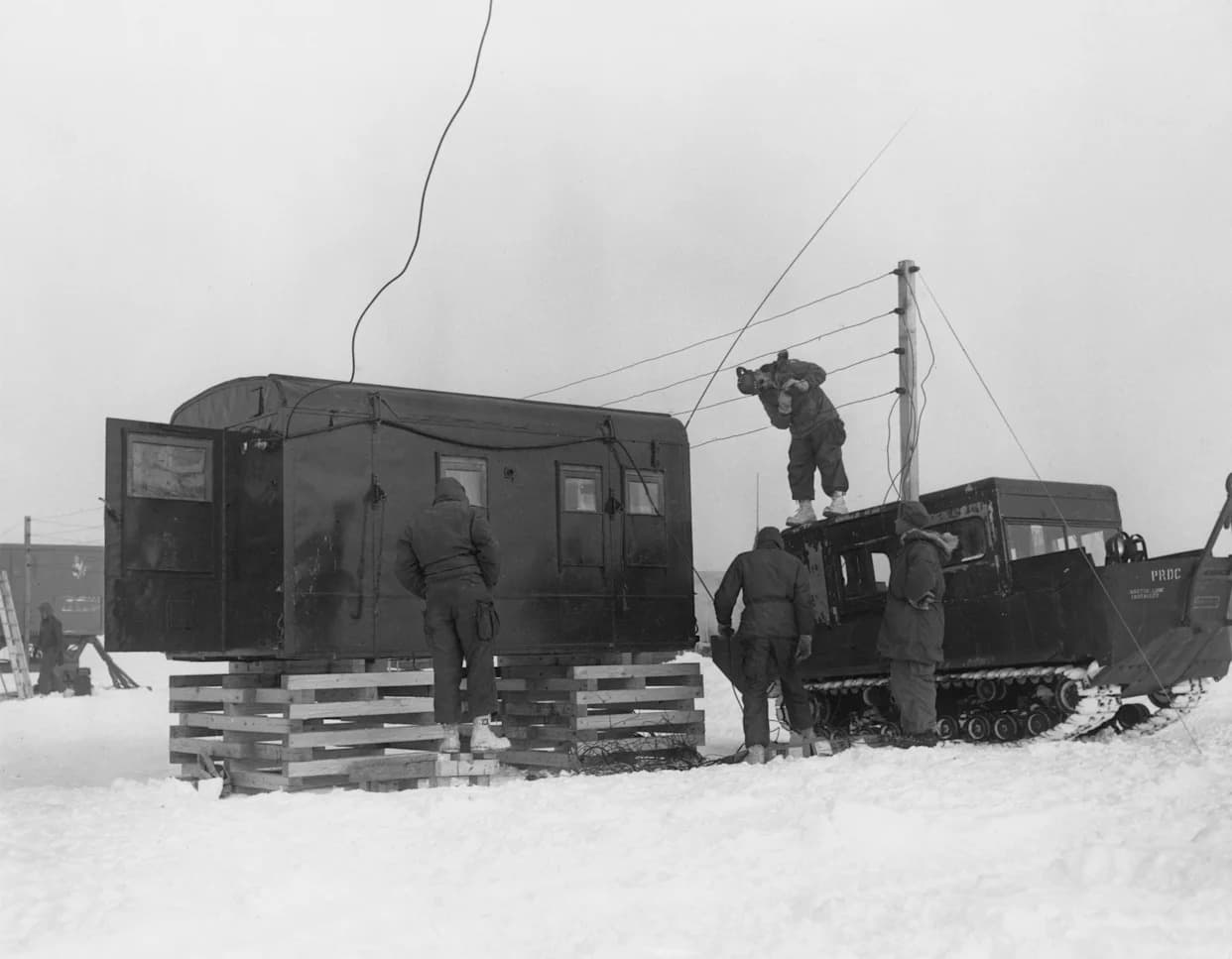
Men of the U.S. Army Polar Research and Development Center set up communications at the temporary camp used during the construction of Camp Century, an Arctic U.S. military research base in Greenland. (U.S. Army/Pictorial Parade/Archive Photos/Getty Images)(Pictorial Parade)
In the summer of 1959, American troops carved a web of trenches into the Greenland ice sheet to build Camp Century — a covert Arctic research station powered by a small nuclear reactor. Located roughly 150 miles inland from Thule (today Pituffik), the base operated for six years before being abandoned in 1966 as too costly and difficult to maintain.
Cold War Ambition and Scientific Legacy
At Camp Century, scientists drilled nearly a mile down into the ice and recovered a set of ice cores that proved scientifically valuable and unique. The installation’s buried tunnels, machines and infrastructure were a product of Cold War engineering: innovative, secretive and built in one of the planet’s most hostile environments.
Why Camp Century Matters Today
Decades after its closure, Camp Century has re-entered public conversation as warming temperatures alter Greenland’s ice sheet. Interest in Greenland’s rare earths and other minerals — and the geopolitical attention that followed President Donald Trump’s widely reported 2019 suggestion about buying the island — have revived questions about access, sovereignty and the environmental and technical challenges of Arctic extraction.
Science, Engineering and Geopolitics Intersect
Geologist Paul Bierman of the University of Vermont, interviewed on The Conversation Weekly podcast, argues that the history of Camp Century and the renewed study of its ice cores underscore three complexities: the logistical and engineering limits of Arctic projects, the environmental risks of disturbed ice and infrastructure, and the diplomatic sensitivities involving Denmark and Greenlandic self‑rule. Melting ice does not automatically translate into easy access to mineral wealth — extraction in Greenland faces formidable technical, legal and ethical hurdles.
Podcast and Credits: The Conversation Weekly episode features Paul Bierman and draws on his research into U.S. involvement in Greenland and the practical limits of mining the island. The episode was written and produced by Mend Mariwany and Gemma Ware, mixed by Michelle Macklem, with theme music by Neeta Sarl. News clips were taken from New York Times Podcasts, the BBC and NBC News.
Listeners can find The Conversation Weekly on common podcast platforms, download the episode via RSS, and access transcripts through Apple Podcasts or Spotify.
Help us improve.