The article documents how federal agents and some senior officials have increasingly labeled protesters and legal observers as "domestic terrorists," sometimes without evidence, and how prosecutions under statutes like Section 111 have surged. It traces a longer history of laws and practices that criminalize dissent, highlights unequal enforcement across movements, and describes community responses—mutual aid, documentation, and protest. Experts warn that the securitization of domestic policy threatens civil liberties and that collective solidarity is mounting in response.
How U.S. Authorities Are Criminalizing Protest: ICE, “Domestic Terror” Labels, and a Growing Backlash
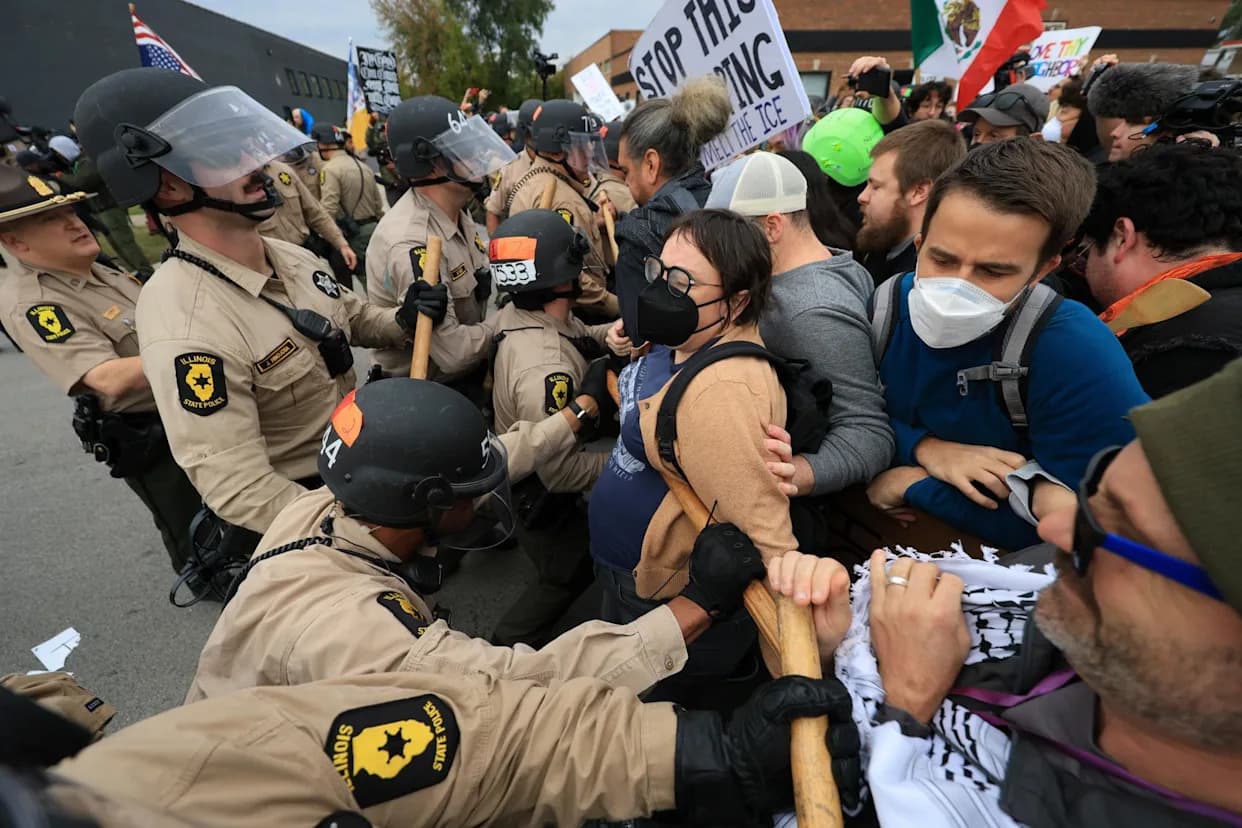
Police clash with demonstrators in the street outside of the ‘Free Speech Zone’ near the immigrant processing and detention center on 17 October 2025 in Broadview, Illinois.Photograph: Joe Raedle/Getty Images(Photograph: Joe Raedle/Getty Images)
When a federal immigration agent shot and killed ICU nurse Alex Pretti in Minneapolis on 23 January, Homeland Security Secretary Kristi Noem publicly labeled Pretti a "domestic terrorist" without presenting evidence. That immediate claim — later softened after public backlash — fits a broader pattern in which senior officials and some federal agents apply anti‑terror rhetoric to protesters and legal observers, sometimes before facts are established.
On-the-Ground Intimidation
Immigration and Customs Enforcement (ICE) officers have at times used the "domestic terrorist" label directly during encounters with civilians. In one widely circulated video from Portland, Maine, an ICE officer told a woman she was being recorded in a database and warned that she was now "considered a domestic terrorist" after she refused to stop filming.
Prosecutions And Courtroom Patterns
Advocates and scholars say a troubling pattern has appeared in court: federal agents initiate or escalate confrontations with protesters or observers, and the Department of Justice then brings charges against the civilians — often under Section 111 of Title 18 (resisting federal employees) — rather than prosecuting the officers involved. By one count, more than 100 prosecutions relying on Section 111 were filed in the second half of 2025.
"It absolutely seems to be the case that federal agents have ramped up their repression of legal observers," said Michelle Phelps, a sociology professor at the University of Minnesota.
Legislative Momentum Against Protest
Criminalizing dissent is not new in the United States, but recent years have seen an acceleration of laws and proposals that broaden the definition of disruptive conduct and increase penalties. According to the International Center for Not‑for‑Profit Law (ICNL), 29 anti‑protest bills passed during Donald Trump’s first term and 25 passed under Joe Biden. Proposed legislation surged in 2021 after nationwide protests following George Floyd’s murder.
Some state laws raise particularly stark concerns: a 2021 Iowa statute shields drivers who hit protesters from liability in certain circumstances; a Florida law from the same year protects people from civil suits if they injure or kill protesters during an event defined as a "riot"; and several states adopted tougher penalties for interfering with energy infrastructure after pipeline protests such as Standing Rock.
Unequal Enforcement And Historical Context
Scholars note that criminalization and violent suppression of dissent have long histories in the U.S. — from surveillance and mass arrests of civil‑rights leaders to laws intended to suppress large protests. Gloria J. Browne‑Marshall, a constitutional law professor, says what may seem new to some observers is the fact that middle‑class white people are increasingly visible among those targeted.
Nick Estes, a historian and member of the Lower Brule Sioux Tribe, described recent killings and prosecutions as part of a "war on solidarity," arguing that harsh treatment has sometimes depended on whom protesters ally with — for example, harsher penalties for climate and Indigenous activists than for other violent or extremist actors.
Community Response And Recommendations
Community organizers report two parallel trends: fear and withdrawal among vulnerable populations, and increased solidarity and resistance in many neighborhoods. Mutual‑aid networks, public demonstrations, cellphone documentation of enforcement actions, legal accompaniment of observers, and pressure on local officials are among the responses organizers describe.
Experts recommend strategies both short‑ and long‑term: adopt tactics from past movements (pressuring corporations, coordinated legal support, nonviolent mass action), resist the post‑9/11 securitization of domestic policy, and pursue legislative and civic reforms to protect civil liberties. Some activists call for abolishing or fundamentally restructuring ICE.
What’s At Stake
Observers warn that expanding the use of anti‑terror labels and prosecutorial tools risks consolidating executive power and eroding constitutional protections for free speech, assembly, and due process. As historian Nick Estes put it, law and order should reflect societal values; growing public solidarity, he argues, is a direct response to a moment of intensified state violence and securitization.
Help us improve.