Mississippi Democrats have introduced legislation to create a state-level Voting Rights Act after the U.S. Supreme Court has narrowed protections under the federal law. The proposal would establish a Mississippi Voting Rights Commission to require pre-clearance for certain election changes and add safeguards for voters with limited English proficiency. Advocates and legal experts say state laws and recent model legislation are gaining momentum as a necessary backstop if federal remedies continue to erode.
Mississippi Moves to Build Its Own Voting Rights Law as Supreme Court Erodes Federal Protections
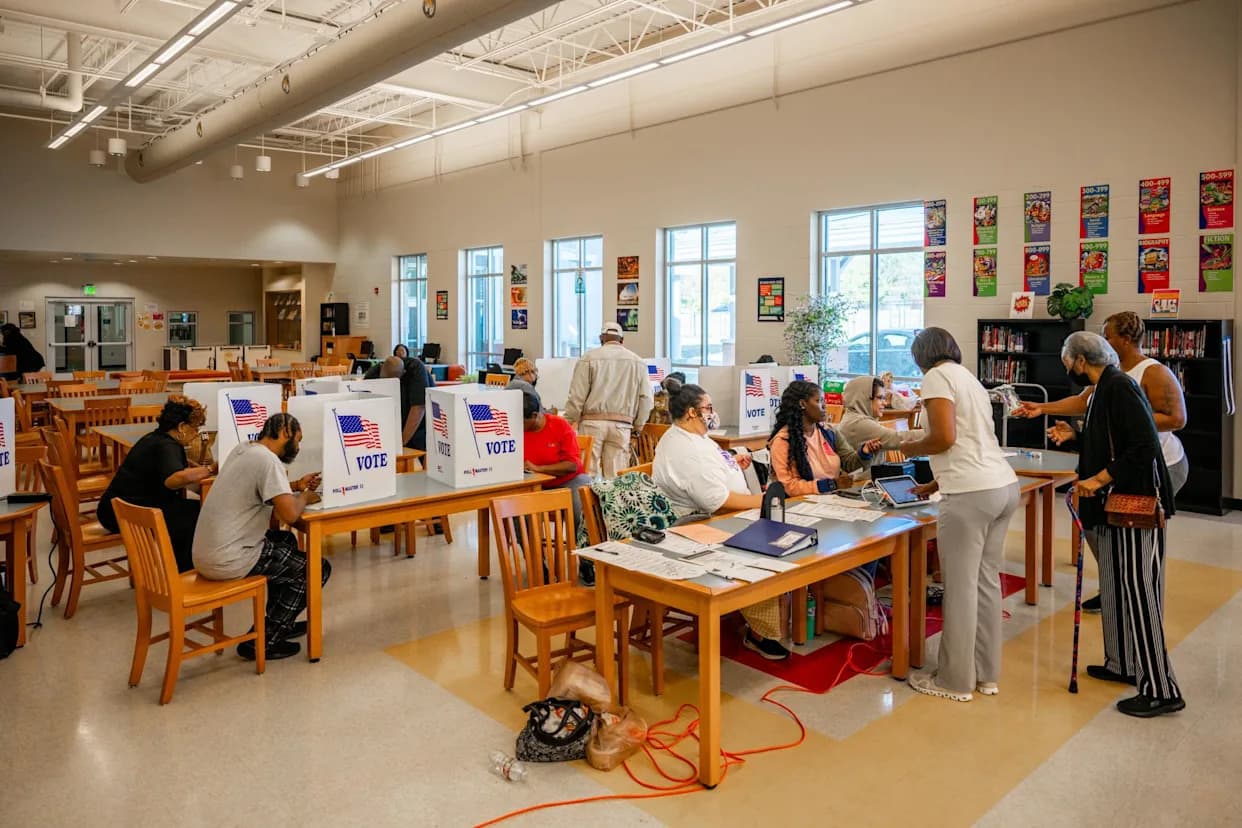
Voters fill out their ballots at Blackburn Laboratory middle school on 7 November 2023 in Jackson, Mississippi.Photograph: Brandon Bell/Getty Images(Photograph: Brandon Bell/Getty Images)
On Martin Luther King Jr. Day this year, several hundred Mississippians gathered on the steps of the state capitol to call for stronger voting protections. State Representative Zakiya Summers and State Senator Johnny DuPree, both Democrats, introduced legislation to establish a state-level version of the Voting Rights Act of 1965 aimed at preventing the dilution of minority voting power in Mississippi.
The proposed bill would create a Mississippi Voting Rights Commission to review and, for certain jurisdictions, require pre-clearance approval of changes to election policies or practices. The measure also includes protections for voters with limited English proficiency and other safeguards to address longstanding barriers to participation.
Why State Action Now?
Advocates say the push for a state law responds to years of judicial decisions that have weakened the federal Voting Rights Act. Notably, the U.S. Supreme Court's 2013 decision in Shelby County v. Holder invalidated the coverage formula that determined which jurisdictions needed federal pre-clearance. A pending case, Louisiana v. Callais, threatens to further narrow Section 2 of the federal act, which has been a critical tool for challenging discriminatory voting practices.
Mississippi obviously has a long and sordid history related to racial discrimination in the context of voting and redistricting. We have gone through a number of different experiences in this state where Black voters have been blocked from political participation, and that’s not something that is long ago history. It’s something that persists today. — Amir Badat, Fair Fight
Supporters point to modern obstacles such as abrupt polling-location changes, voter purges that disproportionately affect Black voters, long lines, and barriers encountered by voters with disabilities or limited English proficiency. They argue that these problems show the need for a state-level backstop if federal protections continue to be eroded.
Voices From Mississippi
Senator Johnny DuPree, whose election helped break a 13-year two-thirds Republican supermajority in the state senate, said Section 2 of the federal act enabled legal challenges to district maps that were instrumental in his victory. Civil-rights attorney Carroll Rhodes noted that litigation under the federal act prompted redistricting and a special election last year, and called state-level voting rights laws "long overdue." He added that some state constitutions already permit broader voter protections than available at the federal level.
National Momentum and Model Legislation
Beginning with California in 2002, eight states — California, Washington, Oregon, Virginia, New York, Connecticut, Minnesota and Colorado — have adopted state-level voting rights acts. Momentum has accelerated in recent years: between 2018 and 2023 (excluding the Covid-disrupted 2020 session), at least one state voting-rights act has passed annually, with laws growing stronger and more comprehensive.
The Legal Defense Fund (LDF) and partner organizations released model state legislation to help states craft their own voting-rights acts. The model draws from the most effective provisions of the federal law, extends or clarifies them for state use, and offers annotations and an appendix to help tailor provisions to local needs.
We can no longer depend upon federal protection alone for the right to vote. The federal courts and the Department of Justice used to be primary protectors of voting rights. States need to step up and take an active role in protecting their own voters. — Adam Lioz, Legal Defense Fund
Lata Nott of the Campaign Legal Center emphasized that state laws restore tools for voters to challenge discriminatory practices in court — protections that have become harder to secure at the federal level.
Outlook
Summers acknowledged procedural hurdles in the Mississippi legislature and warned the bill could stall in committee. Still, proponents argue that the proposal serves both as a potential legal safeguard and as an organizing tool to raise public awareness about threats to voting rights.
Whether the bill advances, supporters say Mississippi has an opportunity to act independently to protect voters, regardless of what the Supreme Court decides about the future scope of federal protections.
Help us improve.