HKUST researchers built DDMS, a generative-AI forecasting system that extends thunderstorm and heavy-rain warnings up to four hours ahead—beyond the current 20 minutes to two hours window. Trained on Fengyun-4 infrared data (2018–2021) and validated with 2022–2023 cases, the model refreshes every 15 minutes and has improved accuracy by over 15%. Developed with China’s weather authorities, DDMS aims to give emergency services more lead time after record rainfall in 2025.
AI Boosts Storm Forecasts: Hong Kong Team Predicts Severe Rains Up to Four Hours Ahead
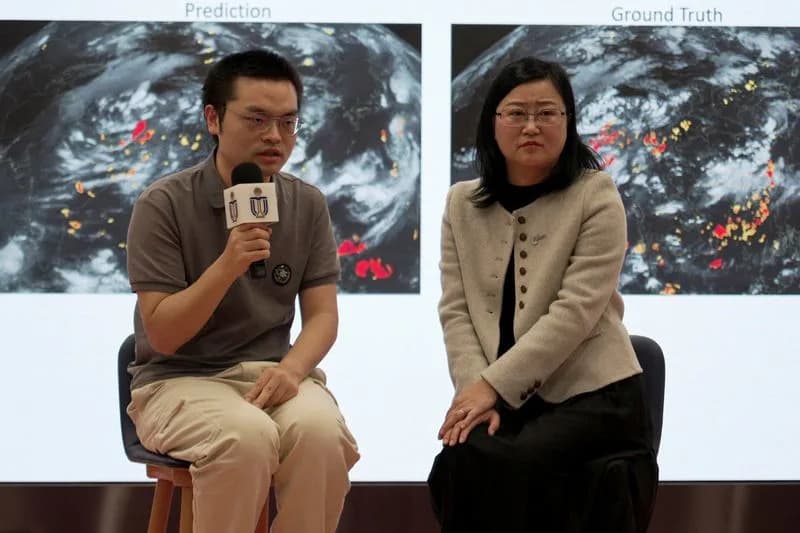
Researchers Su Hui and Dai Kuai from Hong Kong University of Science and Technology (HKUST) attend at a press conference about an artificial intelligence (AI) weather‑forecasting system, in Hong Kong, China January 28, 2026. REUTERS/Joyce Zhou
A research team at the Hong Kong University of Science and Technology (HKUST) has developed an AI-driven forecasting system designed to predict thunderstorms and intense downpours up to four hours in advance—significantly longer than the current 20-minute to two-hour window.
Project Lead and Publication: The effort, led by Su Hui, chair professor of HKUST's civil and environmental engineering department, was published in the Proceedings of the National Academy of Sciences in December. Su says the aim is to combine artificial intelligence and satellite observations to give communities and emergency services more time to prepare for extreme rainfall events.
How the System Works: The framework, called the Deep Diffusion Model based on Satellite Data (DDMS), uses generative AI techniques. During training the model is intentionally given noisy inputs so it learns to reverse that noise and reconstruct clearer, sharper predictions—a denoising diffusion approach that helps produce more precise short-term forecasts.
Data, Validation and Performance: DDMS was trained on infrared brightness temperature measurements captured by China’s Fengyun-4 geostationary satellite from 2018 through 2021, then validated using spring and summer samples from 2022 and 2023. The team reports that the system refreshes forecasts every 15 minutes and has improved prediction accuracy by more than 15% compared with existing methods.
"We hope to use AI and satellite data to improve prediction of extreme weather so we can be better prepared," — Su Hui, HKUST.
Operational Collaboration and Context: The model was developed in collaboration with China's weather authorities. Both the China Meteorological Administration and the Hong Kong Observatory are evaluating DDMS for integration into operational forecasting systems. The work is seen as especially timely after an unusually active 2025 season: Hong Kong issued its highest rainstorm warning five times and the second-highest 16 times last year, setting records for extreme rainfall events.
Why Satellites Matter: Satellites like Fengyun-4 can detect cloud formation and convective development earlier than some ground-based systems such as radar, offering a longer lead time to spot emerging storms. By combining satellite imagery with meteorological expertise and modern AI methods, the researchers aim to improve short-term warnings for urban flood risk, emergency response and public safety.
Next Steps: The team will continue operational testing and collaboration with meteorological agencies to refine the system and evaluate real-world performance before broader operational rollout.
Help us improve.